
What Is the Carrier in a Masterbatch?
The carrier is the resin that forms the base of every masterbatch pellet. Learn what it does in your barrel and what it leaves in your part.
Your plant injection molds polypropylene flip-top caps with an integrated hinge for a shampoo brand. Purchasing replaced the usual blue masterbatch with a cheaper concentrate advertised as compatible with any resin. The color matched on the first try on the sample plaque, so production started without further trials, and the operator raised the dose by one point to reach the shade.
Three weeks later, your customer's filling line reported hinges breaking after a few openings and caps with matte streaks next to the gate. The customer returned a full shipment, quarantined your caps and requested a root cause analysis with a deadline. The pigment was the same blue as before. The difference was in the resin carrying it, a component nobody checked because it did not appear on the purchase order.
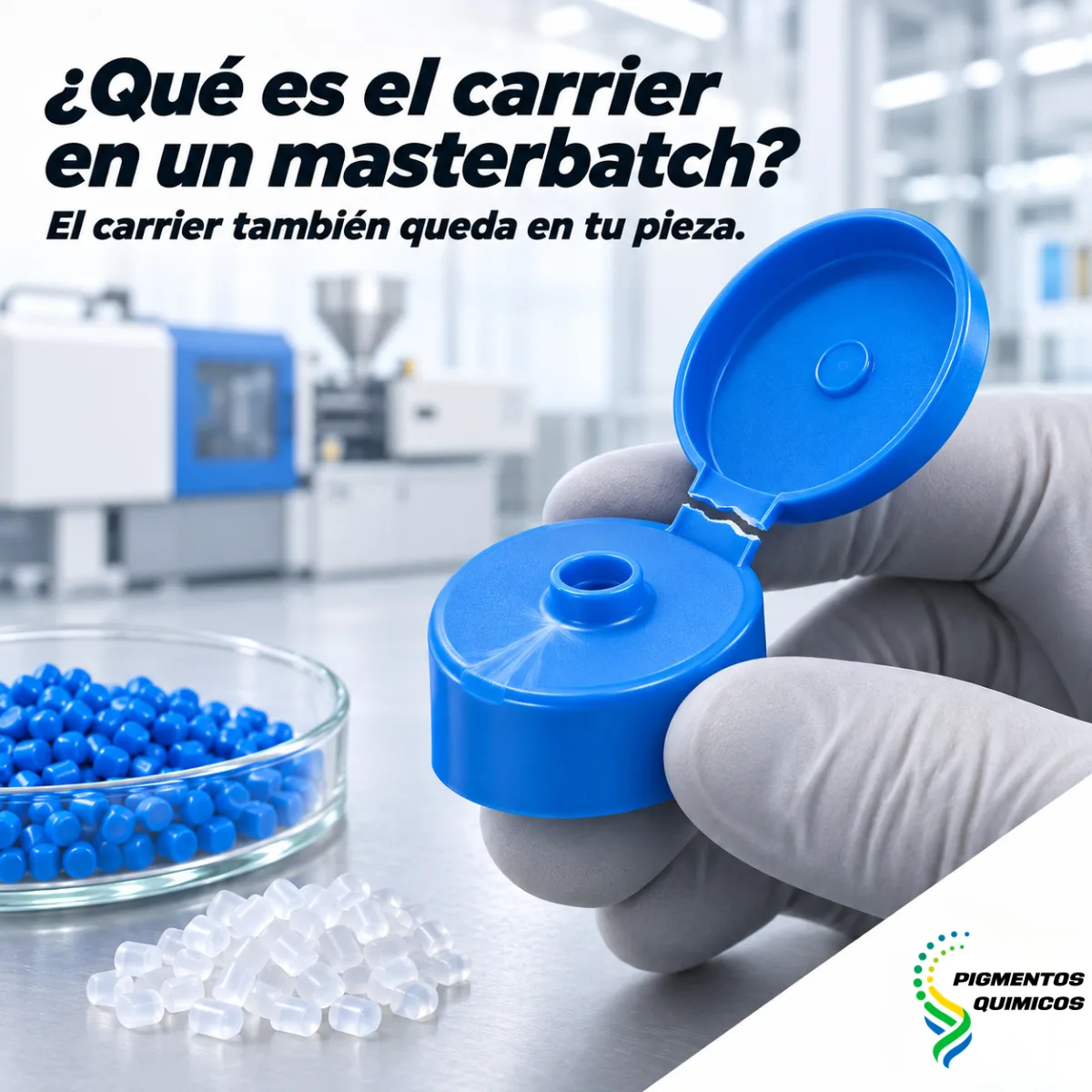
The carrier is the resin that forms the base of every masterbatch pellet. It holds the pigment, delivers it in the barrel and stays in your part, with an effect on properties, color and compliance.
What the carrier does before the pellet reaches your plant
Every masterbatch has three components: the pigment or active additive, the dispersion aids and the carrier, also called the carrier resin or polymer vehicle. The pigment provides the color, and the carrier turns it into a clean pellet that can be dosed. Its work starts at our plant, long before your operator opens the bag.
Wetting and holding the pigment while the concentrate is made
During masterbatch manufacturing, the carrier is melted in an extruder and receives the powdered pigment. The screw breaks up the pigment agglomerates, and the molten resin coats each particle to keep it apart from the others. This step is called pigment wetting. The carrier's affinity for the pigment and its melt viscosity determine how much loading the pellet can take and how fine the dispersion is. A well-chosen carrier allows a concentrate with more pigment per kilo, and that translates into a lower dose on your machine.
Polymer-specific, copolymer and wax carriers, the three families
A polymer-specific carrier belongs to the same family as your resin: polyethylene for polyethylene, polypropylene for polypropylene, polystyrene for polystyrene. It offers the best dispersion and the least interference with the part's properties. Copolymer carriers, such as ethylene vinyl acetate (EVA), and wax-based carriers melt at low temperatures and blend into several resins at once. That is why concentrates sold as universal use them. That versatility has a cost: the wax and the copolymer remain inside your part as a material foreign to your resin, and their effect grows with the dose.
What the carrier does inside your barrel
In your machine, the carrier has a single job: melt on time and release the pigment into your resin evenly. If it melts late, the pigment travels locked inside unmixed granules and shows up as streaks, specks or matte areas. If it melts too early and with very low viscosity, the concentrate separates from the rest of the melt and the color varies from part to part.
Melt flow index and melting temperature versus your process
Two carrier parameters decide that behavior: its melt flow index (MFI) and its processing temperature range. The carrier-resin compatibility rule states that the carrier's MFI should be equal to or slightly higher than your resin's, and that its temperature range should overlap your barrel profile. The operational implication is direct: before approving a concentrate, compare your resin's data sheet with the masterbatch's on those two values.
Moisture and thermal stability that come with the carrier
The carrier also defines how the concentrate is handled before loading. Carriers made of polycarbonate, polyethylene terephthalate (PET) and other hygroscopic resins absorb water from the air and require drying beforehand, just like your resin. Wax carriers, on the other hand, tolerate high temperatures poorly: in a polycarbonate or PET process they can degrade, release volatiles and leave silver streaks on the surface. That is why the right carrier for a high-temperature process is one that can withstand that temperature for the entire residence time.
What the carrier leaves in your finished part
The carrier stays in your product. At a dose between 1% and 4%, the carrier is a small fraction of the part, and even so that fraction shows up on three fronts: mechanical properties, appearance and compliance.
Separate phases that weaken hinges, walls and weld lines
When the carrier belongs to the same family as your resin, it blends in without a trace. When it is foreign, it forms small separate zones inside the polymer. In a thick, rigid part those zones go unnoticed. In an integrated hinge, a thin wall or a weld line, they act as crack initiation points, and that is exactly what the plant in the opening experienced when it raised the dose of a universal concentrate in polypropylene.
Haze, gloss and base tone in clear and light-colored parts
Every polymer scatters light differently. A foreign carrier inside crystal polystyrene, polycarbonate or clear PET produces a haze that no pigment adjustment can correct. In light colors and whites, the carrier's natural tone also adds up: a resin with a yellowish tint dulls a bright white. Wax carriers also migrate to the surface over time and affect printing, label adhesion and film sealing.
Compliance is assessed on the complete formula
Every regulatory declaration for a masterbatch covers the complete formula, carrier included. In food contact applications, an approved pigment inside a carrier without support leaves the concentrate without the compliance your customer needs. In a compostable resin, a fossil-based carrier compromises the part's certification. In packaging declared as single-material, the carrier's family counts toward recyclability. That is why we ask for the end application before choosing the carrier resin.
Five questions about the carrier before approving a masterbatch
The masterbatch technical data sheet states the carrier type, yet few plants review it as closely as the color. These five questions turn that data point into an approval criterion:
- 1. What polymer is the carrier made of, and does it belong to the same family as your resin?
- 2. What are its melt flow index and processing temperature range compared with your resin's?
- 3. Does the carrier need drying before it goes into the hopper?
- 4. At what dose was the concentrate validated, and how does that dose affect your part's properties?
- 5. Which declarations does the complete formula cover: food contact, heavy metals, compostability or whatever your customer requires?
If the supplier answers all five in writing, the carrier stops being an unknown in your process. If any question goes unanswered, it points to the machine trial worth running before releasing a lot.
How we choose the carrier at Pigmentos Químicos
At Pigmentos Químicos we formulate masterbatch, pigments and additives for polyethylene (PE), polypropylene (PP), polystyrene (PS), polycarbonate (PC), polyethylene terephthalate (PET) and acrylonitrile butadiene styrene (ABS). In every custom development, we choose the carrier based on your resin, your process, your part geometry and the end application. If your part has a hinge, a thin wall or needs transparency, we take it into account from the formulation stage.
We send you a free 1 kg sample so you can validate it on your line at the actual production dose. The minimum order for a development is 100 kg, with an estimated lead time of 7 to 10 business days after approval. Every order ships with a quality certificate, technical data sheet and safety data sheet, and we operate under an ISO 9001:2015 certified quality management system, with traceability by production lot.
The carrier is the part of the masterbatch nobody orders by name and the one that stays in your part the longest. It holds the pigment, decides how the concentrate melts in your barrel and remains in the product, affecting its strength, appearance and compliance. At Pigmentos Químicos we choose the carrier based on your resin, your process and your customer's application. Send us your resin's data sheet and a description of your part through our color development page.
Frequently asked questions
Can I use a universal masterbatch in all my resins?
You can in thick, rigid parts at a low dose, where the foreign carrier has little effect. In hinges, thin walls, clear parts or products with a regulatory declaration, a carrier from the same family as your resin is the better choice, because there the fraction of foreign carrier becomes a defect or a compliance failure.
How do I know whether a defect comes from the carrier and not the pigment?
Carrier defects appear from the start of production, get worse as the dose goes up and do not improve with temperature adjustments: matte streaks, hazy areas, unmelted specks or a loss of strength in hinges and weld lines. A pigment defect shows up in the color, in the dispersion or in outdoor weathering behavior.
Does the carrier change the masterbatch dose I need?
Yes. A carrier with good affinity for the pigment accepts a higher loading and a finer dispersion, which lets you reach the shade at a lower dose. A lower dose also reduces the amount of carrier that ends up in your part.
Related articles

What Are Biodegradable Plastics?
A biodegradable plastic turns into water, carbon dioxide and biomass under defined conditions. Learn the resin families and how to process and color them.

What Is the Difference Between Biodegradable and Compostable?
Biodegradable describes a process, and compostable is a condition a standard defines and certifies. Learn the standards and what your customer can claim.
How Is a Custom Color Developed?
A custom color is developed in five stages, from the reference to the production standard. Here is what to send and how to validate it on your line.