
How Is a Custom Color Developed?
A custom color is developed in five stages, from the reference to the production standard. Here is what to send and how to validate it on your line.
Your plant injection molds polypropylene caps for a detergent brand that has just refreshed its corporate blue. Your supplier's lab matched the shade in a few days, the plaque matched the reference and the marketing team signed off without objections. In the first production, the color came out perfect and the caps came out oval: the pigment selected accelerated the crystallization of the polypropylene, the part shrank unevenly and the seal stopped closing against the bottle. Your customer's filling line stopped packaging, several pallets of caps were sent back to your warehouse and the launch was rescheduled because of a color that had passed every color test.
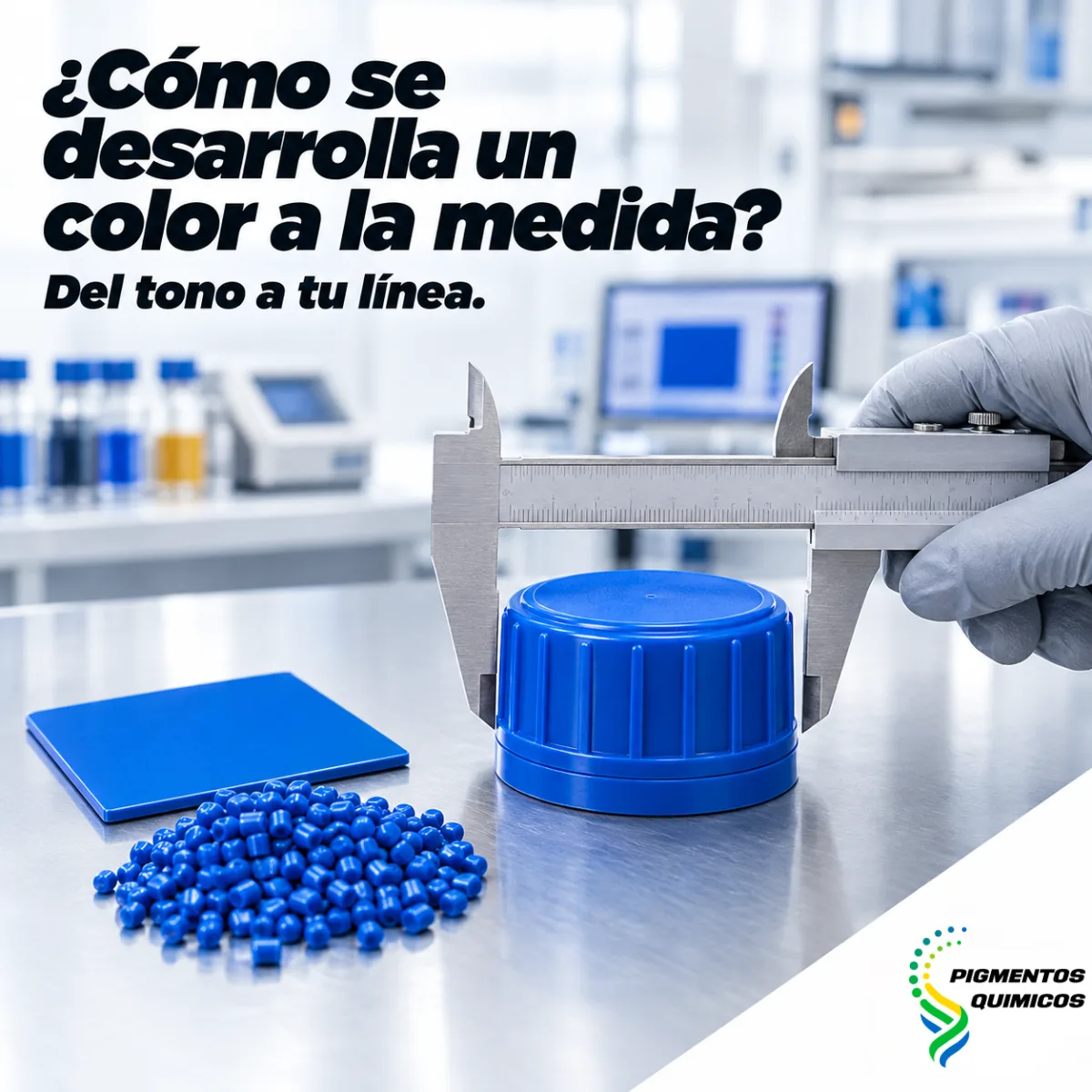
A custom color is developed in five stages: defining the reference and the conditions of use, selecting compatible pigments, matching the shade on your resin, validating a sample on your line and setting the production standard.
Why a color that matches on the plaque can fail on your line
A color development answers two questions at the same time. The first is visual: whether the shade matches the reference. The second is technical: whether the pigments that produce that shade can withstand your process, your resin and the life of your product. The cap example shows what happens when only the first one gets answered. A well-run development starts with the second, because it defines which pigments can go into the formula before anyone looks for the shade.
Pigments that alter the resin: shrinkage, warpage and migration
Some organic pigments, such as certain phthalocyanine blues and greens, act as nucleating agents in high-density polyethylene and in polypropylene. They speed up crystallization and change how the part shrinks. On a test plaque the effect goes unnoticed; on a cap, a crate or a flat part with dimensional tolerances, it shows up as warpage. Other colorants migrate in flexible or plasticized resins and stain whatever they touch, a mechanism we covered in our article on color that bleeds onto everything it touches. That is why the list of candidate pigments is narrowed down before the shade is matched.
Temperature and residence time: the heat that shifts the shade
Every pigment has its own heat stability. Our catalog includes pigments rated from 140 °C up to 300 °C, depending on the shade. A yellow that withstands polyethylene film extrusion can shift in polycarbonate injection molding. A shade that comes out right on the lab machine can also degrade in a large barrel, where the material stays longer. That is why your process temperature and residence time enter the development as starting data, along with the reference.
What we need to know about your part before formulating
The quality of a development depends on the information it starts with. A reference without context forces the lab to make assumptions, and every wrong assumption gets paid for during validation or, worse, in production. These are the details worth sending from the very first email.
The reference: physical sample, Pantone or RAL
We develop color matches from a physical sample or from a Pantone or RAL reference. A physical sample in plastic is the most reliable reference, because it already carries the effect of the substrate. A printed paper guide requires translating the shade onto a different surface, as we explained in our article on the myth of the perfect Pantone. If the reference is a molded part, tell us which resin it is made of and whether it has texture or gloss, because both change how the color is perceived.
Resin, process and target let-down ratio
The resin determines which pigments are compatible and how the shade looks: the same blue looks different in polypropylene than in ABS. The process defines the temperature, the shear and the final thickness, and it varies widely between injection molding, film extrusion and blow molding. The target let-down ratio, which in our developments ranges from 1 to 4%, sets the loading of the masterbatch. If your feeder performs best at 2%, the formula is calculated for that number from the start.
Conditions of use and regulatory requirements
An outdoor part needs pigments with good lightfastness and, often, a UV stabilizer in the same formula. A food container requires a formulation that complies with FDA regulations for direct or indirect contact. A part assembled next to others from a different supplier calls for a tighter color tolerance. Each of these details rules out options and avoids approving a shade that would later have to be reformulated.
From the lab to the formula: how the shade is matched without surprises
Pigment selection and first recipe
With the list of compatible pigments in hand, the formulator looks for the combination that reproduces the reference with as few components as possible. A formula with fewer pigments repeats better from one lot to the next and reduces the risk of the color changing under a different light. The first recipe relies on the spectrophotometric measurement of the reference and on accumulated experience. At Pigmentos Químicos we bring more than 20,000 formulations developed over more than 30 years of manufacturing masterbatch.
Adjustments against the reference under several light sources
The recipe is processed in the specified resin, a plaque is molded and compared with the reference, both with the spectrophotometer and in a light booth under several illuminants. The color coordinates show which way to correct: lighter or darker, redder or greener, yellower or bluer. Each adjustment is repeated until the difference falls within the agreed tolerance. In our article on industrial colorimetry we explain how those differences are calculated; for the development, what matters is that the tolerance and the measurement conditions are defined before the first plaque.
Dispersion and carrier resin: a shade that repeats on the machine
A perfect match in the lab is of little use if the pigment disperses differently on your equipment. The carrier resin of the masterbatch must be compatible with your base resin and melt in a similar range. The pigment also has to be well dispersed in the pellet, so your screw only needs to distribute it. Poor dispersion causes specks, streaks and a weaker color than expected, even when the formula is correct.
Validation on your line: the step that protects your launch
The lab plaque proves that the formula reproduces the color. Validation at your plant proves that the color holds up on your machine, in your mold and with your temperature profile. In the cap example, a trial with dimensional measurement would have revealed the warpage before your customer's filling line found it.
A free one-kilogram sample to test on your machine
With every development we prepare a free 1 kg sample so you can test it in your own conversion process. It is best to run it at the target let-down ratio, on the production machine and mold. Beyond color, check the properties that matter for your part: dimensions, closure, gloss, strength or weldability. We have already written about why producing volume without validating a sample can end up costing more; with a new color, that step matters even more.
Approval with a reference part and written conditions
Approval closes with a part or plaque signed by both sides, which becomes the physical standard for the color. Along with it, the measurement conditions should be put in writing: color difference formula, illuminants, observer and tolerance. That file settles any future question, because every lot is compared against the same reference under the same rules.
How we develop your color at Pigmentos Químicos
Four steps, from your standard to your production line
Our process has four steps. First, you send us a physical sample as the standard or the technical specifications of the color you need. Next, we formulate the masterbatch in our lab for your resin and your process, and we prepare the one-kilogram sample. You receive it and confirm that it works on your line. Once you approve it, you issue the purchase order and we deliver the full order in 7 to 10 business days, with a quality certificate, technical data sheet and safety data sheet.
Minimum order, resins and color repeatability
A custom development starts at 100 kg and works with PE, PP, PS, PC, PET and ABS; for other resins we assess compatibility before quoting. We are an authorized Pantone partner and operate under an ISO 9001:2015 certified quality management system, with traceability for every production lot. That traceability ensures that the color you approve today is repeated in every future order. It also makes it possible to review any change in your process against the original formula and standard.
A custom color is developed with complete information, pigments chosen for your process, a measured match and validation on your own line. At Pigmentos Químicos we formulate your masterbatch on your resin, send you a free kilogram to test it and follow a repeatable process so the color is the same in every order. Send us your reference, your resin and your process at https://pigmentosquimicos.com
Frequently asked questions
How long does a custom color development take?
The match depends on how complex the reference is and how many adjustments it needs. Once you approve the sample on your line, we deliver the order in 7 to 10 business days. To shorten the process, send the physical reference, the resin, the process, the target let-down ratio and the part's conditions of use from the start.
Can I order a custom color with additives included?
Yes. We can formulate a single masterbatch that carries both the color and the additive your part needs, for example a UV stabilizer for parts exposed to the weather. Dosing a single material simplifies your operation and keeps two concentrates from going in at different ratios.
What happens if I change resin after approving the color?
The color has to be validated again. A different resin, even of the same type, can shift the shade because of its natural color, its transparency or its melt flow index, and it can change compatibility with the carrier. Let us know before the change so we can review the formula and test a sample on the new resin.