

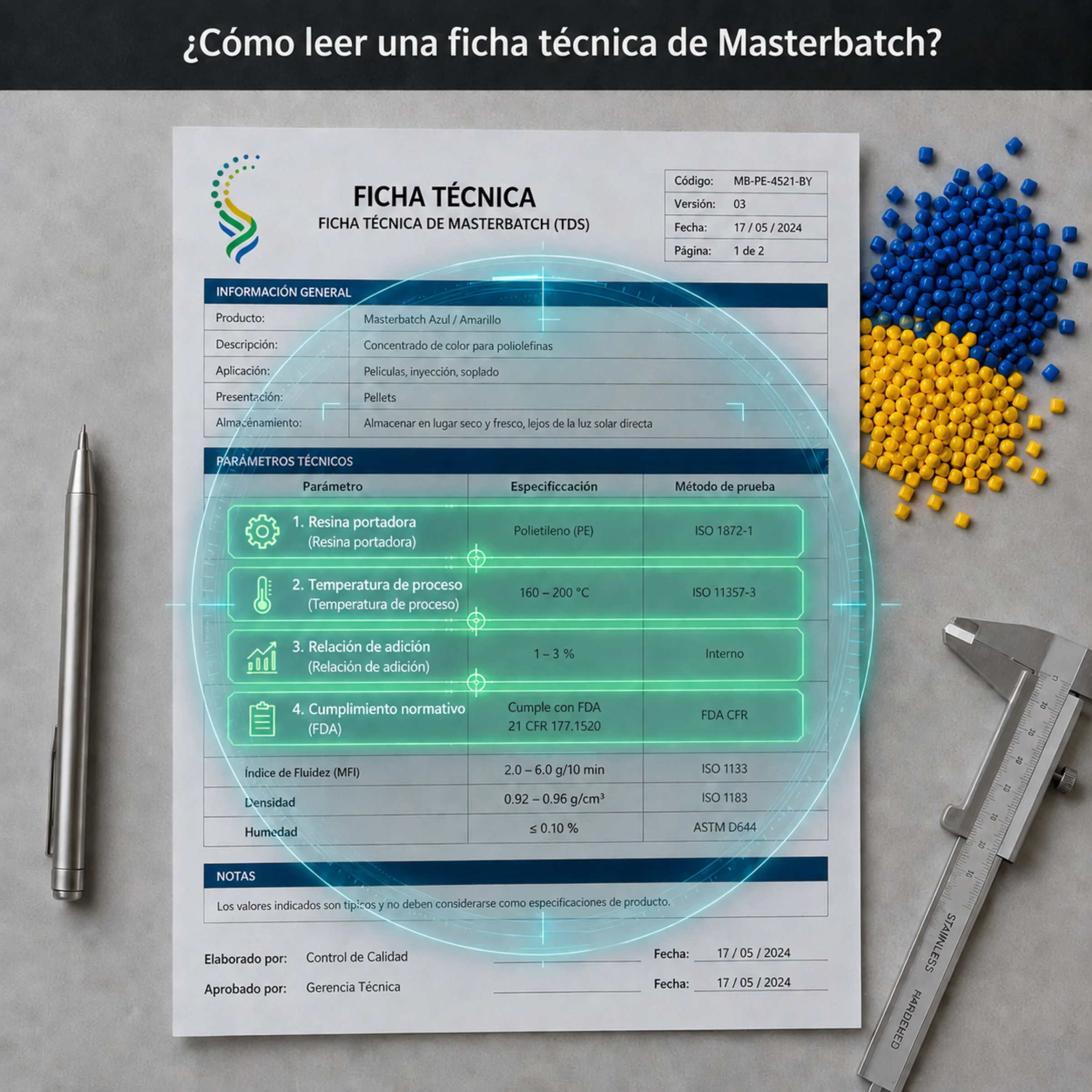
How to Read a Masterbatch Technical Datasheet
The Masterbatch datasheet contains your process's first quality control checkpoint. Knowing how to read the carrier, pigment concentration, temperature range, and compliance declarations prevents costly rejects.
How to Read a Masterbatch Technical Datasheet
The masterbatch technical datasheet contains your process's first quality control checkpoint. Four critical parameters — carrier resin, pigment concentration (let-down ratio), maximum processing temperature, and regulatory compliance declarations — determine whether a masterbatch is suitable for your application before the first kilogram is dosed into your machine.
In our experience supporting technical buyers and process engineers, we have observed that most compatibility errors — dispersion failures, color variability, regulatory non-compliance — could have been prevented by a more systematic reading of the datasheet before purchasing.
1. Carrier Resin: The Compatibility Foundation
The carrier resin is the polymer matrix that holds the concentrated pigment in the masterbatch. It is always listed in the datasheet either as a specific resin grade (e.g., 'LDPE carrier, MI 20 g/10 min') or as a resin family ('polyolefin carrier'). This information is critical because the carrier must be chemically compatible with your host resin to achieve adequate dispersion.
The basic compatibility rule: the carrier melt flow index (MFI) should be 1.5 to 3 times higher than the MFI of your base resin at equivalent temperature. This viscosity differential ensures the masterbatch melts and flows into the base resin before the mixing zone of the screw, producing uniform dispersion. If the carrier MFI is too similar to or lower than your base resin MFI, you risk incomplete dispersion and streaking.
2. Let-Down Ratio (LDR): The Dosage Specification
The let-down ratio specifies how much masterbatch to add per unit of base resin to achieve the target color. A datasheet that shows LDR 2% means: 2 kg of masterbatch per 100 kg of base resin, or 20 g per kg. This is the most commonly misread parameter in procurement — errors of 50–100% in dosage are surprisingly frequent when the LDR is interpreted incorrectly.
Some datasheets express LDR as a ratio (1:50 means 1 part masterbatch to 50 parts resin = 2%), others as a percentage by weight, and others as grams per kilogram. Verify which unit is being used before programming your dosing equipment. A double-dosage error on a concentrated carbon black masterbatch can produce a part that is too dark and mechanically compromised by pigment overload.
3. Maximum Processing Temperature: The Thermal Stability Limit
Every masterbatch datasheet specifies a maximum processing temperature for the pigment system. This value represents the temperature above which one or more pigments in the formulation begin to degrade, causing color shift, loss of intensity, or the generation of degradation products that may be regulated in food contact applications.
This limit must be compared against your machine's actual barrel and nozzle temperatures, not just the resin's nominal processing temperature. In a multi-zone injection machine, the nozzle and hot runner temperatures are frequently 10–30°C higher than the rear barrel zones. If your formulation requires 260°C and the masterbatch is rated to 240°C, you need a thermally upgraded masterbatch — not a machine adjustment that may compromise the base resin.
4. Regulatory Compliance Declarations
The compliance section of the datasheet lists which regulatory frameworks the masterbatch has been evaluated against. The most common are EU 10/2011 (food contact plastics in Europe), FDA 21 CFR 178.3297 (colorants for polymers in the US), REACH SVHC (substances of very high concern in the EU), and RoHS (restriction of hazardous substances in electronics).
A datasheet that states 'suitable for food contact' without specifying which regulation, test method, or specific polymer is not a compliance declaration — it is a marketing claim. A proper Declaration of Conformity names the specific regulation, the specific polymer(s) tested, the test laboratory, and the migration limits achieved. Request the full Declaration of Conformity, not just a 'food contact: yes' checkbox.
5. Lot-Specific Data: The Certificate of Analysis (CoA)
The technical datasheet describes the product specification; the Certificate of Analysis (CoA) is the per-lot measurement. The CoA must include at minimum: the measured MFI of the lot, a spectrophotometric color reading (L*a*b* values under D65/10°), and the lot number traceable to production. Without the CoA, you have no verification that what arrived matches what was specified.
In high-consistency color applications (automotive, packaging, consumer goods), require that the CoA ΔE versus the approved master standard is below 0.5 for each lot. Any lot with ΔE > 1.0 against the master is outside human perception tolerance and will produce visible color variation between production batches.
Frequently Asked Questions (FAQ)
What does 'universal carrier' mean in a masterbatch datasheet?
A universal carrier masterbatch is formulated with a carrier resin compatible with multiple polymer families — typically a blend designed to be processable in both polyolefins (PP, PE) and some engineering resins. Universal carriers offer procurement simplicity but often sacrifice dispersion quality compared to polymer-specific carriers. For critical color applications, polymer-specific masterbatches consistently produce better results.
How do I know if a masterbatch is truly food-contact compliant?
Request the full Declaration of Conformity (DoC), not a summary statement. A valid DoC under EU 10/2011 must specify: the name and contact of the responsible operator, the regulation cited, the specific substances included and their migration limits, and a statement that the declaration covers the specific contact conditions (food type, temperature, duration). Without these elements, the declaration cannot be used for regulatory purposes.
What should I do if the supplier cannot provide a CoA per lot?
This is a quality management red flag. Any manufacturer producing to an ISO 9001 or equivalent system must maintain lot traceability and provide a CoA per production batch. If a supplier cannot provide this, you have no documented basis for accepting or rejecting a lot, and your own quality system is at risk if that material enters a certified production process. Request a sample of the CoA format before committing to a supplier relationship.