

How Does Warehouse Humidity Affect Masterbatch?
Warehouse humidity damages your masterbatch in ways your dryer does not reach. Learn which ones they are and five practices that prevent them.
Your plant runs blown polyethylene film for packaging bags, and during the rainy season the raw materials warehouse works with the dock door open all day. The bags of white masterbatch spent the night next to that door, on a wooden pallet touching the wall. At six in the morning the operator took them to the extrusion area, which was already warm, opened them right away and loaded the hopper. Nobody thought about moisture, because polyethylene does not absorb water.
Within half an hour the film bubble started showing holes and small bubbles, and it broke twice before the shift change. Quality tried to trace the masterbatch lot and found the bag labels illegible from the moisture and two cardboard boxes crushed under the stack. The claim to the supplier went nowhere because nobody could prove which lot had been loaded. The entire shift ended up in the grinder, and your customer's order shipped two days late.
Warehouse humidity damages your masterbatch in ways your dryer does not reach. It condenses water on cold pellets, weakens bags and boxes, erases traceability, cakes powders and, in dry weather, charges the line with static.
Why a masterbatch that does not absorb water can still fail from humidity
The conversation about moisture in masterbatch focuses on the moisture absorbed by the pellet, the water that enters the structure of hygroscopic carriers and is removed with a desiccant dryer. That problem exists and has a known solution. Warehouse air also acts in other ways, and those ways also affect the polyethylene and polypropylene concentrates nobody dries. We find them behind rejections that get blamed on the pigment, the supplier or the operator.
Condensation, the water that arrives stuck to the pellet surface
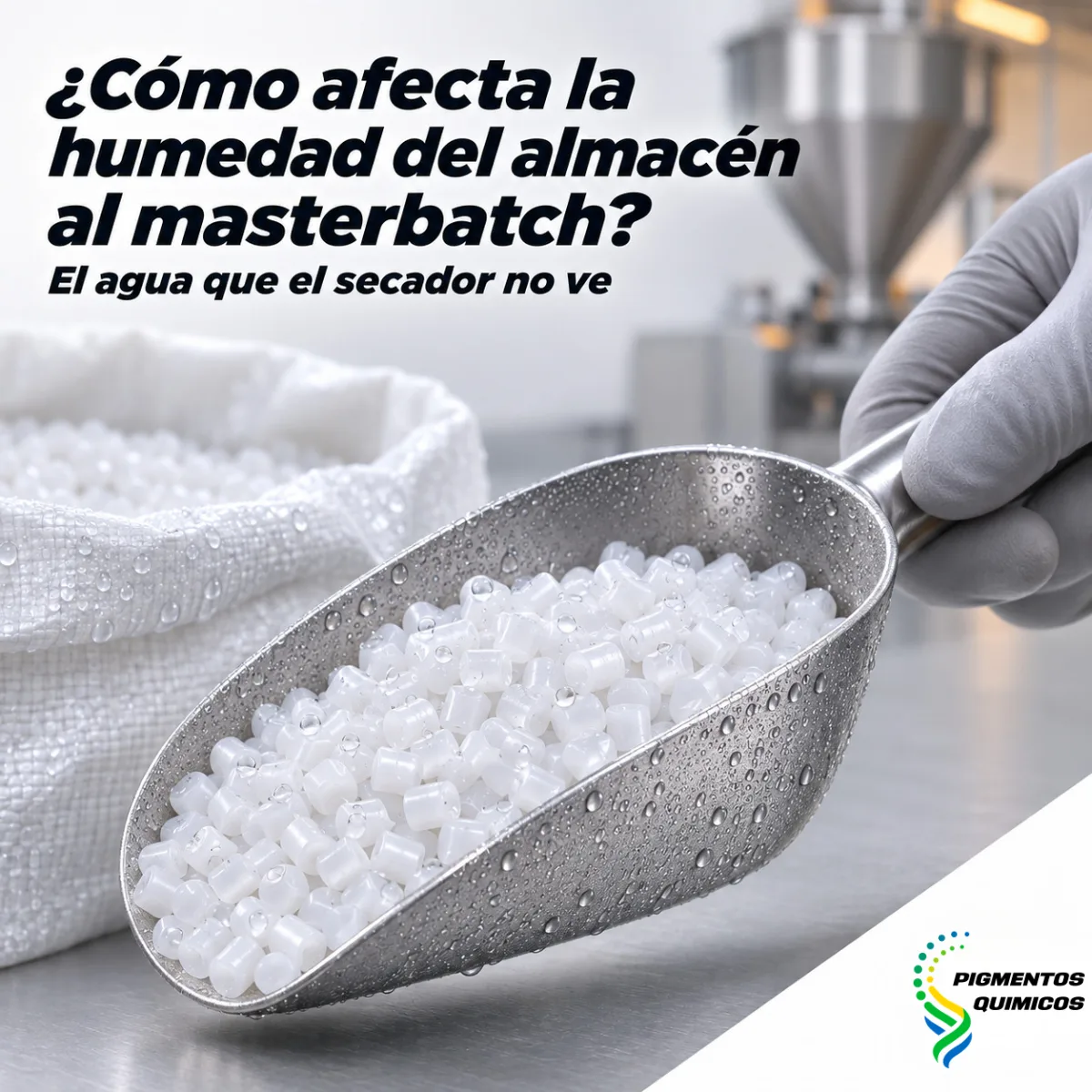
Warm air holds more water vapor than cold air. When a bag that spent the night in a cool warehouse enters a warm, humid processing area, the surface of the bag and of the pellets sits below the dew point of the surrounding air. The vapor condenses into fine droplets on the material. If the operator opens the bag at that moment, the water falls straight onto the pellets and goes into the hopper with them. In the barrel that water turns into steam and shows up as voids, bubbles and silver streaks, just like in the film from the opening.
The fix costs little: the bags are moved closed to the processing area and stay that way until they reach room temperature. Acclimation time depends on the temperature difference and the package size, so it is worth measuring it once in your plant and turning it into a work rule.
Open bags that breathe with every temperature change
A half-used bag folded shut with a clip goes back to the warehouse with plant air inside. Every night the air cools and leaves moisture on the material, and every day it warms up and draws in more outside air. After several cycles, the leftover material builds up water on its surface and dust from the environment. Leftovers are heat-sealed or moved to an airtight container, with the opening date written on the label.
Packaging and labels, the first victims of humid air
Masterbatch travels in multiwall paper bags, polyethylene bags or large cardboard boxes, on wooden pallets. Each of these materials responds to warehouse humidity differently, and the damage shows in the stack before it shows in the part.
Cardboard and paper that lose strength in the stack
Cardboard and paper absorb water from the air and lose compression strength. A stack that holds up in the dry season gives way in the rainy season, and the bottom boxes get crushed or tear. Pellets that spill from a torn bag mix with floor dust, pallet splinters or residue from other raw materials. That contamination reaches the part as black specks or foreign particles, and nobody links it to the warehouse climate.
Damp pallets, mold and odors that travel with the material
The wood of a pallet resting on concrete or against a wall absorbs moisture and grows mold. That mold stains the packaging and leaves an odor in the material. In containers for food, cosmetics or hygiene products, a foreign odor is enough for your customer to reject the lot. Pallets kept away from the wall and from damp floors, or plastic pallets, eliminate that pathway.
Illegible labels and lots that lose their identity
The bag label ties the material to its lot quality certificate, its manufacturing date and its purchase order. A paper label with ink that smears or an adhesive that peels off from moisture leaves the material without an identity. Without identity, the first in, first out principle breaks down and a claim to the supplier loses its basis. Protect the label with a sleeve, record the lot when you receive it and log it in the machine logbook when you load it.
Powdered pigments and additives that cake on the shelf
Many plants store powdered pigments, mineral fillers and the additives they use for adjustments or for their own blends next to the masterbatch. Fine powder exposes far more surface to the air than a pellet, and with moisture its particles bind into hard lumps. A pigment lump that enters the barrel does not disperse with the screw's normal mixing and comes out in the part as a concentrated color speck or a streak. In thin film that speck becomes a hole.
Some additives are designed to capture water, such as the desiccants added to process wet recycled material. Those additives start working as soon as the container is opened in a humid warehouse, and they reach the machine with part of their capacity already used up. In both cases the rule is the same: closed containers, shelves off the floor and use in order of arrival.
At the other extreme, dry air brings static and irregular dosing
Ambient humidity also matters when it is missing. In the dry season or in air-conditioned warehouses, pellets traveling through pneumatic conveying hoses and plastic hoppers build up an electrostatic charge. Charged pellets stick to hopper walls, ducts and each other, and masterbatch fines cling to equipment surfaces.
Pellets that stick to the hopper and a feeder that loses accuracy
A masterbatch feeder works with small quantities, and any pellet stuck to its hopper changes the actual ratio compared with the programmed one. The result is a shade that goes up and down from part to part, with no change in the formula or the machine. Grounding hoppers, ducts and feeders, along with basic humidity control in the area, reduces that effect. Static in the finished part is a different problem, and it is solved with an antistatic additive in the formulation.
Five warehouse practices that protect your masterbatch
These practices work in the warehouse you already have and call for order, one measuring instrument and a written rule for each shift:
- 1. Measure warehouse temperature and relative humidity with a data-logging hygrometer, and check the readings in both the rainy and the dry season.
- 2. Keep masterbatch away from docks, roll-up doors, emergency showers, cooling towers and washing areas, on pallets kept off the wall and the floor.
- 3. Move the bags closed to the processing area and open them only once they reach room temperature.
- 4. Heat-seal or transfer to an airtight container any bag that comes back half used, with the opening date on the label.
- 5. Protect labels, record the lot when you receive it and log it in the machine logbook when you load it.
These five practices complement drying. The dryer removes the water the carrier absorbed, and an orderly warehouse keeps water, dust and static from reaching the hopper by other routes.
How we protect what leaves our plant at Pigmentos Químicos
At Pigmentos Químicos we manufacture masterbatch, pigments and additives for polyethylene (PE), polypropylene (PP), polystyrene (PS), polycarbonate (PC), polyethylene terephthalate (PET) and acrylonitrile butadiene styrene (ABS). Every order ships with a quality certificate, technical data sheet and safety data sheet, and the technical data sheet states the product's handling and storage conditions. We operate under an ISO 9001:2015 certified quality management system, with traceability by production lot.
If your plant operates in a humid region or with large temperature swings between day and night, share those conditions with us when you request your color development. With that information we recommend the right carrier, handling and packaging for your warehouse. A custom development starts with a free 1 kg sample so you can validate it on your line, with a minimum order of 100 kg.
Humidity in your warehouse reaches the masterbatch through condensation, packaging, labels, powders and static, and the dryer solves none of those pathways. A measured, orderly warehouse protects color, traceability and the pace of your line in both the rainy and the dry season. At Pigmentos Químicos we recommend the right handling for each concentrate and for the conditions in your plant. Send us your resin, your process and your warehouse conditions through our color development page.
Frequently asked questions
Do I need to dry a polyethylene masterbatch if my warehouse is humid?
A polyethylene or polypropylene masterbatch absorbs very little water and does not need desiccant drying. What you need to control is condensation: move the bags closed to the processing area and open them once they reach room temperature. If water is already on the pellet surface, a hot air oven removes it before you load the hopper.
How do I tell a condensation defect from an absorbed moisture defect?
Condensation appears at the start of the shift or when opening bags that come from a colder warehouse, and it disappears once the material acclimates. Absorbed moisture affects hygroscopic carriers, persists throughout production and can only be corrected with desiccant drying.
Can I use a masterbatch bag that got wet in the warehouse?
If the bag is polyethylene and the water stayed outside, the material can be used after drying the outside and acclimating the closed bag. If water got into the bag, set the material aside, dry it and validate a sample on the machine before releasing it. If the label was lost, identify the lot using your receiving records before using it.
Related articles

What Are Biodegradable Plastics?
A biodegradable plastic turns into water, carbon dioxide and biomass under defined conditions. Learn the resin families and how to process and color them.

What Is the Difference Between Biodegradable and Compostable?
Biodegradable describes a process, and compostable is a condition a standard defines and certifies. Learn the standards and what your customer can claim.

How Is a Custom Color Developed?
A custom color is developed in five stages, from the reference to the production standard. Here is what to send and how to validate it on your line.