
Moisture in Masterbatch: The Silent Enemy That Ruins Your Parts' Finish
Bubbles, silver streaks, and irregular finishes can share a common cause: moisture in the masterbatch. Learn to identify, prevent, and protect your production.
Moisture in Masterbatch: The Silent Enemy That Ruins Your Parts' Finish
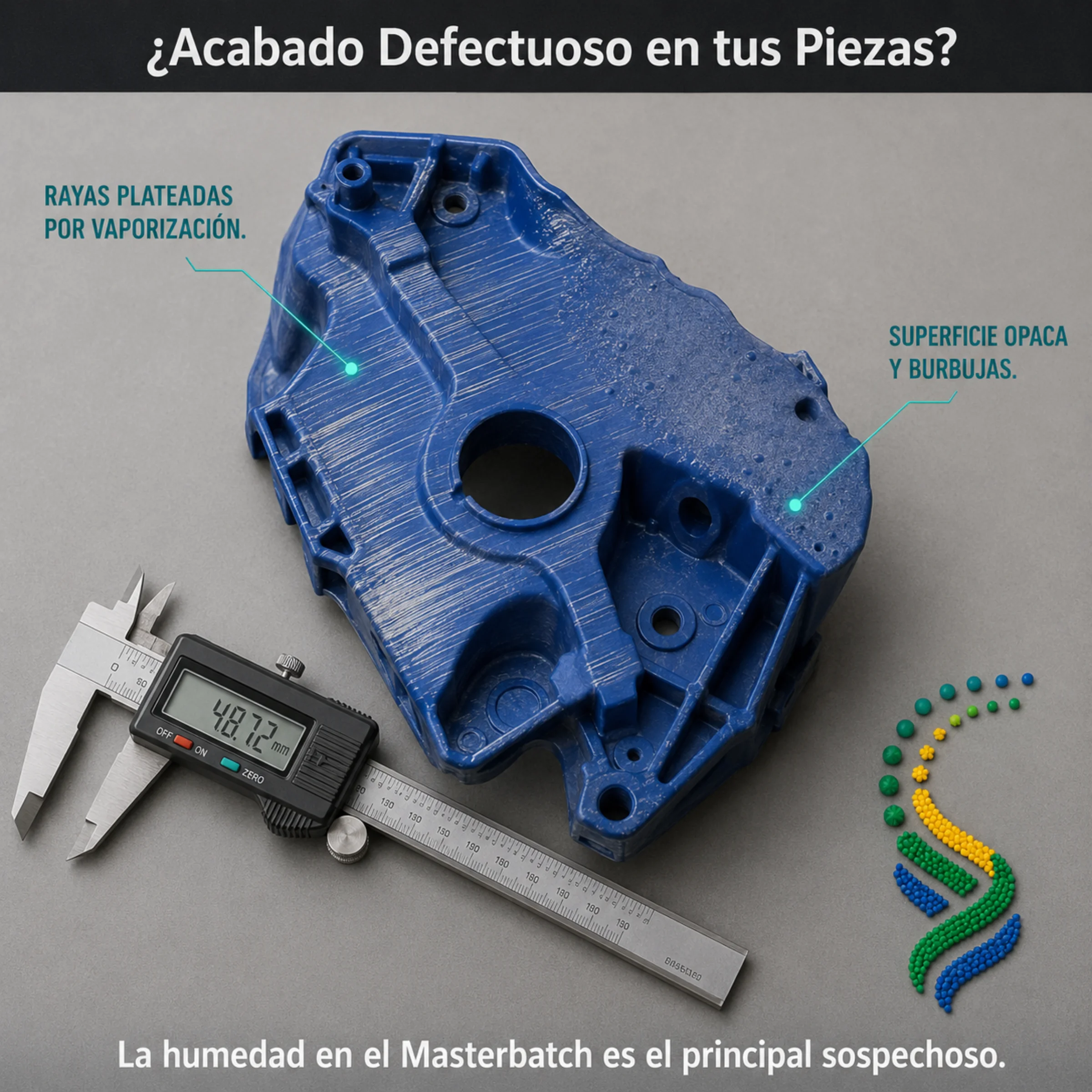
Moisture absorbed by the masterbatch vaporizes inside the barrel at processing temperatures, generating bubbles, silver streaks, and irregular surface finishes. The mechanism is predictable and entirely preventable with correct packaging management, storage conditions, and pre-drying protocols.
One of the most frequent diagnostic calls we receive from processors involves surface defects that appear suddenly in an established production run — often attributed first to the machine, then to the mold, and finally, after significant troubleshooting time, correctly identified as moisture in the colorant system. Understanding the mechanism eliminates the diagnostic delay.
How Moisture Enters the Masterbatch
Masterbatch pellets absorb atmospheric moisture through their surface when packaging integrity is compromised. The primary entry points are: partially opened bags stored in humid environments, bags left overnight without resealing, bags stored on the floor of warehouses with temperature swings that cause condensation, and product transferred to non-sealed intermediate containers. Hygroscopic carrier resins (EVA, EMA, some polyester-based carriers) absorb moisture more aggressively than polyolefin carriers (PP, HDPE) and require stricter handling.
What Happens Inside the Barrel
When moisture-laden masterbatch enters the plastication barrel, the water contained in the pellets converts to steam at temperatures above 100°C. In a typical injection or extrusion barrel operating at 200–260°C, this vaporization is instantaneous. The steam cannot escape through the solid polymer melt, so it creates micro-voids and gas pockets that manifest on the part surface as bubbles, silver streaks (splay marks), or frosted surface areas that disrupt the intended finish.
In hygroscopic engineering resins (PET, PA, PC, PBT), this problem is compounded by hydrolytic degradation — the water molecules break polymer chain bonds at high temperature, reducing molecular weight and causing a permanent loss of mechanical properties (impact resistance, tensile strength) that cannot be corrected after processing.
Identifying Moisture-Related Defects
The distinguishing feature of moisture-related surface defects versus dispersion-related defects is the pattern: moisture causes diffuse, elongated silver streaks that follow the flow lines of the melt, while poor dispersion creates discrete color specks or bands concentrated in specific areas of the part. Moisture defects also tend to appear or worsen as the machine runs continuously and the hopper material is exposed to ambient air — a clear signature of progressive moisture uptake during production.
Pre-Drying Protocols
For hygroscopic masterbatch formulations, pre-drying before processing is the most reliable solution. Standard pre-drying conditions for common carrier types are: EVA-based carriers at 60°C for 2–4 hours in a dehumidifying dryer (desiccant type, not hot-air); EMA carriers at 65°C for 2–3 hours; polyester-based carriers at 80–100°C for 3–4 hours. Hot-air ovens are not sufficient for hygroscopic materials — they require a desiccant dryer with a dew point below -30°C to achieve the required moisture level (<0.02% w/w).
For polyolefin-carrier masterbatches (PP, HDPE), pre-drying is generally not required provided the packaging seal is intact and storage conditions are controlled. The correct approach is to prevent moisture ingress rather than to dry the material after the fact.
Packaging and Storage Requirements
Request masterbatch supplied in multi-layer bags with an inner moisture barrier layer (PE or foil liner). Storage temperature should be between 15–25°C in a dry warehouse; avoid proximity to exterior walls in climates with high humidity and temperature swings. Any partially used bag must be resealed completely — folding the top and clipping it is not sufficient; heat-sealing or a zip-lock inner liner is required.
Frequently Asked Questions (FAQ)
How quickly does masterbatch absorb moisture once the bag is opened?
The rate depends on the carrier resin and ambient humidity. Hygroscopic carriers (EVA, EMA) can reach moisture levels that cause splay defects within 4–8 hours of exposure in a humid environment (>60% RH). Polyolefin carriers (PP, HDPE) are much slower, often requiring days of exposure to accumulate defect-causing moisture. In tropical or high-humidity processing environments, even polyolefin masterbatches should be sealed between production runs.
Can I dry masterbatch in a regular oven?
Not reliably for hygroscopic materials. A conventional hot-air oven reduces surface moisture but cannot remove moisture that has diffused into the interior of the pellet because the ambient air in the oven remains humid. A desiccant dryer (with a dew point of -30°C or lower) creates the dry air conditions needed to pull moisture from inside the pellet. For polyolefin masterbatches with minor surface moisture, a hot-air oven at 70°C for 1–2 hours may be sufficient, but this is not a substitute for proper storage and handling.
If my part shows silver streaks, how do I confirm it is moisture and not a different cause?
Dry a small sample of the masterbatch at 80°C for 3 hours in a desiccant dryer, then run a small production trial with the dried material. If the silver streaks disappear or are significantly reduced, moisture is confirmed as the cause. If the defect persists after drying, investigate back pressure, melt temperature, and injection speed — those are the primary variables for non-moisture-related splay marks.