
What Is the Difference Between Biodegradable and Compostable?
Biodegradable describes a process, and compostable is a condition a standard defines and certifies. Learn the standards and what your customer can claim.
Your plant thermoforms PLA trays for a berry packer that wanted compostable packaging for its export line. The resin arrived with a compostability certificate and your team processed it without setbacks. The customer asked for thicker trays so they could withstand stacking in cold storage, and your team increased the sheet gauge and added the brand's green masterbatch. The packer printed "compostable, put it in your home compost" on the label. Months later, the quality department of a retail chain asked for the certificate backing that claim. The document covered the resin for industrial composting, with a maximum thickness lower than that of the trays, and it made no mention of the colorant anywhere. The chain pulled the product from its shelves, the packer reprinted its entire label inventory and asked you to share the cost.
Biodegradable describes a process that can happen in any environment and time frame. Compostable is a certified condition: the material biodegrades and disintegrates under composting, with time frames and limits set by a standard.
Why "biodegradable" without conditions tells your customer very little
Almost any organic material eventually biodegrades if you give it enough time and the right environment. That is why the word alone says little: it is missing the environment, the time frame and the percentage of material that gets converted. The word "compostable" comes with those three things defined by a standard. Every certified compostable plastic is biodegradable under those conditions, while a biodegradable plastic can fall far short of the compostability requirements.
The families of biodegradable plastics differ in their raw materials and in how they are processed. Here we focus on what your customer can claim about them and on the evidence it needs to do so.
Biodegradation: microorganisms that convert the polymer
Biodegradation is the conversion of the material into carbon dioxide, water and biomass through the action of bacteria and fungi. It is measured in the lab as the percentage of the material's carbon that ends up converted into carbon dioxide over a defined time and temperature. Without those two figures, a biodegradation number has no point of reference.
Compostability: four requirements met at the same time
Compostability standards require four things at once. The first is biodegradation: under the European standard EN 13432, at least 90% of the material must biodegrade within a maximum of six months under controlled composting conditions. The second is disintegration: after twelve weeks, fragments larger than 2 mm must be below 10% of the original material. The third is chemical characterization, with heavy metal limits. The fourth is the quality of the resulting compost, assessed with ecotoxicity tests such as plant germination and growth.
Industrial and home composting: the conditions that decide the result
A part certified as compostable biodegrades under the conditions the standard tests. Outside those conditions the result changes, and that is where most unsupported labels begin.
Industrial composting: high temperature and a controlled process
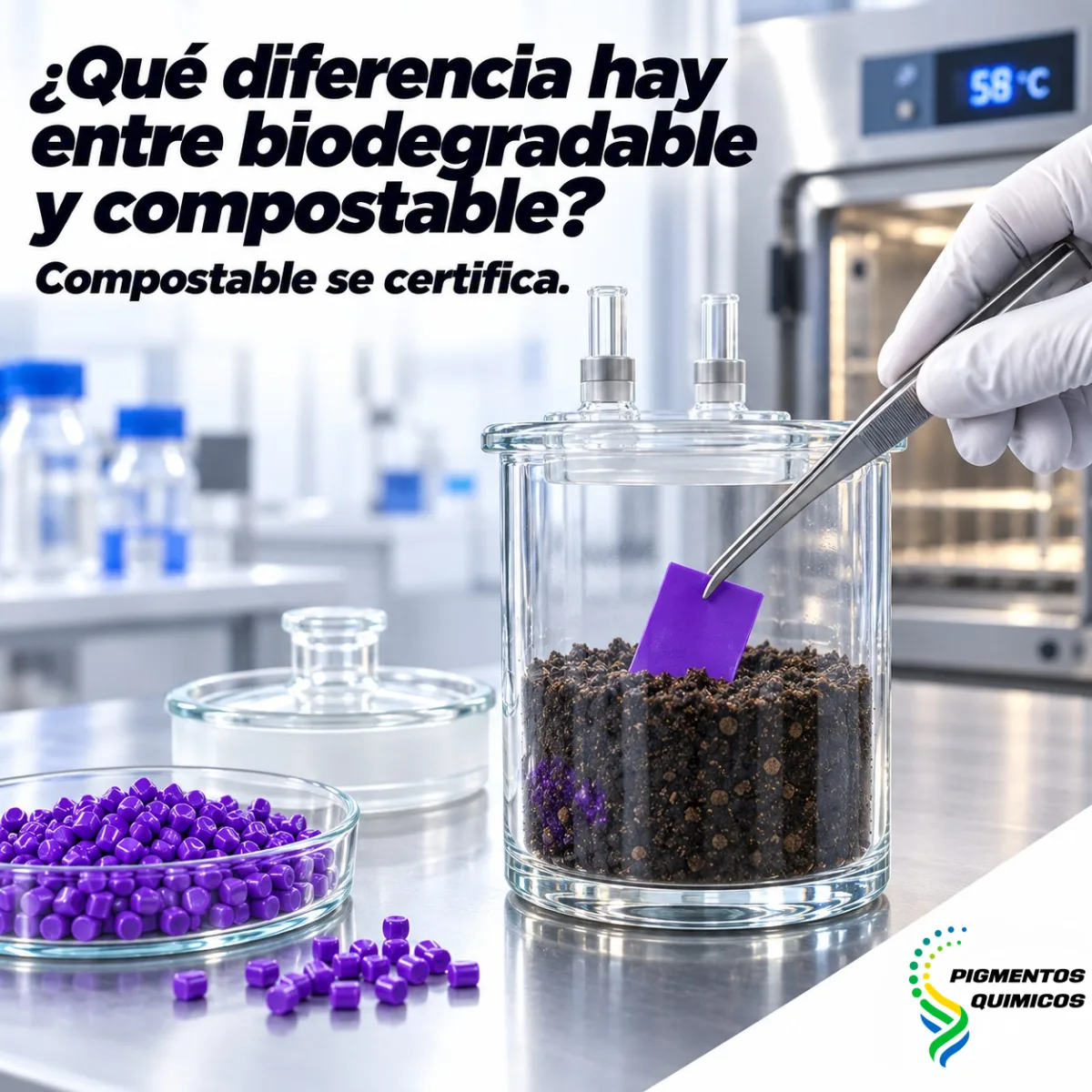
An industrial composting facility keeps the pile at high temperatures, with controlled moisture, aeration and turning. The ISO 14855 test method runs at 58 °C, a temperature PLA needs to degrade at a good pace. Industrial certification assumes the package reaches one of those facilities. If the destination city has none that accepts packaging, the tray ends up in a landfill, where it behaves differently.
Home composting: ambient temperature and longer time frames
A backyard compost pile rarely reaches those temperatures, and its moisture and aeration vary with the weather and with how each person tends it. Home composting certification schemes test at ambient temperature and over periods of up to twelve months. Many PLA-based materials hold industrial certification and lack home certification, because at ambient temperature they degrade very slowly. The "home compost" label in the opening example needed that second certification.
Soil and water: separate assessments
Biodegradation in soil or water has its own methods and certifications. A part that is compostable in an industrial facility can take much longer in a farm field or in the ocean. Every environment a label mentions needs its own evidence.
The standards behind a compostable claim
EN 13432, EN 14995 and ISO 17088
In Europe, EN 13432 sets the requirements for packaging recoverable through composting, and EN 14995 applies the same criteria to plastics in general. ISO 17088 is the international specification for compostable plastics. Independent certification bodies evaluate against these standards and issue a certificate with a defined scope.
ASTM D6400 and the rules in the United States
In the United States, ASTM D6400 specifies plastics designed to be composted in municipal or industrial facilities. The Federal Trade Commission (FTC) requires competent and reliable scientific evidence for any environmental claim, and asks that the label disclose when composting facilities are not available to a substantial majority of consumers. Some states also require compliance with ASTM D6400 to use the word "compostable" on a product. Mexico also has Mexican reference standards for degradable and compostable plastics, and some local laws that restrict single-use items treat compostable products differently.
Certificate scope: material, thickness and formulation
A compostability certificate covers a specific material or product, up to a maximum thickness and with a defined formulation. Thickness matters because a thicker wall takes longer to disintegrate. Formulation matters because every colorant, additive and ink is part of the heavy metal and ecotoxicity evaluation. If you increase the gauge, change the color or add an additive, the part can fall outside the certificate. The masterbatch carrier is also part of that analysis and can invalidate your bioplastic certification.
The risk of claiming "compostable" without backing
The brand prints the label, and the evidence is usually spread across the resin supplier, the masterbatch supplier, the ink supplier and your plant. When a retail chain or an authority asks for it, each link in the chain has to answer for its part.
Labels that promise more than the certificate covers
The most frequent mistakes keep repeating: claiming home composting with an industrial certificate, using "biodegradable" with no environment or time frame, applying the resin certificate to a thicker part or one with a different color, and leaving out that the package needs a composting facility. Each one exposes your customer to a product recall and your plant to sharing the cost, even when the resin is the right one.
What documents to gather before printing the label
We recommend that your customer and your plant put together this file before releasing the first lot:
- A current certificate for the material or product, with its standard, the type of composting covered and the maximum thickness.
- Confirmation that the actual gauge of the part falls within that thickness.
- Masterbatch and ink documentation showing that they are part of the certified formulation or that they comply as components.
- The label text reviewed against the certificate scope, word by word.
- A lot record that ties each production to the resin, masterbatch and certificate used.
Contamination in the plant: conventional resin that slips into the lot
The certificate also assumes the part contains only the evaluated materials. In a plant that processes polyethylene, polypropylene and PLA on the same machines, the risk shows up in purging, in regrind that goes back into the hopper and in unlabeled bags. A compostable sheet with traces of conventional resin falls outside its certified formulation, even if it looks identical. That is why it is best to dedicate hoppers and grinders to the compostable line, purge with a compatible material before each production and separate recovered material by resin type.
How we support a color for compostable packaging at Pigmentos Químicos
At Pigmentos Químicos we ask from the first contact whether your customer will claim its packaging as compostable, under which standard and for which type of composting. With that answer we assess the compatibility of the pigments and the carrier with your resin and with the certification requirements, before quoting. Our custom development starts at 100 kg and includes a free 1 kg sample, which you can use to produce the material your certification body needs to evaluate. Every order comes with a quality certificate, technical data sheet and safety data sheet to add to your file.
Biodegradable describes a process; compostable is a condition that a standard defines and a certificate backs up, with a type of composting, a thickness and a formulation. At Pigmentos Químicos we review with you from the start the claim your customer will make, so the color of your packaging stays within what its certificate covers. Send us your resin, the gauge of your part and the label your customer plans to print at our color development page
Frequently asked questions
Can compostable packaging go in the regular trash?
It can, although it loses its advantage. In a landfill, with little oxygen, it degrades differently and very slowly. The benefit of compostable packaging depends on it reaching a composting facility, and the label should tell consumers where to dispose of it.
If my resin has a compostable certificate, does my part have one too?
Only if the part falls within the certificate scope: the same material, a thickness equal to or below the maximum covered, and colorants, additives and inks included in the evaluated formulation. Check those three points before approving any label.
How long does it take for a compostable plastic to break down?
Under industrial composting conditions, EN 13432 requires at least 90% of the material to biodegrade within a maximum of six months. In a backyard compost pile, the time frame can be much longer, and in soil or water it depends on each material and environment.
Related articles
What Is an Antibacterial Additive in Plastics?
An antibacterial additive inhibits bacteria on the plastic surface. Here is how it works, what undermines it and how ISO 22196 testing proves it.
How Is Masterbatch Concentration Measured?
Masterbatch concentration is measured by pigment loading and by tinting strength against a standard. Here is how each method works and how to read it.
What Is Industrial Colorimetry?
Industrial colorimetry measures color with a spectrophotometer and expresses it in CIELAB and ΔE, so every production lot is approved on objective criteria.