
What Is an Antibacterial Additive in Plastics?
An antibacterial additive inhibits bacteria on the plastic surface. Here is how it works, what undermines it and how ISO 22196 testing proves it.
Your plant injection molds blue polypropylene containers for a food processor, and the new order added one line to the specification: "antibacterial surface." Your buyer found an additive at a good price, your team dosed it alongside the color masterbatch and the first lot shipped on time. During the supplier audit, the customer asked for two documents: the antibacterial activity test report on the finished part and proof that the additive is cleared for food contact. Neither existed, and the blue in that lot had come out duller than the approved standard. The customer held the shipment and suspended the order while your plant tried to prove a property it had promised in writing.
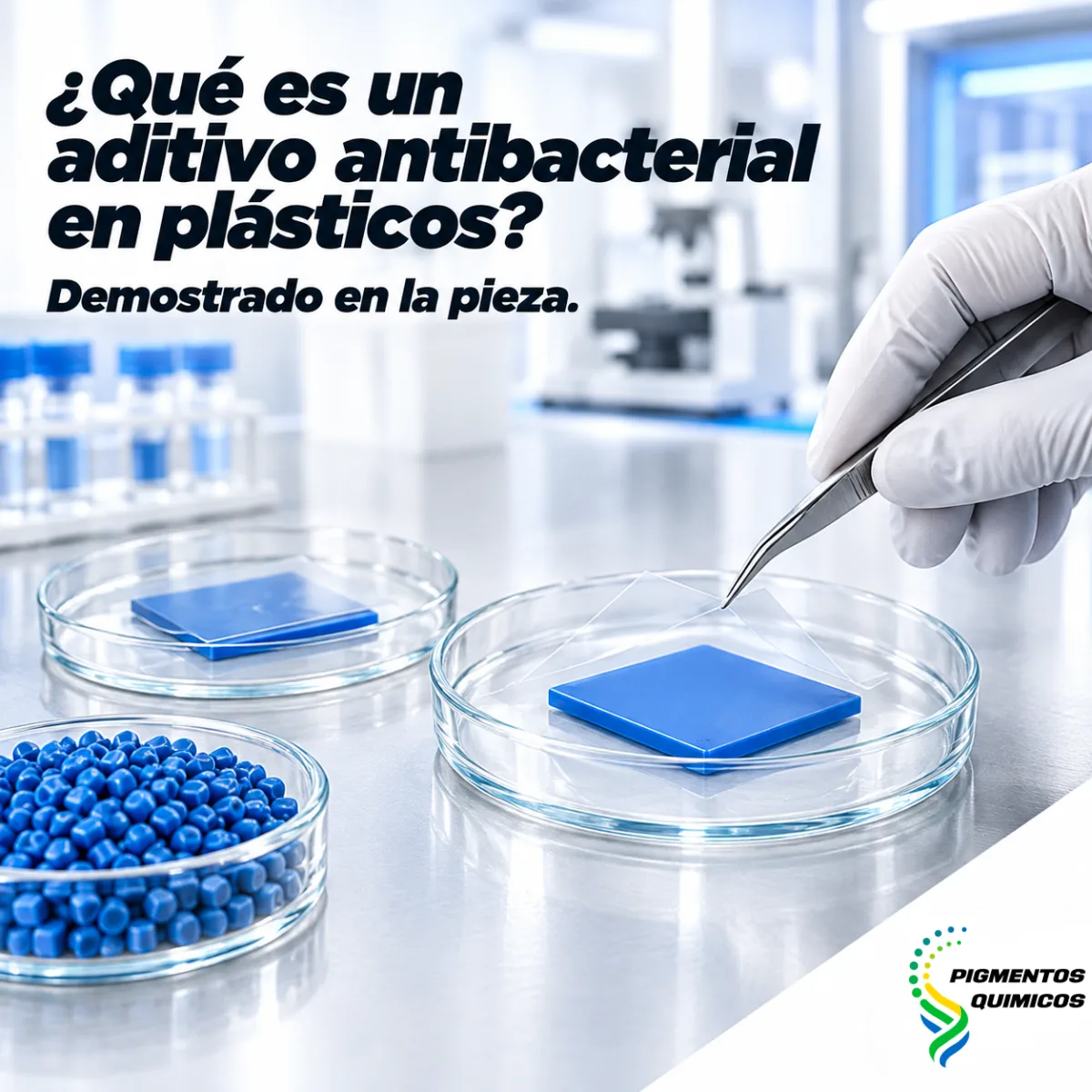
An antibacterial additive is a compound incorporated into plastic to inhibit the growth of bacteria on its surface. Its effectiveness depends on the resin, the formulation and the process, and it is proven with tests on the finished part.
What an antibacterial additive does inside your part and where its reach ends
Untreated plastic gives bacteria a surface where they can survive and multiply between one cleaning and the next, especially in scratches, joints and damp areas. The antibacterial additive is blended with the resin during processing and ends up distributed throughout the part. That way, the effect remains even as the surface wears, unlike a coating that rubs off. In our article on plastic additives we place it within the antimicrobial family, alongside the additives that inhibit fungi.
Bacteriostatic or bactericidal: two different effects
A bacteriostatic additive slows the reproduction of bacteria on the surface; a bactericidal one kills them. In both cases, the effect is measured as a difference against an identical part without the additive. Its job is to protect the part's surface between one cleaning and the next, and your customer's sanitizing is still necessary. The effect is limited to the part; the food and the person using it are outside its reach.
Silver, zinc and copper ions: how inorganic additives work
A very common family in engineering plastics is inorganic antibacterials: silver, zinc or copper ions carried on glass, zeolite or phosphates. With ambient moisture, the surface releases ions in very small amounts. Those ions damage the bacterial membrane and block its enzymes. They withstand injection molding and extrusion temperatures well and act over a long period, although they need moisture to activate and can affect the color if the formulation is not handled carefully.
Migrating organic additives: fast action with more restrictions
Organic antibacterials dissolve in the resin and gradually migrate to the surface, where they act on the bacteria. Their effect is usually fast. In exchange, their heat stability is lower, they are depleted by repeated washing and several substances in this family carry regulatory restrictions, especially for food contact. The choice between one family and the other depends on your process temperature, the expected life of the part and the regulations that apply to your product.
Three ways a poorly formulated antibacterial compromises your part
The blue container example brings together the most common mistakes: an additive chosen on price, dosed separately and with no evidence on the actual part. Each mistake has a specific mechanism, and all three can be prevented at the formulation stage.
Interaction with pigments and other additives: the color that dulls
Silver ions can darken or yellow the part when they react with light, with processing heat or with sulfur compounds present in other additives in the formula. Some fillers and additives, in turn, can interfere with ion release and weaken the antibacterial action. That is why the color, the antibacterial and the other additives are formulated as a system and tested together, on the same resin, before the color is approved.
Dispersion and thickness: unprotected surfaces
Only the additive at or near the surface does any work. If the antibacterial forms agglomerates, some areas of the part are protected and others are left exposed. The test can then give different results depending on where the sample is cut. Dosing it as loose powder or with an incompatible carrier increases that risk. A well-dispersed masterbatch reduces it, because the additive reaches the screw already distributed in the pellet.
Temperature and residence time: the additive that degrades before the mold
An organic antibacterial processed above its heat stability degrades, loses effectiveness and can cause odor or a color change. The risk grows in large barrels, during line stops with material sitting in the barrel and in high-temperature resins such as polycarbonate. That is why the maximum temperature of your process goes into the development brief before the additive is chosen, just as it does with any pigment.
How to prove that a plastic surface is antibacterial
An antibacterial part is proven with a laboratory test. When your customer asks for that property, what they actually need is a report that backs it up, run on a part or plaque made with your final formulation, color included.
ISO 22196: the test method for plastic surfaces
The ISO 22196 standard describes a method for measuring antibacterial activity on plastic and other non-porous surfaces. In general terms, a known amount of test bacteria, such as Escherichia coli and Staphylococcus aureus, is placed on the treated sample and on an identical sample without the additive. Both are covered with a film, incubated for a set time and then the surviving bacteria on each one are counted. The result is expressed as an antibacterial activity value, and the acceptance criterion is set by your customer or by your product specification.
What the test covers and what it leaves out
The method evaluates bacteria under controlled humidity and temperature. Fungi are evaluated with other methods. Performance after repeated washing, abrasion or light exposure requires additional testing, if your application calls for it. The report applies to the formulation tested: if you change the resin, the color or the let-down ratio, it is best to repeat it.
Food contact and consumer-facing claims
If the part touches food, the additive and the complete masterbatch must comply with the food contact regulations that apply in your market, as we explained in our article on the difference between FDA compliance and compliance with Cofepris, Mexico's health regulator. If your customer wants to print an antibacterial claim on the packaging or the label, every word of that claim must be backed by a test. A claim without evidence exposes your customer and your plant in an audit or before a health authority.
When an antibacterial additive pays off and when it only adds cost
An antibacterial makes sense in parts for repeated use that come into contact with food, hands or moisture. Some examples are processing containers and trays, cutting boards, appliance interiors and accessories, toilet seats and bathroom accessories, handles and non-invasive hospital parts. In all of these cases the surface gets dirty, scratched and cleaned many times over its service life.
In other applications, the additive does little. In single-use packaging, in a part hidden inside equipment or in a project where the buyer expects it to replace sanitizing, the antibacterial makes the formula more expensive without addressing the real problem. In those cases we tell you before quoting, because an unnecessary additive is also a cost your customer ends up questioning.
How we evaluate a masterbatch with antibacterial action at Pigmentos Químicos
Color and additive in a single masterbatch
At Pigmentos Químicos we formulate masterbatch that carries both the color and the additive your part needs in a single material. When your customer asks for antibacterial action, we treat it as a custom development. We review with you the resin, the process, the color, the applicable food contact regulations and the test your customer will request. With that information we evaluate how compatible the additive is with the pigments and with the other additives in the formula. Dosing a single concentrate keeps the color and the function from going in at different ratios.
A sample to validate and documentation with every order
A custom development starts at 100 kg and includes a free 1 kg sample so you can validate it on your line. With that sample you can mold the plaques you will send to the outside laboratory that runs the test, with your actual resin, color and let-down ratio. We have formulations that comply with FDA regulations for food contact, and in a development with an antibacterial we check that every component has that backing. Every order arrives with a quality certificate, technical data sheet and safety data sheet, so your audit file is complete from the first lot.
An antibacterial additive protects the surface of your part when it is chosen for your resin and your process, formulated together with the color and proven with a test on the finished part. At Pigmentos Químicos we review every color and additive development with you before formulating it, so what your specification promises is backed up. Tell us about your part, your resin and your customer's requirement at https://pigmentosquimicos.com
Frequently asked questions
Does an antibacterial plastic eliminate the need to sanitize?
The additive reduces bacterial growth on the surface between one cleaning and the next, and your customer's cleaning and sanitizing protocols still apply. Any product communication, from the technical data sheet to the label, should make that clear.
Does the antibacterial additive change the color of my part?
It can. Some silver-based antibacterials tend to darken or yellow the part with light, heat or certain additives. That is why the color is matched with the antibacterial already included in the formula, and the approval plaque is molded with the complete formulation.
How long does the antibacterial action last in a part?
It depends on the additive family, its concentration, the thickness of the part and how often it is washed or worn. Inorganic additives usually keep working longer than migrating organic ones. If your application requires a defined service life, ask for testing after washing or aging.