

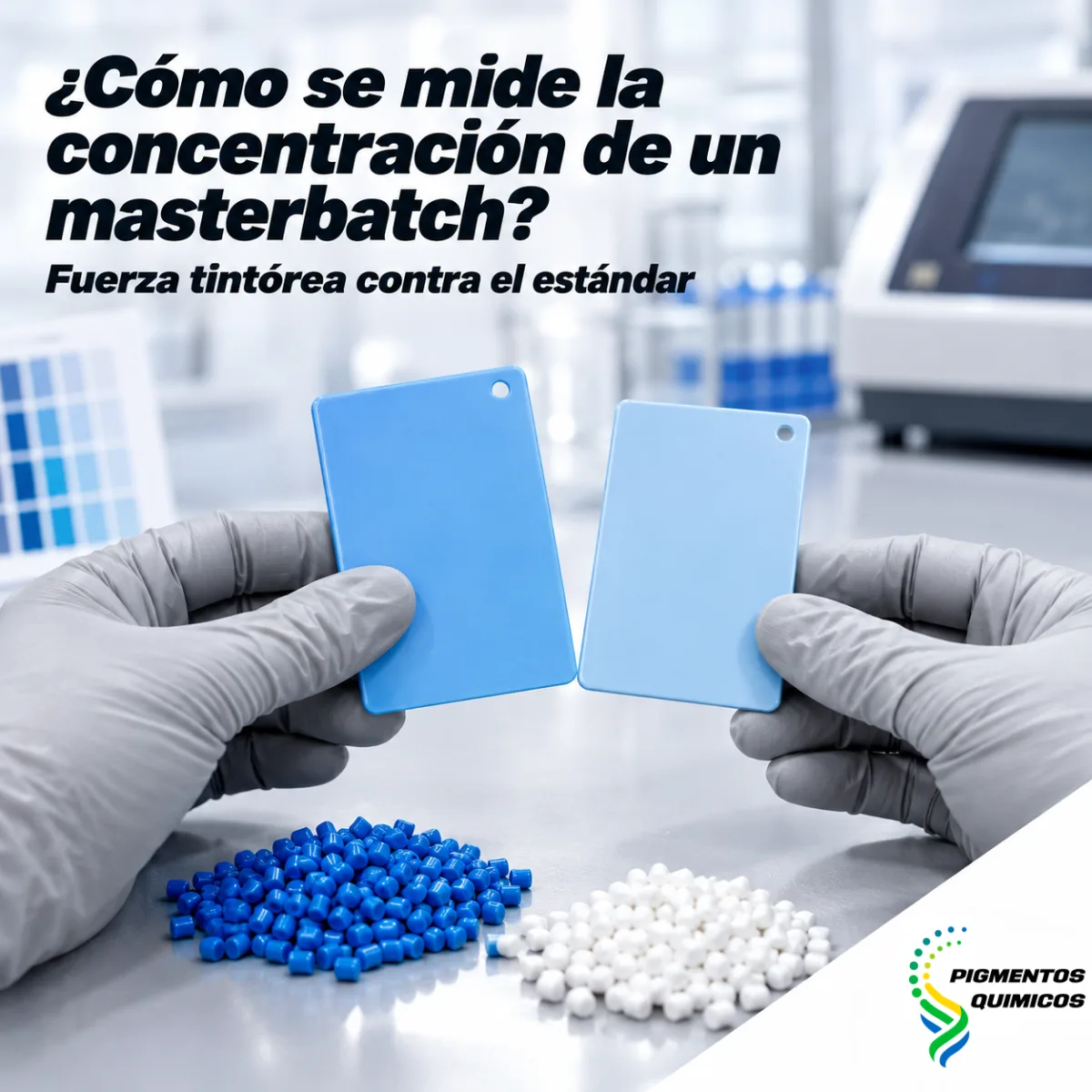
How Is Masterbatch Concentration Measured?
Masterbatch concentration is measured by pigment loading and by tinting strength against a standard. Here is how each method works and how to read it.
Your plant injection molds thin-wall white polypropylene cups for a yogurt brand, and opacity is written into the contract because the cup protects the product from light. A new lot of white masterbatch arrived, the certificate stated the same titanium dioxide loading as always and your team started up with the usual dosing. By midweek, the customer reported cups that let light through when held up to a lamp and set aside several pallets for inspection. Your supervisor raised the dosing to recover the white, concentrate consumption shot up and no one at the plant could answer the buyer's question: "How much pigment does that masterbatch really contain?"
Masterbatch concentration is measured in two complementary ways: by composition, with tests such as ashing that weigh the inorganic pigment, and by performance, comparing its tinting strength against a standard with a spectrophotometer.
Loading, let-down ratio and final concentration: three figures your team can confuse
When someone at the plant says "the masterbatch comes at 40%", they may mean three different things, and confusing them is behind many color complaints. The first is the loading of the concentrate; the second, the ratio at which it is blended with your resin; the third, the pigment that ends up inside the part. Each one is measured differently and answers a different question.
Pigment loading: how much colorant each kilogram of concentrate carries
Loading is the percentage by weight of pigment, or of pigment plus additives, contained in the masterbatch; the rest is the carrier resin and, in some formulas, dispersants or mineral fillers. A titanium dioxide white usually carries high loadings, because it needs a lot of pigment to cover; an organic pigment with high tinting strength achieves an intense color with lower loadings. That is why two concentrates with different loadings can perform the same in your part.
Let-down ratio: the proportion in which the masterbatch is blended with your resin
The let-down ratio, or dosing, indicates how many parts of masterbatch go in for each part of natural resin. It is expressed as a percentage of the blend or as a ratio: 1:50 means one part of concentrate for every fifty parts of resin, about 2% of the total. Your feeder controls this number, and in our article on masterbatch dosing we explain how it is set with machine trials.
Concentration in the part: the figure your customer sees
The pigment that reaches the part results from multiplying the loading by the let-down ratio. A concentrate with 40% pigment dosed at 2% leaves 0.8% pigment in the finished product; the same result is obtained with a 20% concentrate dosed at 4%. The part receives the same amount of pigment in both cases, although your cost per kilogram and your risk change: with high loadings and low let-down ratios, any variation in the feeder has a greater effect on the color.
Why the same percentage on the label can give you a different color
The declared loading indicates how much pigment went into the formula. Your customer, on the other hand, approves the color that pigment produces inside the part, and between one and the other there are two variables the percentage does not capture.
Dispersion: pigment that is in the formula and stops tinting
A poorly dispersed pigment agglomerate contributes all its weight to the loading and very little to the color, because the particles at the center of the agglomerate remain hidden from the light. A lot with poor dispersion can have the correct loading and still tint less, in addition to leaving specks and streaks on the part. We already explained this mechanism in the article on reducing masterbatch consumption without losing coverage. Measuring only the loading leaves out half of the problem.
Pigment grade: the same chemistry with a different performance
Two titanium dioxides, or two phthalocyanine blues, can differ in particle size, surface treatment or crystal form, and therefore in hiding power and in shade. If the pigment grade changes, the loading can stay identical while the color of your part shifts. That variation only shows up when the masterbatch is compared against a standard in terms of color.
Ashing: the test that weighs the inorganic pigment and leaves everything else out
How the ash test works
Ashing, or the ash content test, consists of weighing a sample of the masterbatch in a crucible and placing it in a muffle furnace at high temperature until the resin and the organic components burn off completely. The residue is then weighed. That weight, expressed as a percentage of the initial sample, corresponds to the inorganic fraction of the concentrate. The ISO 3451 standard describes the general procedures for determining ash in plastics.
The method works very well for titanium dioxide white masterbatch and for colors formulated with iron oxides or other mineral pigments, which withstand the temperature of the muffle furnace. For the cups in the example, an ash test at receiving would have confirmed or ruled out in a single afternoon whether the lot carried the loading stated on the certificate.
What the ash leaves unanswered
The residue includes everything inorganic: the pigment, and also the calcium carbonate, talc or other mineral fillers in the formula. A correct ash value confirms the total mineral fraction without identifying which part of it is pigment. Calcium carbonate also loses weight at very high temperatures as it releases carbon dioxide, so the test temperature must be fixed and repeated the same way in every measurement. Organic pigments burn off along with the resin and leave no useful residue.
Carbon black: nitrogen furnace and thermogravimetric analysis
Carbon black also burns in a muffle furnace with air, so its content is measured by heating the sample in a nitrogen atmosphere: the polymer decomposes into volatile compounds, the carbon remains and the residue is weighed. Thermogravimetric analysis follows the same principle in greater detail, because it records the weight loss as the temperature rises, first in nitrogen and then in air. That way it separates the resin, the carbon black and the mineral fillers in a single test.
Tinting strength: the measurement that compares your lot against the standard in terms of color
Ashing answers how much mineral there is in the concentrate. Your customer, however, needs to know whether this lot tints the same as the approved one, and for that the relative tinting strength is measured, the most widely used control for color masterbatch.
Plaques at a fixed let-down ratio on the same resin
The new lot and the standard are processed in parallel with the same resin, the same let-down ratio and the same machine conditions, and plaques of the same thickness are molded. Any color difference between the two plaques then comes from the concentrate, because everything else was held constant.
White reduction: the test that amplifies the difference
In an intense, opaque color, a difference in loading is hard to notice, because the pigment already saturates the part. That is why colors are also evaluated in reduction: the masterbatch is blended with a fixed amount of titanium dioxide white, and in that pastel shade any variation in strength becomes evident.
From the spectrophotometer to a relative strength percentage
The spectrophotometer measures the reflectance of both plaques, and the software calculates the strength of the lot as a percentage of the standard, based on the pigment's absorption in the region of the spectrum where it absorbs most. A result close to 100% indicates that the lot tints the same; below that, it tints less and your usual dosing will fall short; above that, it tints more and you will be adding more pigment than you need. Along with strength, the ΔE is reported, which indicates whether the shade also changed. We explain how to interpret that number in the article on colors approved by eye and rejected in quality control.
Density and additives: when the pigment is only part of what needs to be measured
Density in white and filled concentrates
Titanium dioxide and mineral fillers are much denser than the carrier resin, so the density of the masterbatch rises with its loading. Measuring the density of each lot offers a quick consistency check for white and filled concentrates: it detects deviations against previous lots, although to know the exact loading it is best to confirm it with an ash test.
Additives: a technique for each chemistry
In an additive masterbatch, such as a UV stabilizer, an antistatic or a slip agent, the color says little or nothing about the concentration. Concentration is verified with analytical techniques specific to each chemistry, such as infrared spectroscopy, or X-ray fluorescence when the additive contains an identifiable element. It is also validated with the functional test on the part.
How we safeguard the concentration of your masterbatch from one order to the next
Development and approval on your resin
At Pigmentos Químicos we develop each masterbatch in the laboratory for your resin and your process, and we send you a free one-kilogram sample so you can validate the color on your own line before ordering. That approved development becomes the color reference for your product, the same one against which you should compare every lot you receive.
Quality certificate and traceability with every order
Every order includes a quality certificate, technical data sheet and safety data sheet, and our quality management system, certified under ISO 9001:2015, maintains the traceability of every production lot. We measure color with a spectrophotometer, so any conversation about a lot starts from a measurement.
Incoming inspection at your plant
We also recommend adding your own check when you receive each lot: a color plaque against the sample you approved and, for white or filled concentrates, an ash test or a density measurement. With those records, the day a cup comes out translucent you will know within hours whether the cause lies in the loading, the dispersion or the feeder.
Masterbatch concentration is verified by composition and by performance, and combining both tests protects your color from one order to the next. At Pigmentos Químicos we develop your concentrate on your resin, deliver it with a quality certificate and help you define what to check at receiving. Tell us about your color, your resin and your let-down ratio at https://pigmentosquimicos.com
Frequently asked questions
Is the pigment percentage on the certificate enough to approve a lot?
It is a good first filter, although an incomplete one. The loading confirms how much pigment went into the formula; tinting strength against the standard confirms that this pigment tints like the approved lot. For colors with tight tolerances, ask for both checks or perform the second one at receiving.
Can I find out how much masterbatch a finished part contains?
With inorganic pigments, yes: ashing the part gives its mineral content, and if you know the loading of the concentrate and the resin contains no other fillers, you can estimate the actual let-down ratio. With organic pigments, the way to do it is to compare the color of the part against plaques molded at known let-down ratios of the same masterbatch.
Is a more concentrated masterbatch worth it to spend less?
A higher-loading concentrate is dosed at a lower ratio and reduces the volume you buy and store. In exchange, it requires a more precise feeder, because the same dosing variation shifts the color more, and a carrier capable of dispersing that additional pigment. The decision is made with trials on your machine and against your color tolerance.