
How to Choose the Right Masterbatch for Your Polymer: The Decision That Prevents Batch Failure
A masterbatch incompatible with the base polymer produces dispersion defects, loss of mechanical properties, and quality rejections. Here are the three parameters that determine real compatibility.
Masterbatch selection is not just a color decision. The chemical and rheological compatibility between the masterbatch carrier resin and the base polymer determines whether the concentrate disperses correctly — or produces a batch of rejects. Three technical parameters govern this compatibility, and missing any one of them produces defects that no process adjustment can fix.
The carrier resin: the most critical and most overlooked parameter
The carrier is the resin in which the masterbatch pigments and additives are dispersed. During processing, the carrier must melt and mix homogeneously with the client's base resin. If the carrier is not compatible with the base resin, the masterbatch does not disperse correctly: concentrate pellets melt incompletely or independently from the resin, producing inclusions, concentrated color spots, and opacity variations in the finished part.
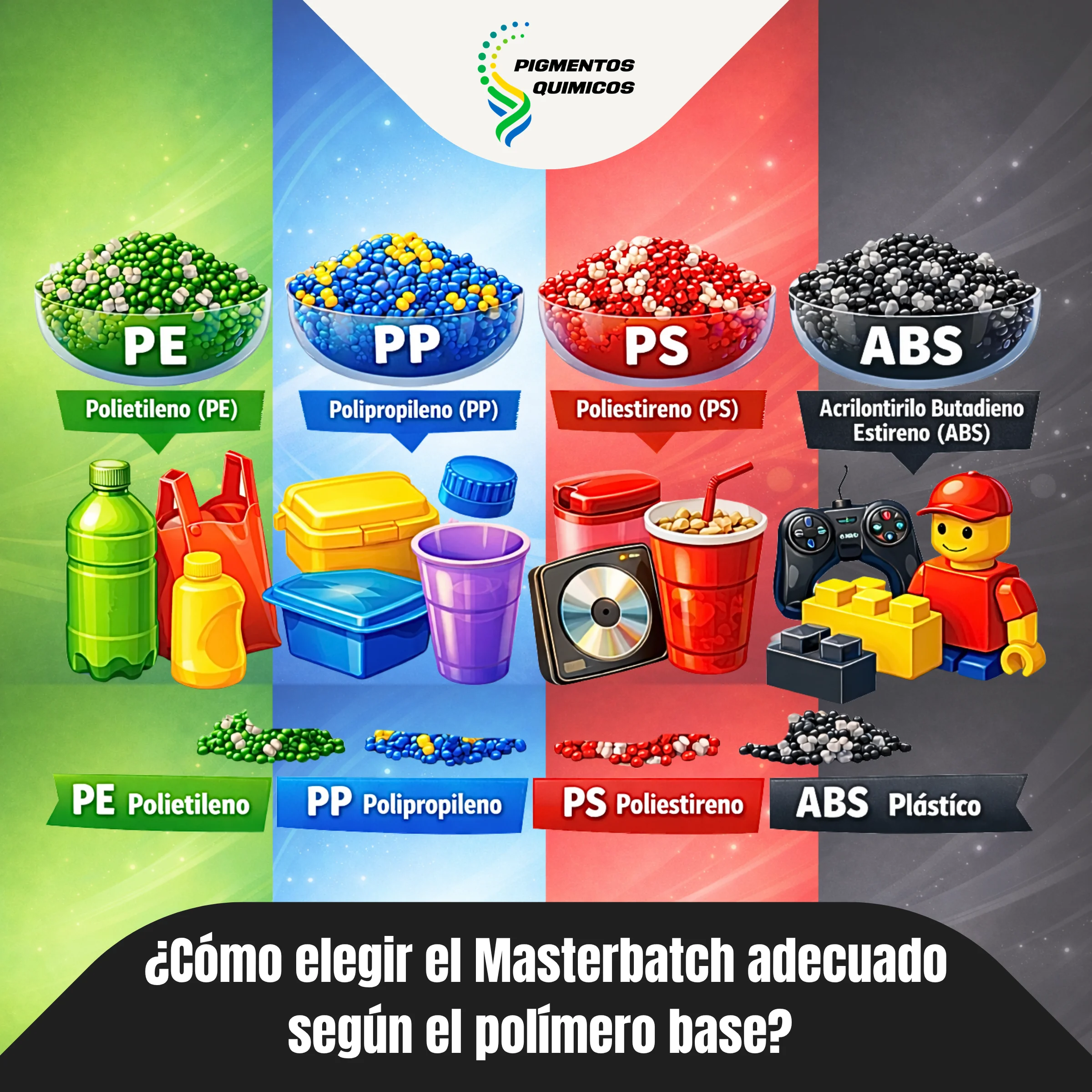
Compatibility rule: the carrier must be from the same polymer family as the base resin, or from a family with demonstrated compatibility. A PP-carrier masterbatch is compatible with PP resins, PP copolymers, and PP/EPDM blends. It is not compatible with HDPE, ABS, PC, or PET. A PE-carrier masterbatch is compatible with PE of different densities (LDPE, HDPE, LLDPE) but not with PP — even though both are polyolefins.
Specific vs. universal masterbatch: when each is the correct choice
Specific masterbatch is formulated with a carrier that exactly matches the client's base resin. It offers the best possible dispersion, maximum tinting strength, and minimal interference with the mechanical properties of the final product. It is the correct choice when the application has strict mechanical property requirements, when lot-to-lot color consistency is critical, or when the base polymer is a technical resin with high sensitivity to incompatible carrier contamination.
Universal masterbatch uses a carrier designed for acceptable compatibility with a broad range of polymers. It is correct for operations processing multiple resins with the same masterbatch that prioritize inventory simplification over performance optimization. Its limitation: it does not deliver the dispersion level or tinting performance that specific masterbatch provides in the resin it is optimized for.
Selection process: from technical datasheet to machine trial
The correct masterbatch selection process follows a logical order: identify the correct carrier (same polymer family as the base resin); verify masterbatch MFI against the base resin MFI; verify masterbatch processing temperature range against the client's process temperature profile; and run a machine trial producing control plaques to verify dispersion and color before approving the masterbatch for volume production.
When the client provides base resin specifications (grade, MFI, process temperature, functional additives present), the correct masterbatch can be identified before the machine trial, reducing the risk of batch failures from incompatibility. The 20,000-piece batch in the opening story failed because that verification step was skipped. It is the cheapest step in the selection process — and the most commonly omitted.