
What Is the Difference Between Plastic Extrusion and Injection Molding?
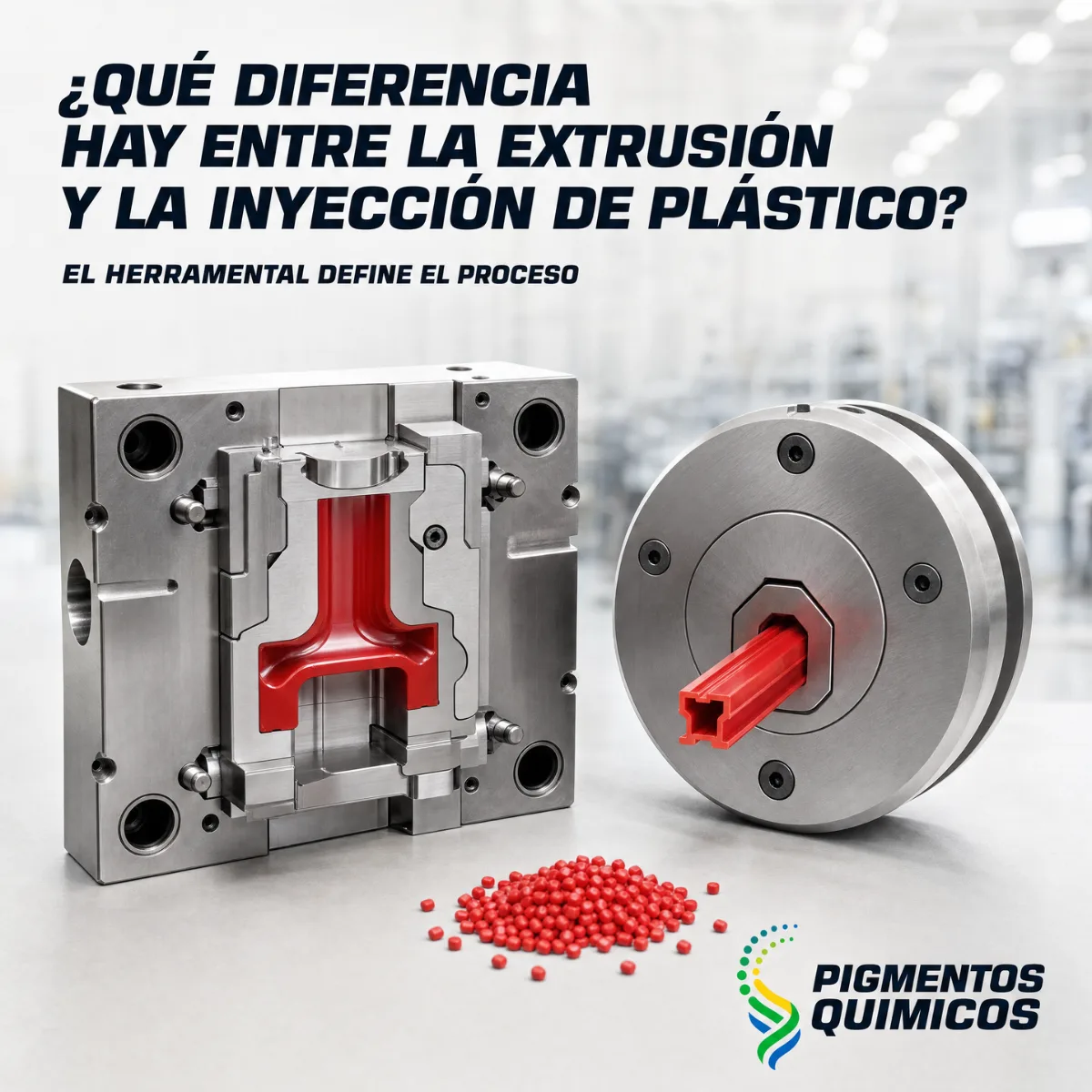
Injection molding fills a closed mold one part at a time; extrusion pushes material continuously through an open die. That changes the tooling, the costs and how the masterbatch is melted, mixed and dosed.
For years your plant has been injection molding the corner pieces and connectors of a modular shelving system in your customer's brand gray, with a masterbatch that has never given you any trouble. This year the customer also asked you for the extruded profile that joins those parts, and your team started up the extruder with the same concentrate at the same percentage. The profile came out lighter, with fine streaks along its length, and once the shelving is assembled, the corner piece and the profile look like they come from two different brands. The customer put the launch on hold and rejected the first production lot of profile.
Injection molding fills a closed mold one part at a time; extrusion pushes material continuously through an open die. That changes the tooling, the costs and how the masterbatch is melted, mixed and dosed.
The same molten plastic, two destinations that demand different decisions
Injection molding and extrusion share the same starting point: a screw turning inside a heated barrel that melts the resin together with the masterbatch. What the material meets at the end of the barrel defines the product, the tooling investment, the production pace and the way the color is incorporated.
Injection molding: a closed mold filled one part at a time
In injection molding, the screw accumulates a measured amount of molten material and shoots it at high pressure into a closed, cooled mold. The material fills the cavity, solidifies under pressure and the finished part comes out when the mold opens: a lid, a corner piece, a bucket. Each shot is an intermittent cycle, and the steel of the mold defines the geometry in all three dimensions.
Extrusion: an open die that shapes a continuous product
In extrusion, the screw works without pause and pushes the material through an open die that gives it the shape of a cross section. What comes out is a continuous product: pipe, profile, sheet, film or coated cable. It is then cooled with water or air, a puller draws it at constant speed and, at the end of the line, it is cut or wound.
As a general rule, anything with a closed shape, details on several faces or threads is injection molded, and anything that keeps the same cross section along its length is extruded. Many products combine both, such as a pipe with its fittings or the shelving system in our example, and that is where the color challenge begins.
Tooling, cycle and tolerances: where the cost of your project is defined
The mold concentrates the investment before the first part
An injection mold is a piece of steel engineering with cavities, cooling channels, ejectors and sometimes a hot runner. Building one takes weeks or months, and the investment is recovered through volume. An extrusion die forms a single cross section and usually costs less than a mold of comparable complexity, although the line needs a cooling tank, a sizing unit, a puller and a cutter or winder.
A design change in an injection molded part can force you to rebuild the mold; in extrusion, adjusting the die is usually faster and cheaper. Injection molding calls for volumes that pay for the tooling, and extrusion calls for long production runs that justify starting up the line.
Seconds per cycle versus meters per minute
Injection molding is measured in seconds per cycle and parts per cavity, and cooling inside the mold usually sets the pace. Extrusion is measured in kilograms per hour and meters per minute, and the limit lies in the capacity to melt and cool the product. Starting up and stabilizing an extruder consumes time and material, so every stoppage and every color change carries more weight.
Tolerances: the mold sets the part and the line adjusts the cross section
The tolerances of an injection molded part depend mainly on shrinkage and cooling in the mold. In extrusion, the material swells as it leaves the die, is stretched by the puller and shrinks as it cools, so the dimensions depend on the sizing unit, the line speed and the water temperature. Any variation in speed shows up in the wall thickness and, as we will see, in the color.
Why the masterbatch that works in your injection molding machine can fail in the extruder
This is where most complaints originate. The pigment in the masterbatch has to melt, distribute and disperse in the base resin while the material travels through the barrel, and each process gives it different conditions. In another article we explain why color fails more easily in thin film; here are the four variables that change with the process.
Residence time: intermittent shots versus continuous flow
In injection molding, the material stays in the barrel for several cycles, depending on the shot size relative to the barrel capacity, and it waits while the mold cools and opens. With a machine that is oversized for the part or with a hot runner, residence time grows longer and sensitive organic pigments can shift in shade. In extrusion, the flow is continuous and residence time depends on throughput: stable as long as the line holds its speed, and long at every slowdown or stoppage, with the material exposed to heat in the barrel, screen and die.
Mixing and shear: the mold gate versus the die
In the injection molding machine, mixing happens while the screw loads the next shot, and back pressure is the operator's lever to improve it. Then the passage through the gate at high speed homogenizes the melt, but it also orients effect pigments and marks the zones where two flow fronts meet. In the extruder, the screw is usually longer, with mixing sections, and the screen adds resistance to flow. Mixing is more sustained, although the agglomerates the screw failed to break up reach the screen or the product intact.
Dosing tied to screw recovery or to line throughput
In injection molding, the feeder delivers masterbatch only while the screw is loading, and its calibration depends on recovery time; if that time changes, the color ratio changes with it. In extrusion, the feeder follows a continuous throughput: if the line speeds up or slows down while the feeder keeps its pace, the color concentration rises or falls. A gravimetric feeder linked to the extruder is the safest way to hold the ratio.
Carrier resin and melt flow index: injection grades versus extrusion grades
Injection molding resins usually have a high melt flow index so they can fill the mold; extrusion resins have a low one, which provides the melt strength a pipe or profile needs to hold its shape. A high-flow carrier works well in the injection molding machine, but in a viscous extrusion resin it can melt too early, slip without blending in and leave streaks. The practical rule calls for a carrier that is compatible with the base resin and has a melt flow close to it or slightly higher.
Color defects that reveal which process the part came from
When a color complaint arrives, the type of defect almost always points to the process and the variable responsible. Recognizing it saves you days of blind adjustments.
In injection molding: weld lines, flow marks and warped parts
In injection molding, defects appear at fixed points on the part. Weld lines form where two flow fronts meet, and with metallic or pearlescent pigments they look like a dark seam. Flow marks next to the gate reveal an oriented pigment. In addition, certain phthalocyanine blues and greens act as nucleating agents in polyethylene and polypropylene and alter shrinkage, so a lid can come out warped simply because of the color it carries.
In extrusion: longitudinal streaks, specks and sections of a different shade
In extrusion, defects stretch in the direction of the line. A continuous streak points to poorly distributed pigment, a buildup on the die lip or degraded material in a zone where the flow stagnates. Specks are agglomerates that got through the screen. Sections of a different shade usually coincide with a screen change, a speed variation or a feeder that lost its pace, and because the product is continuous, they compromise many meters before anyone detects them.
Color changes also have different costs. On the injection molding machine, purging the barrel and hot runner is enough; on the extruder you have to purge the barrel, screen and die, with meters of transition material that end up in the grinder. That is why in extrusion it pays to schedule colors from light to dark.
How we formulate color when your product combines injection molded and extruded parts
At Pigmentos Químicos we treat each process as a development of its own, even when the target color is the same.
One masterbatch per process, with the carrier each resin needs
We formulate the injection molding concentrate on a carrier compatible with your injection grade and the extrusion concentrate on one compatible with your extrusion grade, using pigments that withstand the temperature profile and residence time of each line. When the goal is to use a single concentrate in both processes, it should be tested on both lines before it is approved.
A single color standard, approved on the real part from each process
Approval happens twice, on the injection molded part and on the extruded product, both measured with a spectrophotometer against the same standard and under the same light source. The profile has a different thickness, finish and cooling from the corner piece, and each formulation is adjusted until the two match.
Documented dosing for each line
We deliver the dosing for each process along with the conditions under which it was approved: temperatures, line speed or cycle time, and feeder type. That way your team reproduces the color in every production lot and detects the variable that shifted in good time.
If your product combines injection molded and extruded parts, the color is designed for both processes from the start. At Pigmentos Químicos we formulate the masterbatch for the resin and the line of each part, and we approve it against a single standard. Tell us about your parts, your resins and your processes at https://pigmentosquimicos.com
Frequently asked questions
Can I use the same masterbatch for injection molding and extrusion?
In some cases, yes, when the two resins have a similar melt flow and the color is dark and forgiving. With a low-flow extrusion resin or a light, demanding color, it is better to use a separate concentrate for each process, approved against the same standard.
Why do the injection molded part and the extruded profile come out in different shades at the same dosing?
Each process leaves the pigment in different conditions: thickness, finish, cooling rate and orientation change how light reads the color. At the same dosing, a thin-walled profile can look lighter than a thick part, so the dosing is adjusted for each process.
Which process is right for a new product?
It depends on the geometry and the volume. Closed shapes, details on several faces or threads call for injection molding; a constant cross section along the length is extruded with less expensive tooling. For color, define the process before developing the masterbatch, because the formulation changes with it.