
What Are the Most Common Mistakes in Plastic Injection Molding?
The most common injection molding mistakes: wet material, excess heat and residence time, poor venting, insufficient holding and poorly blended masterbatch.
Your plant injection molds the front covers of a fan in light gray ABS for a home appliance brand. On Monday a new lot of resin arrived and, because the dryer was busy with another material, the warehouse sent it straight to the hopper. By the afternoon the covers were coming out with silver streaks around the gate, and the operator raised the barrel temperature to "dry" the material inside the machine. The streaks continued, the gray took on a yellowish tone and sink marks appeared opposite the screw bosses. The brand rejected the entire shipment, and your plant lost several shifts of production and the trust of a customer who had never filed a complaint.
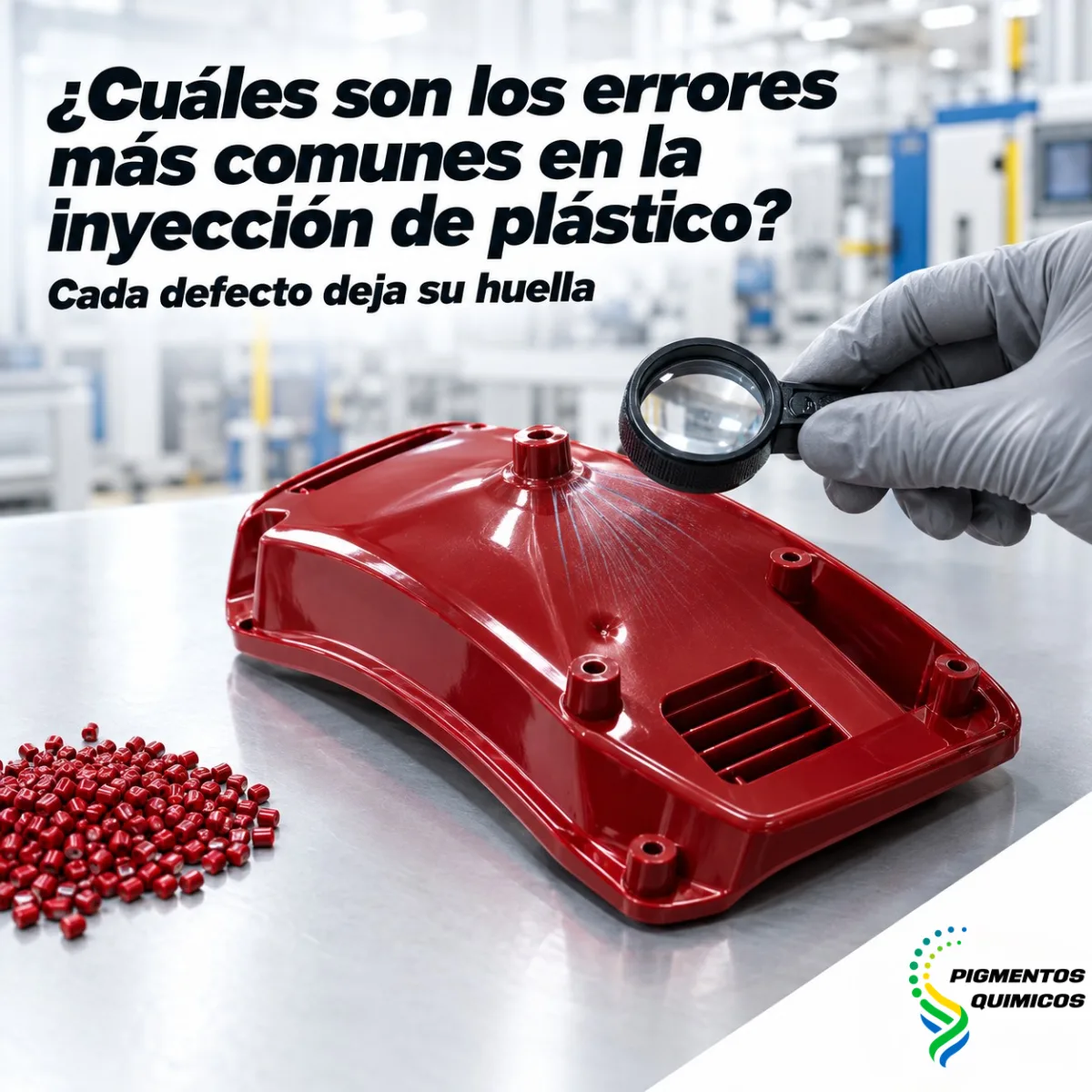
The most common mistakes in injection molding are wet material, excessive temperatures and residence times, poor venting, insufficient holding and poorly blended masterbatch. Each one leaves a recognizable mark on the part.
Mistakes that begin before the injection molding machine fires a shot
Many injection molding defects are blamed on the machine when their origin lies in the material that went into the hopper. Checking the resin, the masterbatch and the regrind first saves hours of parameter adjustments that only move the problem somewhere else.
Wet material: silver streaks and parts that lose strength
Hygroscopic resins, such as nylon, polycarbonate, PET, PBT and ABS, absorb moisture from the air and need drying before they are injection molded. If they go in wet, the water turns into steam inside the barrel and leaves silver streaks radiating from the gate, bubbles and a dull surface. In polycarbonate, PET and nylon, moisture also breaks the polymer chains during melting, and the part comes out looking good but with lower impact strength. Raising the barrel temperature, as in the case of the covers, speeds up degradation and leaves the moisture where it was.
Drying is controlled with a dehumidifying dryer, the time and temperature specified by the resin manufacturer, and a hopper sealed off from the surrounding air. Polyolefins absorb almost no moisture, although they can carry surface condensation when the material arrives cold at a warm plant, and concentrates with mineral fillers or regrind can also retain it. In another article we explain how moisture in masterbatch affects the finish; for these cases we offer a desiccant additive that absorbs the moisture present in the resin or in recycled material.
Masterbatch with an incompatible carrier: streaks, delamination and lower impact strength
A concentrate formulated on a carrier that is incompatible with the base resin disperses poorly in the melt. Color streaks appear on the part, along with layers that peel off near the gate and, in engineering materials such as ABS or polycarbonate, a drop in impact strength. Universal carrier concentrates solve many cases in polyolefins; in engineering resins, the better choice is a carrier of the same polymer type, or one that is compatible and proven in that resin.
Regrind without a fixed ratio: shade and properties that change from lot to lot
Runners and rejected parts are ground and returned to the hopper. If one shift mixes in one ratio and the next shift another, the color and the strength move with it, because regrind has already been through the heat at least once and can carry fines, dust or degraded material. Set the percentage, mix it evenly and keep the regrind of each color separate so that dark residue ends up far from a light-colored part.
Machine settings that burn the material and alter the color
Excessive temperature and residence time: black specks and shifting shades
A barrel temperature above the resin's processing window, or a small shot on a large injection molding machine, leaves the material exposed to heat for too long. Sensitive organic pigments shift in shade, ABS yellows and black specks appear from degraded material that built up in the check valve, the nozzle or the hot runner. As we explained when discussing residence time in the barrel, this defect is often mistaken for a pigment problem. Match the machine to the size of the part and check the zones where material can stagnate.
Burns at the end of fill: trapped air with no way out
A brown or black mark that always appears in the same spot, at the end of the plastic's flow path or at the bottom of a rib, usually comes from air trapped in the cavity. The plastic pushes the air into a corner with no exit, and the air compresses, heats up and burns the flow front, a phenomenon known as the diesel effect. It is corrected with clean vents of the right depth in the mold and a lower injection speed in the last part of the fill. Its fixed location distinguishes it from thermal degradation, which appears at random.
Back pressure and screw speed: insufficient mixing or excess heat
Back pressure is the resistance the screw meets as it moves back while loading the next shot. With too little, the masterbatch mixes poorly and the part shows color streaks or clouds, especially with low-dosage concentrates. With too much, or with the screw turning too fast, shear heats the material, lengthens recovery and, in glass-filled resins, breaks the fibers. The right setting is usually the minimum that gives a uniform color with a stable recovery time.
Injection speed: jetting and flow marks
When plastic enters at high speed through a small gate into a wide section, it comes out as a jet that snakes before touching the walls and leaves a wavy mark visible on the surface. A speed that is too low, on the other hand, cools the flow front and forms concentric ripples or dull zones near the gate. A staged speed profile, slow through the gate and faster through the body of the part, solves many of these cases.
Filling, holding and cooling: where sink marks and warped parts originate
Sink marks and internal voids: short holding or a gate that freezes too early
As the part cools, the plastic shrinks, and the holding phase pushes in extra material to compensate. If the holding pressure or time falls short, or if the gate freezes before the part has finished packing, thick sections sink on the surface opposite ribs and bosses or form voids inside. A higher melt temperature increases shrinkage, and that explains the sink marks on the covers in our example. In the design, ribs and bosses thinner than the nominal wall reduce the problem at its source.
Short shots and flash: the same setting at two extremes
A short shot occurs when the material fails to fill the cavity: insufficient shot size, low temperature, a clogged vent or a gate too small for the flow length. Flash sits at the opposite extreme, with plastic escaping through the parting line because the pressure exceeds the clamping force, the material is too fluid or the mold is already worn. Correcting one with an abrupt adjustment usually causes the other, so it pays to find the fill point with partial shots before applying holding pressure.
Warpage: uneven cooling and shrinkage that changes with the color
A part warps when one zone shrinks more than another: mold halves at different temperatures, walls of uneven thickness or strong orientation of the material in the flow direction. Some organic pigments also alter the crystallization of polyolefins and change shrinkage, so the same part can come out flat in one color and twisted in another. That is why a color change on a tight-tolerance part deserves dimensional validation.
How we eliminate the mistakes that come from color and additives at the root
At Pigmentos Químicos we start every injection molding complaint with the mark the defect leaves, because that mark separates process problems from material problems.
Diagnosis by location and timing
A defect that always appears in the same spot on the part usually comes from the mold or the fill; one that appears at random comes from the material, such as poor dispersion or moisture. If it started with a new lot of resin or concentrate, we check that lot; if it started with a parameter change, we check the process sheet. This reading keeps you from switching suppliers over a problem that a vent would have solved.
Compatible, well-dispersed masterbatch for your resin
We formulate the concentrate on a carrier compatible with your injection molding resin and with pigments that withstand your processing temperature and residence time. We control dispersion during manufacturing so the color blends in with normal back pressure, without forcing you to overheat or overwork the material.
Additives that target the cause of the defect
When the origin lies in the material, the right additive helps: the desiccant, for resins and recycled material with moisture; the antioxidant, to limit thermal degradation and preserve properties in regrind; and the polypropylene clarifier, which promotes a finer, more uniform crystalline structure and can shorten the cycle. We dose them for your part and validate them on your injection molding machine.
The most costly injection molding mistakes almost always start with a small variable: a hopper of undried resin, minimal back pressure, a clogged vent or a concentrate with the wrong carrier. At Pigmentos Químicos we formulate masterbatch and additives for your resin and your injection molding machine, and we help you read the mark each defect leaves. Tell us about your part, your resin and the defect you are seeing at https://pigmentosquimicos.com
Frequently asked questions
How can I tell whether a defect comes from the masterbatch or the process?
Look at where and when it appears. A defect fixed in the same spot on every part points to the mold or the fill; a random one points to dispersion, moisture or contamination of the material. If it coincides with a lot change, set aside samples from that lot and compare them against the previous one on the same machine and with the same parameters.
Which resins do I need to dry before injection molding?
Hygroscopic resins, such as nylon, polycarbonate, PET, PBT and ABS, require drying with dehumidified air under the conditions set by the resin manufacturer. Polyolefins, such as polyethylene and polypropylene, are normally molded without drying, except when they carry condensation, wet regrind or concentrates with mineral fillers that retain water.
Does raising the barrel temperature help correct a short shot?
Sometimes it improves the fill, although it is rarely the best first lever. First check the shot size, the injection speed, the vents and the mold temperature. A high barrel temperature increases shrinkage and sink marks, lengthens cooling and exposes the pigment to degradation, so raise it only within the resin's processing window.