

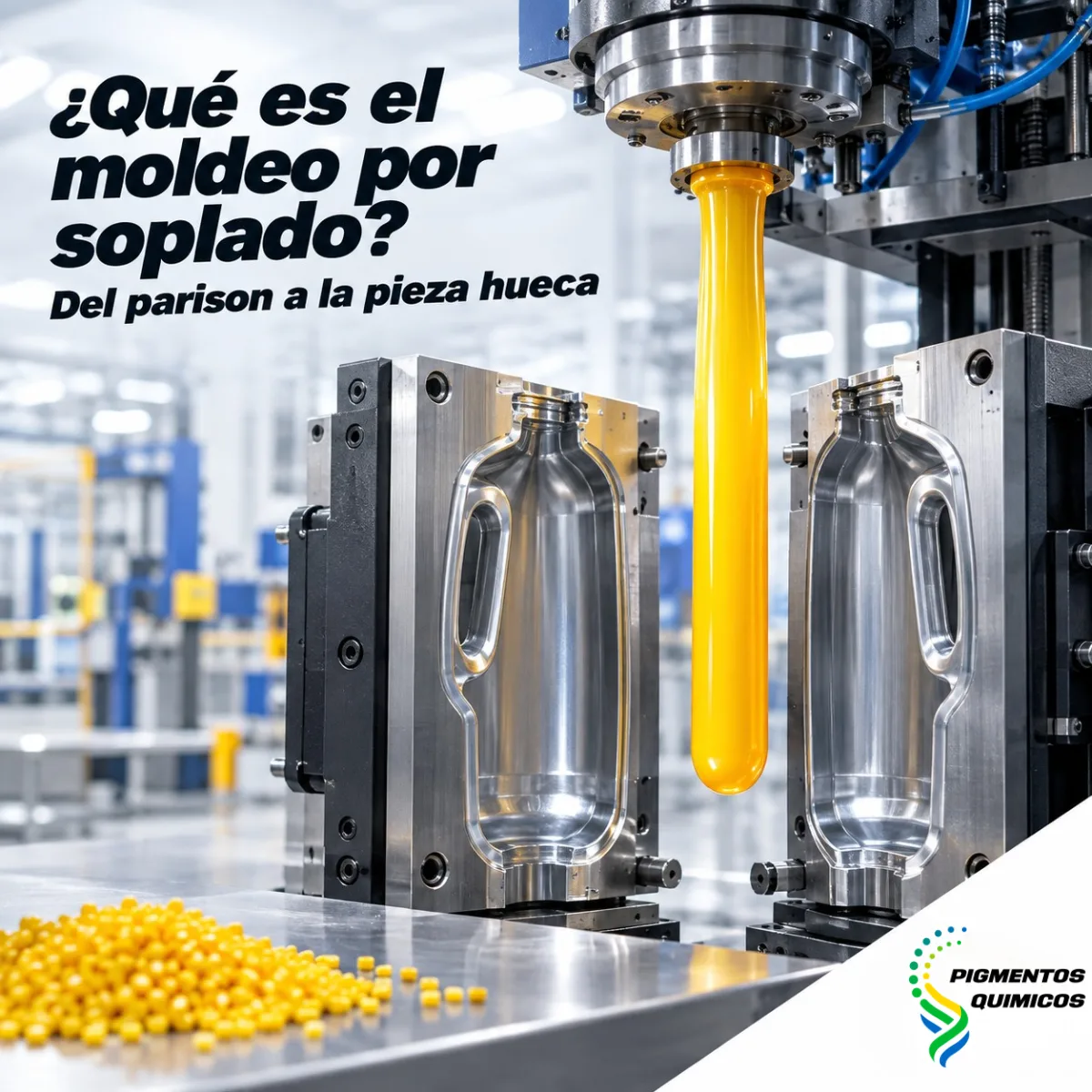
What Is Blow Molding?
Blow molding inflates hot plastic inside a mold to form hollow parts. Three variants: extrusion blow molding, injection blow molding and stretch blow molding.
Your plant blow molds one-gallon jugs in translucent blue high-density polyethylene for a liquid detergent manufacturer. The customer launched a new design with a deeper handle and sharper corners, and your team mounted the new mold with the parison program from the previous model. A few days later, the customer's filling line reported jugs leaking at the bottom and others collapsing in the stack. When the jugs were cut open, the wall at the corners of the handle was much thinner than on the body, and that was exactly where the blue looked almost white. The customer stopped filling, set aside the entire production lot and made the next order conditional on an investigation of your process.
Blow molding inflates hot plastic inside a mold to form hollow parts. Its three variants, extrusion blow molding, injection blow molding and stretch blow molding, define the wall thickness, the cost and the defects of your container.
Compressed air inside a cold mold: the principle that decides how much your container can withstand
Blow molding produces hollow parts: bottles, jugs, jars, drums, tanks and ducts. A hot plastic starting shape, which can be an extruded tube called a parison or an injection molded preform, is trapped inside a split mold; compressed air enters and the plastic inflates until it copies the walls of the mold, where it cools and takes its final shape.
The difference from injection molding lies in what defines the geometry. In an injection molded part, the steel of the mold sets both the outer and the inner face, and with them the thickness. In a blow molded part, the mold defines only the outside; the inside is free, and the wall thickness results from how much the material stretched in each zone before touching the metal. That is why a blow molded container can look perfect on the outside and have very uneven walls on the inside.
Blow-up ratio: the distance the plastic travels before it freezes
The blow-up ratio compares the size of the final part with that of the parison or preform. The material that touches the mold first cools and stops stretching, while the rest moves on toward corners, handles, shoulders and contoured bottoms, where it arrives thinner. Sharp corners and deep handles increase that difference, and if the process does not compensate for it, the part fails at its points of greatest stress, like the jug in our example.
Blow molding resins: melt strength before flow
High-density polyethylene dominates in jugs, cleaning product containers, oil containers and tanks; PET, in water and soft drink bottles; polypropylene, in jars that call for transparency or heat resistance. Blow molding grades usually have a low melt flow index, because the parison has to hang from the head without stretching under its own weight and inflate without tearing. This condition also matters when choosing color concentrates and additives.
Extrusion blow molding: the parison decides whether your jug withstands stacking
Extrusion blow molding is the most common process for medium and large polyethylene and polypropylene containers. An extruder melts the resin and pushes it through a head that forms a vertical tube. When the parison reaches its length, the mold closes around it, pinches the lower end to seal it and cuts the upper end; a blow pin or needle introduces the air, and the part inflates, cools and comes out with flash at the bottom, the neck and the handle.
Continuous extrusion or accumulator head
For bottles and jugs, the extruder works without pause and the molds shuttle back and forth to pick up the parison. For drums, tanks or automotive ducts, an accumulator head is used: the extruder fills a chamber with molten material and a piston pushes it out all at once, so the heavy parison comes out quickly and has less time to cool or stretch.
Parison programming: thickness is distributed before blowing
Because the far zones of the mold receive more stretched material, the parison is produced with variable thickness along its length. The mandrel in the head moves up or down during extrusion and opens or closes the die gap, so the tube comes out thicker at the height of the corners and the handle and thinner where stretching is lower. Some machines also correct thickness around the circumference for flat or oval containers. A new mold running the previous mold's program, as in the case of the jug, distributes the material for a geometry that no longer exists.
Die swell as the material leaves the die and the weight of the tube itself also alter that distribution, so a change of resin lot or head temperature can shift the wall distribution without anyone touching the program.
Pinch-off and flash: the seal that is tested with every drop
The pinch-off at the bottom joins two faces of the parison in a weld. If the material arrives cold, if the pinch-off zone of the mold is worn or if the mold closes too fast, the weld ends up thin and opens in the drop test or under filling pressure. The flash is trimmed and almost always ground to be fed back in, in a ratio that must stay fixed, because every pass through the extruder changes the strength and the shade of the material.
Injection blow molding and stretch blow molding: precision at the neck and strength in the wall
Injection blow molding: an injection molded preform, no flash and an exact neck
In injection blow molding, a preform is first injection molded around a core rod. The rod transfers it, still hot, to the blow mold, where air enters through the rod and inflates the part; a third station ejects it. The thread comes out finished from the injection stage, precise and without flash, which is why the process is used for small pharmaceutical and cosmetic jars. Its limits are part size, the inability to form handles and double tooling that needs volume to pay for itself.
Stretch blow molding: biaxial orientation for PET bottles
Stretch blow molding adds a rod that stretches the preform lengthwise while the air expands it widthwise. That orientation in two directions aligns the polymer chains and gives the bottle strength, transparency and a better gas barrier with thinner walls; that is why it dominates in bottled water, carbonated soft drinks and edible oils. It can be done on a single machine or in two stages, with preforms that are injection molded, stored and later reheated with infrared lamps in the blow molder.
In the two-stage process, the preform heating profile is the central variable. A preform that is too cold overstretches and stress whitens, taking on a pearly appearance; one that is too hot crystallizes and loses transparency. Color plays a part too: a tint or a pigment changes how much infrared energy the preform absorbs, so every color change requires reviewing the oven settings. Polypropylene is also stretch blow molded, and there a clarifying additive helps the container gain transparency.
The defects that reveal a process failure in your blow molded part
The defect in a blow molded part almost always points to the stage responsible, and reading it saves you from changing resin or mold blindly.
Thin walls and collapsing containers: material distribution
A jug that collapses in the stack or a bottle that deforms when capped usually has insufficient wall at the shoulder, the corners or the handle. To check it, parts are cut open and the thickness is measured at defined points; the problem is corrected with the parison program, the head temperature or the preform heating profile. In translucent or light-colored containers, thin zones look paler, a useful signal that visual inspection can take advantage of.
Rocking bottoms and dimensions that change after blowing: cooling
If the part leaves the mold before it has cooled enough, the bottom bulges and the container rocks on the conveyor, or the body goes oval. High-density polyethylene keeps shrinking for hours after blowing, so height, volume and neck diameter must be measured once the part has stabilized. A container approved as it comes off the machine can be out of spec the next day.
Black specks, streaks and rough surfaces: degraded material or trapped air
Black specks and streaks along the container usually come from degraded material in dead zones of the head or from contaminated regrind. A rough surface that looks like orange peel points to a cold parison or a poorly vented mold, where trapped air keeps the plastic from copying the surface. In PET, haze is related to preform temperature or to moisture in the resin, which calls for drying beforehand.
How we support your blow molding process through color and additives
At Pigmentos Químicos we start from your part's blow molding process to formulate the concentrate, because each variant places different conditions on the material.
Concentrates compatible with your blow molding grade
We formulate the masterbatch on a carrier compatible with your blow molding resin, so it blends in without weakening the parison or leaving streaks. In translucent containers, we adjust the loading so the shade holds in the most stretched zones.
Additives for regrind, outdoor exposure and transparency
Our antioxidant helps preserve the properties of material reprocessed with ground flash; our UV stabilizer protects tanks that work outdoors; and our polypropylene clarifier supports the transparency of containers made from that resin.
Approval on the blow molded container
We approve the color on the real blow molded part, measured with a spectrophotometer on the body and in the zones of greatest stretching, against the same standard and under the same light source. That way we confirm that the shade holds where the wall gets thinner, something an injection molded plaque never shows.
In blow molding, wall thickness, the bottom weld and the color are defined in seconds. At Pigmentos Químicos we formulate masterbatch and additives for your resin and your blow molding variant, and we approve them on your real container. Tell us about your part and your process at https://pigmentosquimicos.com
Frequently asked questions
Which blow molding variant is right for my container?
It depends on the size, the resin, the neck and the volume. Jugs, containers with handles and large polyethylene parts are made by extrusion blow molding; small jars with precise threads, by injection blow molding; and PET or clear polypropylene bottles, by stretch blow molding.
Why does a container pass inspection at the plant and then fail on the customer's filling line?
The most frequent causes are post-blow shrinkage, which changes dimensions over the following hours, and thin walls in zones that only take stress during filling, capping or stacking. Measure the parts once they have stabilized and add top load and drop tests to the inspection of every production lot.
How much ground flash can I feed back in?
Your container and your tests define the ratio. What is essential is to keep it constant in every production lot, because regrind has more heat history than virgin resin, and a variation in its percentage changes the strength and the shade of the container. A suitable antioxidant helps protect the reprocessed material.