
Why Does a Tool Handle Lose Its Color After a Summer in the Backyard?
The handle loses color because sun, heat and moisture attack the pigment and the grip elastomer at the same time. You prevent it with high-fastness pigments, UV stabilizer in the masterbatch and validation on your material.
Your customer, a garden and construction tool brand, launched a line of hammers and shovels in the spring with orange handles, its signature color. In September, the hardware chain sent back entire boxes: the handles that spent the summer on the outdoor display and in its buyers' backyards had turned salmon, with a whitish layer that rubs off on the hand and yellowed patches where the sun hit directly. The steel is intact and the tool works, but on the shelf it looks ten years old, and the chain wants the whole season's inventory replaced. Your plant molded those handles with the same orange masterbatch it uses for indoor parts, and the color approved in April was never tested under the sun.
The handle loses color because sun, heat and moisture attack the pigment and the grip elastomer at the same time. You prevent it with high-fastness pigments, UV stabilizer in the masterbatch and validation on your material.
Three different failures your customer calls “fading”
When a tool comes back with a washed-out handle, the complaint almost always says the same thing: the color faded. Behind that word are three different mechanisms, and each one is corrected with a different formulation decision. Identifying which one occurred is the first step, because raising the color dosing solves none of the three.
Pigment fading: the orange that turns salmon
Ultraviolet radiation breaks down the pigment molecule, especially in the organic pigments that deliver the most vivid oranges, reds and yellows. The shade loses saturation evenly and shifts: orange drifts toward salmon, red toward pink, yellow toward cream. If you compare the exposed handle with one kept in the warehouse and the color looks washed out while the surface is still smooth, the failure lies in the pigment that was chosen.
Polymer yellowing: the resin changes beneath the color
Some resins yellow in light because of their own chemistry. Aromatic TPU, widely used in grips for its wear resistance and its cost, is the best-known example: in the sun it develops a yellow tone that adds to the pigment's color. On orange it is barely noticeable; on blue, light gray or green, the handle shifts toward olive green or brown. Aliphatic TPUs resist light much better at a higher price, and the choice between one and the other is made before any discussion of color.
Chalking: the white powder that disappears when you wet the handle
The third mechanism attacks the surface. Radiation and oxygen degrade the outer layer of the polymer, the pigment particles become exposed and the surface turns rough and whitish; when you touch it, it leaves a fine powder on your hand. There is a simple test you can run at the plant: wet the handle. If the color comes back while it is wet and fades again once it dries, the pigment is still there and what failed was the polymer surface. That failure is corrected with stabilization, and adding more pigment does nothing for it.
Why the handle fails before the rest of the tool
On the same tool, the metal head, the label and the handle receive the same sun. The handle deteriorates first for three reasons related to its material, its color and its construction.
The grip elastomer is more vulnerable than a rigid plastic
Soft grips are made with TPU or other thermoplastic elastomers that provide a comfortable feel and cushion impact. Their flexible structure, the same one that makes them comfortable, also makes them more sensitive to oxidation than a rigid polypropylene or nylon. In addition, the grip is usually a thin textured layer: more exposed surface and less thickness before the damage reaches the entire wall. Some elastomers contain process oils that migrate to the surface with heat and carry pigment with them, which shows up as sticky, stained areas.
Brand identity colors are the most demanding
Tool brands choose orange, red, yellow or bright green so their product is recognizable from a distance on the shelf and on the jobsite. Those saturated shades are almost always achieved with organic pigments, and lightfastness varies enormously from one organic pigment to another. When the pigment was chosen to match the shade at the lowest cost, with an indoor part in mind, the handle goes outdoors with a pigment that was never meant for the sun. High-performance organic pigments and inorganic pigments, such as iron oxides, hold up much better; the former cost more and the latter give less brilliant shades, and the balance is defined with the brand from the development stage.
Overmolding: two materials that age at different rates
Many handles combine a rigid polypropylene or nylon core with an overmolded elastomer grip, each with its own masterbatch. On the production line the two match in shade; after a summer, each resin has aged at its own rate and the handle ends up two-toned. The problem also appears across products from the same brand: if the hammer handle and the shovel handle come from different resins or different suppliers, they no longer look like the same family on the display. Weathering stability is formulated for each material, with the same color standard as the target.
The backyard adds heat, water and chemicals to radiation
A summer in the backyard is more aggressive than the exposure described in many specifications. The tool is left leaning against a hot wall, gets wet from the sprinklers or the afternoon rain, dries in the sun and heats up again the next day, in contact with soil, fertilizer or lawn mower gasoline.
Accumulated heat and moisture cycles
Dark and saturated colors absorb more heat, and the surface of a handle in the sun reaches temperatures far above the air temperature. Heat accelerates the oxidation reactions that radiation initiates, so the damage progresses faster during the hours of strongest sun. Wet and dry cycles wash away the degraded layer and expose fresh material, which accelerates chalking. That is why a part that passed a light test without moisture can fail in the backyard.
Sweat, sunscreen and garden chemicals on a material that absorbs
The handle is the only part of the tool in constant contact with the hand. Sweat, sunscreen and insect repellents contain substances that an elastomer can absorb: the surface swells, softens or changes shade. In gardening, fertilizers and pesticides add to the list, and experience with agricultural film shows that certain agrochemicals reduce the effectiveness of some UV stabilizers. If the tool is going to work in that environment, the additive package is chosen with it in mind.
How we formulate a handle that reaches its second summer with its color intact
At Pigmentos Químicos we treat an outdoor handle as a development project of its own, with three decisions made together from the first formulation.
Pigments selected for their weathering fastness
We match the shade with pigments whose data sheets declare good light and weathering fastness in the handle's resin, and we rule out those that only perform indoors even when the color matches. When the brand demands a very saturated shade that no resistant pigment can reach, we say so before production and propose the closest shade that does withstand the sun.
UV stabilizer inside the same masterbatch, calculated for your dosing
We integrate a package of UV absorbers and HALS-type stabilizers into the color concentrate, and we calculate it to reach the required concentration in the part at the dosing you use at the plant, which normally ranges from 1 to 4%. A single concentrate spares your team from running two feeders and reduces the risk of the color coming out right while the protection falls short because of a hopper adjustment.
Validation in an aging chamber on the real material
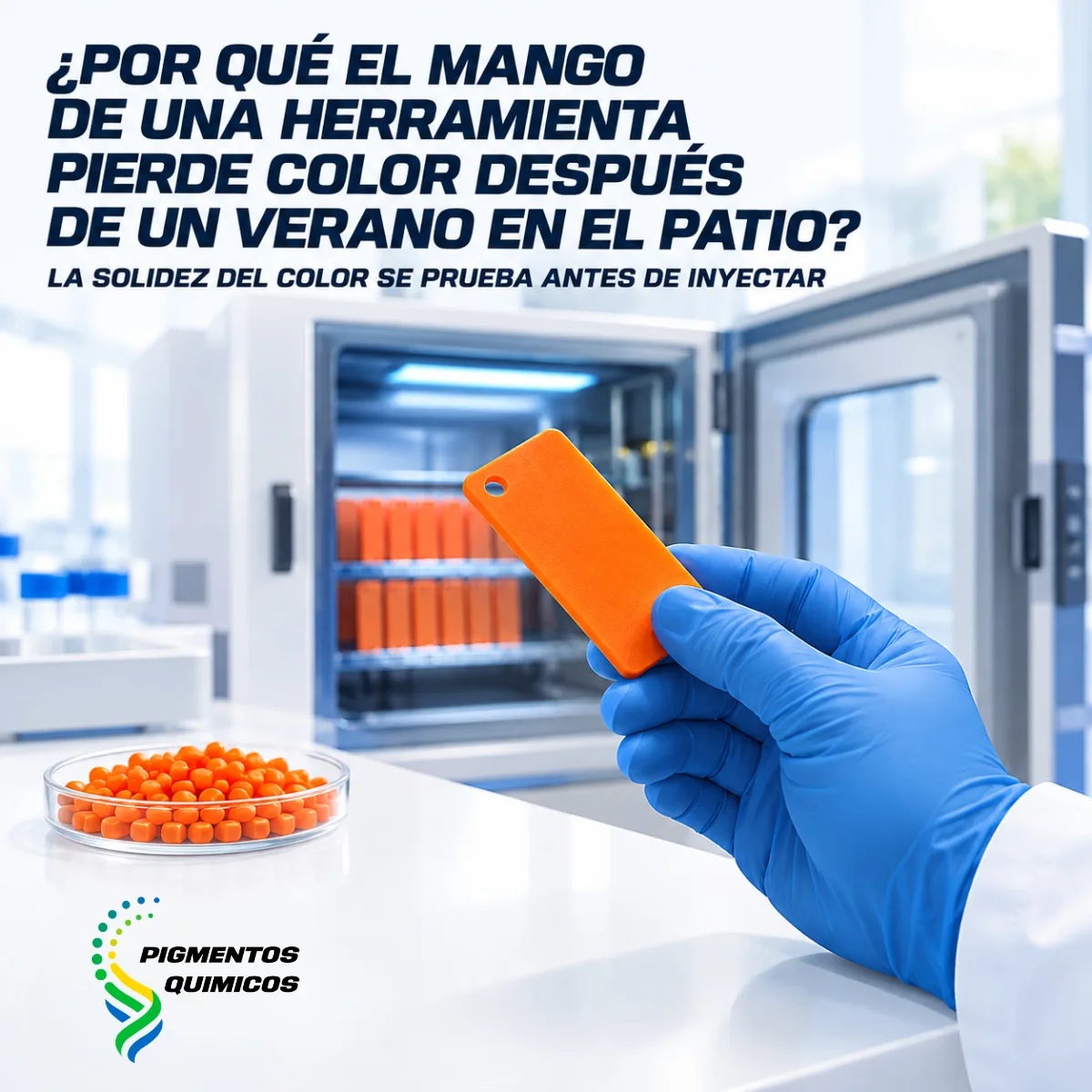
The formulation is tested on the TPU or elastomer you are going to mold, never on a plaque of a different resin. In a development of orange TPU hammer handles, we formulated the masterbatch with UV stabilizers and sent the plaques to a specialized external laboratory, where they spent 78 continuous hours in an accelerated aging chamber. Compared with the unprotected samples, color retention and surface condition improved measurably. That comparison, measured with a spectrophotometer before and after exposure, is the evidence your customer needs to approve the handle for the next season.
What you should define with your customer before approving the color
Ask the brand for four pieces of information before developing the color: where and how the tool will be used, how long it expects the handle to keep its appearance, which resin goes into each part of the handle and what color difference it will accept after the aging test. With that information, the color is approved as performance over time, and the September complaint stops catching you by surprise. Also keep reference parts from each production lot in the warehouse, away from light, so you can measure any handle that comes back from the field against them.
If your customer sent back washed-out handles after the summer, the color it approved was never designed for the backyard. At Pigmentos Químicos we formulate the masterbatch with high-fastness pigments and UV stabilization for your handle's resin, and we validate it before the next season. Tell us about your tool, your resin and where it will be used at https://pigmentosquimicos.com
Frequently asked questions
Does a black handle also lose color in the sun?
Carbon black is one of the best protectors against radiation, so a well-dispersed black handle holds its shade much better than an orange one. Even so, the elastomer can chalk and the black surface turns gray, and a black handle gets hotter in the sun. Stabilization is still necessary if the tool lives outdoors.
How many chamber hours equal a summer in the backyard?
There is no universal equivalence. It depends on the region, the orientation of the part, the test cycle and humidity. The reliable way to use the chamber is comparative: you expose the new formulation, an unprotected sample and, if one exists, a handle with known good field performance at the same time, and you measure the color difference between them.
Is it better to add the UV stabilizer in a masterbatch separate from the color?
It is possible and sometimes convenient, for example when the same stabilizer is used with several colors. The drawback is operational: two concentrates, two dosing rates and two chances for error at the hopper. For a single-color handle line, integrating the protection into the color masterbatch simplifies control at the plant.