
What Should You Consider Before Ordering Color for Cosmetic Packaging?
Before ordering the color, define the resin of each part, the formula that will go inside, the finish and the documentation the brand requires. The color is approved with the package filled and the full family of parts.
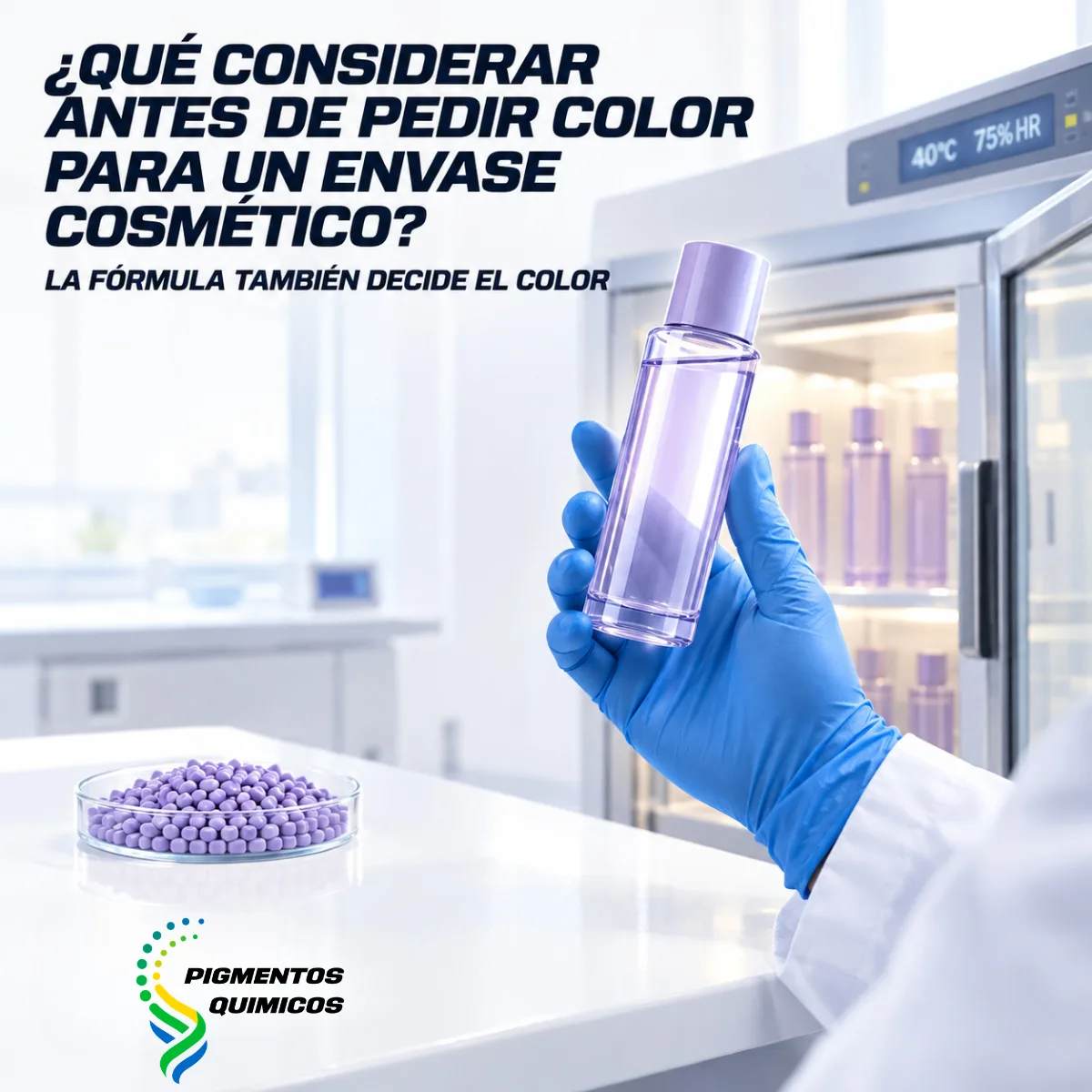
Your customer, a personal care brand, approved a translucent lilac bottle for its new body oil, and your plant already had a full production lot ready when the results of its stability test arrived. The filled bottles that spent several weeks in its lab's warm chamber showed blotchy color near the shoulder, and the oil, which was supposed to look clear, had taken on a lilac tint. The caps, molded in polypropylene at another plant, looked like a different shade next to the bottle. The launch with the retail chain had a fixed date, and thousands of bottles ended up in quarantine while everyone looked for who had failed.
Before ordering the color, define the resin of each part, the formula that will go inside, the finish and the documentation the brand requires. The color is approved with the package filled and the full family of parts.
In cosmetics, an out-of-range shade reads as a different product
On an industrial container, color identifies; on a cosmetic package, color is part of what the consumer buys. The brand invested in a shade that communicates its line, printed it on its display materials and presented it to the retail chain before launch. A deviation that would go unnoticed on a bucket is read, on a cream jar sitting next to another of the same product, as an old lot, an imitation or a quality defect.
Pastel, translucent and pearlescent: the shades with the least margin
The colors most used in cosmetics are also the most delicate to reproduce. A pastel or translucent shade carries a very low colorant load, and at that concentration any variation in dosing, in the resin's base tone or in wall thickness shows immediately. In a translucent bottle, the clarity of the resin is also part of the color: a PET with a slight yellow tint or an unclarified polypropylene changes the result even with the same masterbatch. For these shades we formulate the concentrate at a let-down ratio your feeder can control precisely, and we ask for the exact production resin from the first development.
Bottle, cap and pump: three resins that must look like one
A cosmetic package is rarely a single part. The bottle may be PET or polyethylene, the cap polypropylene and the pump another resin, sometimes made by different processors. The same pigment looks different in each resin because of its crystallinity, its clarity and its gloss, so each part needs its own formulation against a single standard. Before ordering color, agree with the brand on who keeps the master standard and make sure all parts are approved together, side by side, instead of one at a time.
The formula inside can attack the color that holds it
Here lies the biggest difference between a cosmetic package and an industrial one. Oils, fragrances, alcohols, surfactants and natural extracts stay in contact with the package wall for the product's entire life, sometimes in a hot warehouse or in the consumer's bathroom. Those ingredients can dissolve colorant, swell the resin or weaken it, and the damage appears weeks after filling, when the lot has already been manufactured and delivered.
Soluble dyes and pigments: transparency versus stability
Very clean translucent shades are often achieved with soluble dyes, which dissolve in the resin and give transparency without haze. That same solubility makes them more prone to migrate into an oily or alcohol-based formula, like the body oil that turned lilac. Pigments, which remain as dispersed particles, resist extraction better and give up some transparency. The choice between the two depends on what will go inside the package, and that is why the product formula is information we need before developing the color.
Stress cracking and shade changes in the wall
Some combinations of resin and ingredient cause stress cracking: microcracks that appear in the stressed areas of the package, such as the neck or the thread, and show up as whitening of the color. Others cause the resin to absorb part of the formula, and the shade changes in the contact area. The masterbatch also plays a role, because a poorly compatible carrier resin or deficient dispersion creates weak points in the wall where the attack starts sooner.
The compatibility test is done with the real formula
Many cosmetic brands already run stability tests of their product inside the package, with filled bottles stored at elevated temperature for several weeks. Ask for the color to go into that test before approving volume, with bottles from the development sample filled with the final formula. Approving the color on an empty bottle leaves out the variable that generates the most complaints in cosmetics.
Compliance for contact with cosmetics: the conversation that comes before formulating
The brand's regulatory team will ask for evidence that the packaging materials, colorant included, are suitable for contact with its product in the markets where it will be sold. Requirements vary by country, by product type and by the area of the body where the product is applied, and the brand is the one that knows its list. Our recommendation is to settle that conversation at the start: a perfect color that lacks the documentation the brand requires stays in the warehouse.
What information to ask the brand for before quoting
Ask in which countries the product will be sold, what type of formula it will contain, whether the package will be in direct contact with the formula or will be an outer part, such as a case or an overcap, and what documents its regulatory team requires to approve a packaging supplier. With that list, your masterbatch supplier knows from the outset which pigments and additives it can use and which ones are best ruled out.
What documentation to ask your masterbatch supplier for
With every order we deliver a quality certificate, a technical data sheet and a safety data sheet, which support the traceability of the lot. For a cosmetic package, also ask for the composition or compliance declaration that matches your customer's requirements, and confirm that it covers the exact formulation of the approved color. If the color changes pigment during development, the documentation changes too, and it should be reviewed again before the first production lot. A masterbatch with food contact documentation helps, although the brand decides whether its regulatory team accepts it for cosmetic use.
Finish and decoration are decided together with the color
A cosmetic package almost always receives something more after molding: screen printing, hot stamping, a shrink sleeve label or a metallized cap. Each one interacts with the color and with the additives in the concentrate, and a problem at that stage is discovered when the bottle is already pigmented.
Inks and stamping on the pigmented surface
Some additives that help the process, such as slip agents, migrate to the surface and interfere with the adhesion of ink or foil. If the package is going to be decorated, say so when you order the color, so the formulation avoids additives that compete with the decoration and the adhesion test is run on the pigmented part rather than on a natural one.
Shipping scuffs and protection of the contents
A dark or high-gloss bottle shows every scuff from shipping and from the shelf. Anti-scratch additives are available that reduce those marks during handling and filling, and they are worth evaluating together with the color when the package has a glossy finish. If the product formula is sensitive to light, say that too: the opacity and shade of the package help protect it and are defined in the same development.
The file that prevents rejection at launch
Before ordering color for a cosmetic package, gather in a single document the physical standard approved by the brand, the resin and grade of each part, the process and wall thickness, the formula it will contain, the type of decoration, the color tolerance and the regulatory documents the brand requires. With that file we develop the masterbatch on your resin and send you a free one-kilo sample to validate the color in your process. The launch schedule should include the stability test with the filled package; it is the stage that gets cut the most and the one that saves the most lots.
If you are about to order color for cosmetic packaging, the formula, the family of parts and the documentation weigh as much as the shade. At Pigmentos Químicos we develop the masterbatch on the resin of each part, against the brand's standard, and we support you through the test with the filled package. Tell us about your package, your resin and the formula it will hold at https://pigmentosquimicos.com
Frequently asked questions
Can I use the same masterbatch for the bottle and the cap?
Only if both parts are made of the same resin with the same process, and even then it is worth checking. When the bottle is PET and the cap is polypropylene, each part needs its own formulation developed against the same standard, and approval is done with both parts together.
Does a translucent bottle carry more migration risk than an opaque one?
It usually does, because very clean translucent shades are often achieved with soluble dyes, which migrate more easily into oily or alcohol-based formulas. With very finely dispersed pigments you can achieve a more stable translucent shade, with somewhat less clarity. The test with the real formula decides.
What documents should I request for cosmetic packaging?
A quality certificate, technical data sheet and safety data sheet for each lot, plus the composition or compliance declaration that the brand's regulatory team requires for the markets where the product will be sold. Confirm the brand's list before developing the color, because it may rule out pigments from the start.