
How to Protect Plastics from Outdoor Exposure and Extend the Life of Your Polymers
UV radiation, heat, and humidity degrade polymers outdoors. Learn the key technical strategies and additives —HALS, UV absorbers, and carbon black— to protect your plastics.
How to Protect Plastics from Outdoor Exposure and Extend the Life of Your Polymers
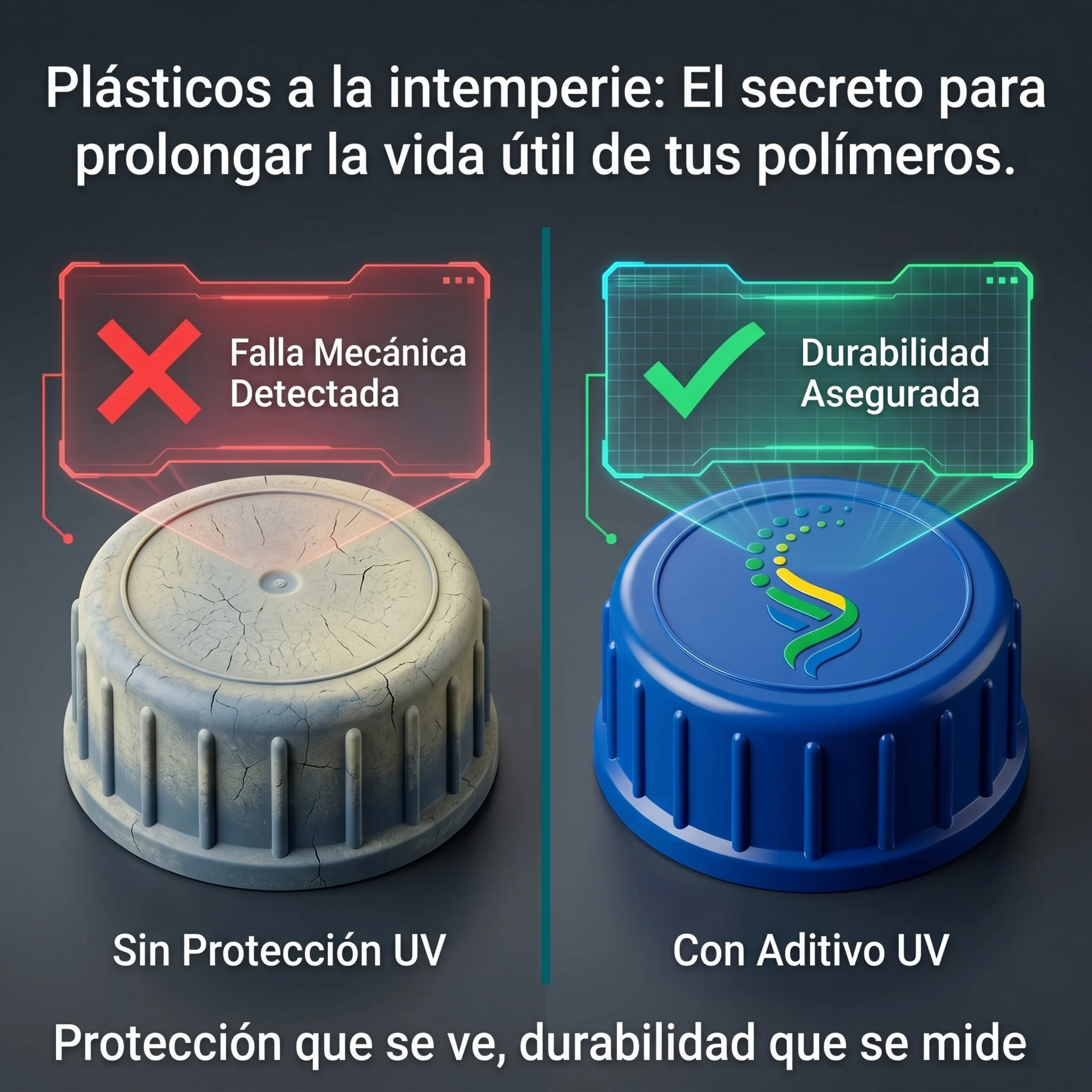
UV radiation, heat, and moisture are the three primary degradation agents for polymers in outdoor applications. The correct combination of HALS stabilizers, UV absorbers, and, where applicable, carbon black, can extend functional polymer life by two to five times compared to unprotected formulations.
In our work with manufacturers of agricultural film, outdoor furniture, automotive exterior components, and construction profiles, we have confirmed that premature degradation is almost always preventable. The technical decisions that determine whether a plastic lasts five years or twenty are made during formulation — not after the part has already failed.
How UV Radiation Degrades Polymers
Ultraviolet radiation in the 290–400 nm range carries enough energy to break the covalent bonds of most polymer chains. In polyolefins, this initiates a photooxidation chain reaction that progressively reduces molecular weight, causing chalking, surface cracking, color shift toward yellow or gray, and loss of tensile strength and impact resistance. The visible degradation you see on a plastic part left outdoors is the endpoint of a process that begins at the molecular level from the first hours of UV exposure.
The photostabilization strategy must be selected based on three variables: the specific polymer chemistry, the geographic location and UV dose (measured in kJ/m² per year), and the minimum required service life.
HALS: The First Line of Defense
Hindered Amine Light Stabilizers (HALS) do not absorb UV radiation — they interrupt the radical chain reaction that UV initiates in the polymer. HALS of the second and third generation (polymeric HALS with high molecular weight) offer superior performance in outdoor applications because they are less volatile, more resistant to extraction by rain, and more compatible with acidic pigments than first-generation monomeric HALS.
In agricultural films and construction profiles, we specify second-generation HALS at dosages of 0.2–0.5% over the base resin. For automotive exterior parts subject to Florida or Arizona weathering requirements (the harshest standardized tests), dosages of 0.5–1.0% with a synergistic combination of HALS + UV absorber are the technical standard.
UV Absorbers: The Optical Screen
Benzotriazole and benzophenone UV absorbers work by absorbing UV energy before it reaches the polymer chains and dissipating it as heat. They are complementary to HALS — HALS acts on the radicals that form after UV hits the polymer; UV absorbers reduce the amount of UV that reaches the polymer in the first place. The most effective formulations combine both mechanisms.
UV absorbers are particularly critical in thick sections (>2 mm) where HALS alone cannot provide uniform protection throughout the cross-section. In thin films (<100 μm), the HALS contribution becomes proportionally more important as there is less material thickness to protect.
Carbon Black: The Special Case for Black Parts
Carbon black at 2–3% concentration is the most cost-effective UV protection system available for black plastic parts. Its mechanism is fundamentally different from HALS and UV absorbers: carbon black screens UV radiation through physical absorption and scattering, acting as an internal opaque barrier. The result is a UV-stable black that can outlast HALS-based systems at a fraction of the cost, provided the particle size is below 25 nm and the carbon black is well-dispersed in the polymer matrix.
The critical variable is dispersion quality. Carbon black that is not fully dispersed creates visible agglomerates and a non-uniform UV screen that compromises protection. This is where a quality masterbatch — with controlled particle size and pre-dispersed carbon black — is technically essential.
Validation Standard: ASTM G154 and G155
Any formulation claiming outdoor durability should be validated under ASTM G154 (fluorescent UV, simulates temperate outdoor exposure) or ASTM G155 (xenon arc, simulates intense solar exposure including visible and infrared). These tests expose samples to accelerated UV cycles and measure color shift (ΔE), gloss retention, tensile strength, and elongation at break at defined intervals. Without this validation, an outdoor durability claim has no technical basis.
Frequently Asked Questions (FAQ)
What is the difference between UV stabilizer and UV absorber?
A UV absorber intercepts UV radiation before it damages the polymer — it works by converting UV energy to heat. A UV stabilizer (typically HALS) interrupts the radical chain reaction that UV initiates in the polymer — it works after the UV has already been absorbed by the material. For maximum outdoor durability, both mechanisms are used together.
How many years of outdoor service can I expect from a UV-stabilized polyolefin?
With a second-generation HALS at 0.3–0.5% and a benzotriazole UV absorber at 0.2%, a polypropylene or HDPE formulation can achieve 10–15 years of outdoor service in temperate climates. In high-UV environments (equatorial, high altitude, or desert), service life decreases proportionally — validation under ASTM G155 (xenon arc) is the only reliable way to predict actual service life for a specific geography.
Does adding UV stabilizer change the color of my part?
HALS and most benzotriazole UV absorbers are colorless or very slightly yellowish in the polymer matrix. At standard dosages (0.2–0.5%), the color impact is negligible for most color applications. If you are producing a very light color (white, light gray, pastel) where even slight yellowing is critical, request a yellow index (YI) measurement from your supplier for the specific HALS/UV absorber combination at the intended dosage.