
What Is the Difference Between Organic and Inorganic Pigments?
An organic pigment is a carbon-based molecule and an inorganic one is a mineral compound. Learn how each changes color, coverage and heat resistance.
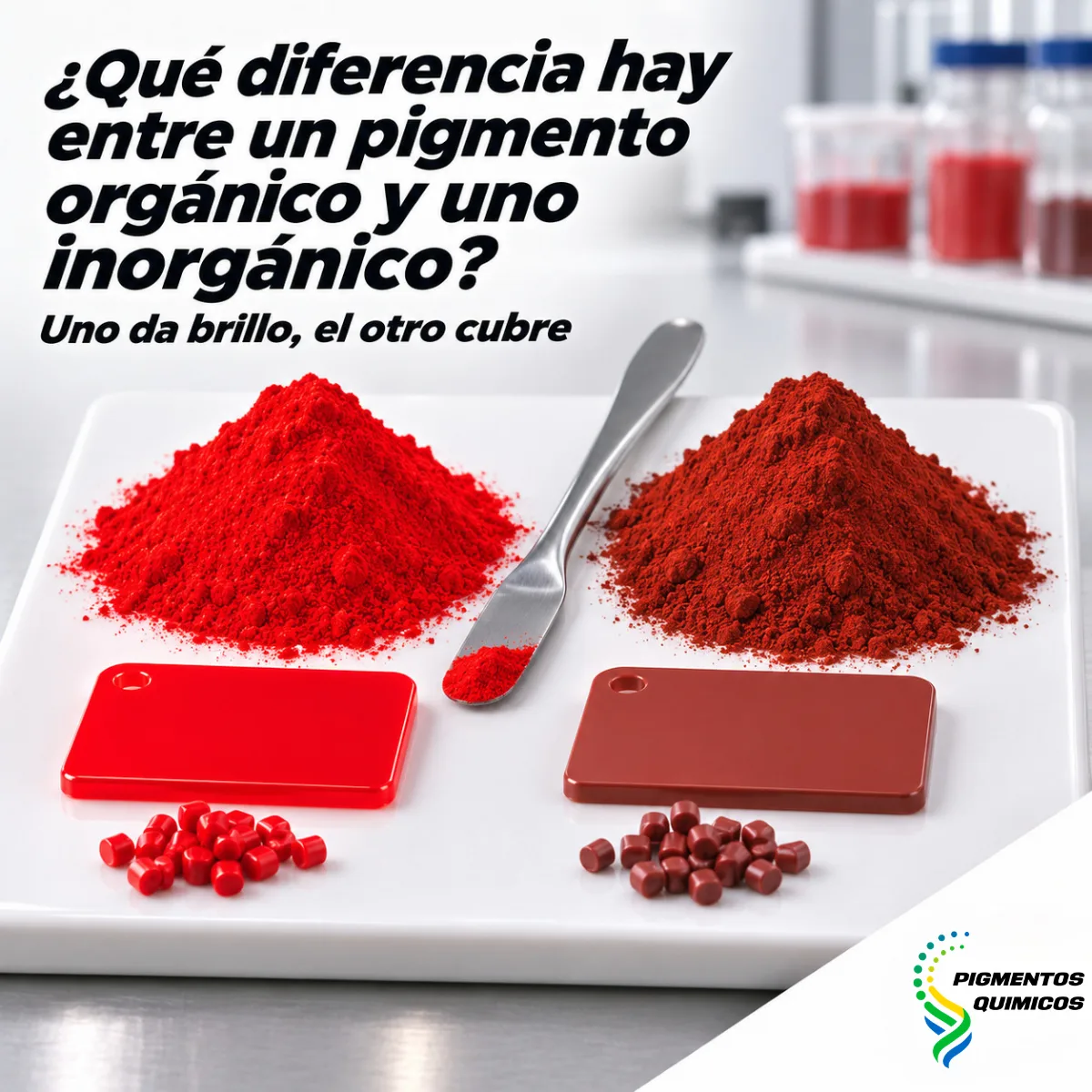
An organic pigment is a carbon-based molecule, and an inorganic pigment is a mineral compound. In plastics, organic pigments give brighter, more intense shades at lower doses, while inorganic pigments cover better and, as a general rule, withstand heat, light and weathering better, with less vivid colors.
Your plant injection molds high-density polyethylene crates for delivery, and your customer asked for a brighter blue to refresh the look of its crates. The previous shade came from an inorganic pigment and looked dull next to the brand's new identity. The supplier proposed a masterbatch with an organic blue, the color plaque was approved on the first try, and the order went into the machine with the same mold, the same temperature and the same cycle.
The next day, the shipping area reported that the crates would not stack. The walls came out slightly curved, the corners did not sit flat and the stacks leaned on the pallet. The color was exact and the part was out of dimension. Your customer rejected the entire lot, and your team spent a week between cooling adjustments and claims to the supplier before understanding that the pigment change had changed the way the plastic shrinks as it cools.
Two different chemistries inside the same color pellet
A color masterbatch is a carrier resin with pigment dispersed in it. That pigment is a solid particle, insoluble in the plastic, that stays suspended in the part and absorbs or reflects light. There are two major pigment families, and each one reaches the pellet with its own behavior regarding heat, light, part shrinkage and health regulations.
Organic pigments, carbon molecules with intense color
Organic pigments are synthesized from carbon-based molecules. In plastics, the most widely used families are azo pigments, which give yellows, oranges and reds, and phthalocyanines, which give very clean blues and greens. Their particles are very fine and absorb light very efficiently. That is why they produce saturated, transparent colors at low doses.
That same fineness has a technical cost. Fine particles tend to agglomerate and require more dispersion energy, and a poorly dispersed organic pigment shows up in the part as specks or streaks of color. Some organics also have a narrow thermal margin and degrade if the barrel temperature or the residence time exceeds what their molecule can withstand.
Inorganic pigments, mineral compounds that cover
Inorganic pigments are mineral compounds, mostly metal oxides and salts. In plastics, the standouts are titanium dioxide, the base of whites and pastel colors; iron oxides, which give reds, yellows and earthy browns; ultramarine blue; and carbon black, which the technical classification groups with the inorganics.
Their particles are larger and have a high refractive index, so they scatter light and hide whatever is behind them. That is where their coverage comes from. Their mineral structure withstands high processing temperatures and solar radiation without breaking down. In exchange, their shades are less saturated and their tinting strength is lower: reaching the same color intensity takes more pigment.
Five differences that decide whether a lot passes or gets rejected
On the plant floor, pigment chemistry translates into five behaviors we review before proposing a formula.
1. Brightness and tinting strength, the organic advantage
Organic pigments win on saturation. A brand red, a safety yellow or an electric blue comes from organic pigments, because most inorganics produce earthier shades. Organics also tint more per gram: with less pigment they reach the same intensity. That efficiency offsets part of their price per kilo, which is generally higher.
2. Opacity, the inorganic advantage
Inorganic pigments win on coverage. Titanium dioxide is the white pigment with the highest hiding power in plastics, and iron oxides also cover well. An opaque color in a thin wall is built on an inorganic base and adjusted with organics to add brightness. If your part is thin and the color must hide the shade of the resin, the share of inorganic pigment in the formula decides the result.
3. Thermal stability against your process profile
Every pigment has a maximum temperature at which it holds its shade during the normal residence time in the barrel. Inorganic oxide pigments withstand the highest temperatures in plastics processing. Among organics the range is wide: some shades work well in polyethylene film at moderate temperature and degrade in an engineering plastic processed much hotter. The shift appears as a duller, browner or yellowish shade, and a higher dose does not correct it.
4. Lightfastness and weather resistance
Ultraviolet (UV) radiation breaks bonds in organic molecules, and a pigment with low lightfastness loses color within a few months in the sun. Inorganic oxide pigments keep their shade for years outdoors. For an outdoor part, the pigment is chosen for its lightfastness and the resin is protected with a UV stabilizer. These are two different protections, and the part needs both.
5. Nucleation-driven warpage in injection-molded parts
This is the effect that caught the plant in the opening by surprise. In high-density polyethylene and polypropylene, some organic pigments, such as certain phthalocyanines, act as nucleating agents and speed up the crystallization of the polymer as it cools. The part shrinks differently in the flow direction and in the cross direction, and it comes out warped. Inorganic oxide pigments have a much smaller effect on crystallization. In crates, caps, pallets and large flat parts, this point is validated on the machine before the color is approved.
What the 26 pigments in our catalog show
At Pigmentos Químicos we publish a pigment catalog with 26 shades for polyethylene and polypropylene. On each data sheet we state whether the pigment is organic or inorganic, its thermal stability and its lightfastness on a scale of 1 to 8. Of those 26 pigments, 19 are organic and 7 are inorganic. The data confirm the general rule and also show its exceptions.
Among the organics, thermal stability ranges from 140 °C for Pigment Red 53:1 to 300 °C for Pigment Yellow 183 and 191, and lightfastness ranges from 3 to 8. Among the inorganics, four of the seven reach 300 °C with a lightfastness of 8: Pigment Red 101, an iron oxide; Pigment Blue 29, ultramarine blue; Pigment Black 7, carbon black; and Pigment White 6, titanium dioxide. The other three inorganics are lead chromates and stay between 190 °C and 210 °C.
The practical conclusion is that the family points the way and the data sheet decides. A high-performance organic yellow withstands more heat than an inorganic chrome yellow, and an economy organic red degrades at a temperature that an iron oxide handles without change. That is why we choose each shade using its data sheet, measured against your processing temperature and your part's exposure.
Heavy metals, the difference the color plaque does not show
Some inorganic pigments contain heavy metals such as lead, hexavalent chromium or cadmium. Lead chromates give bright yellows and oranges with good coverage, which is why they are still used in industrial applications. Those same pigments are excluded from food packaging and from child-contact parts, where regulations limit heavy metals.
For those applications, every pigment, organic or inorganic, is checked against the regulation that applies to your part before it enters the formula. If your part will touch food or end up in a child's hands, tell us in your request, because that condition changes the list of pigments we can use.
Why your color carries both families in the same formula
Most colors in a real product combine pigments from both families. A gray carries titanium dioxide and carbon black. An opaque outdoor green combines a phthalocyanine green with titanium dioxide for coverage. A brand red in a thin wall starts from an organic red and adds an inorganic base that gives it coverage. Each pigment contributes what the other family cannot, and the ratio between them defines the shade, opacity, stability and cost.
That blend has a direct consequence: the weakest pigment in the formula sets the limit. If a green carries a 200 °C organic pigment alongside a 300 °C inorganic one, the whole color works within the 200 °C limit. The same applies to lightfastness and to health regulations.
What to define before you request your color
With these five answers we choose the right pigment combination for your part:
- 1. The resin and the maximum temperature of your process, with the actual residence time in the barrel.
- 2. Whether the part will be exposed to the sun and how long it must keep its color.
- 3. The wall thickness and the level of opacity you need.
- 4. Whether the part will touch food, medicines or children's hands.
- 5. Whether the part is flat, large or has tight tolerances, where pigment-driven warpage is a risk.
With that information we propose the shade, validate the sample under your process conditions and document the pigments in the formula. For development masterbatch we start with a free 1 kg sample so you can validate it on your line before the first order, which starts at 100 kg.
The difference between an organic and an inorganic pigment shows in brightness, coverage, thermal stability, lightfastness, part dimensions and the regulations that apply. At Pigmentos Químicos we combine both families according to each shade's data sheet and the real conditions of your process. Tell us your resin, your processing temperature and how your part will be used, and we will propose the color masterbatch that performs on the machine and in the market.
Frequently asked questions
Is an organic pigment less resistant than an inorganic one?
As a family, inorganic oxide pigments withstand more heat and more sun. High-performance organics reach comparable levels: in our catalog, Pigment Yellow 183 withstands 300 °C with a lightfastness of 8, the same as titanium dioxide. The resistance of each shade is confirmed on its technical data sheet.
Why does a color with inorganic pigment need a higher dose?
An inorganic pigment has less tinting strength than an organic one, so the formula needs more pigment to reach the same color intensity. In exchange, that pigment adds coverage and stability. The final masterbatch dosage, which ranges from 1 to 4% in our products, is defined with the complete formula, your resin and your part's thickness.
Can I replace an inorganic pigment with an organic one without changing my process?
You can if you first validate three points: that the organic pigment withstands your temperature and residence time, that the part keeps its dimensions in polyethylene or polypropylene, and that coverage still holds at your wall thickness. A machine trial with the development sample answers all three before you commit to an order.
Related articles
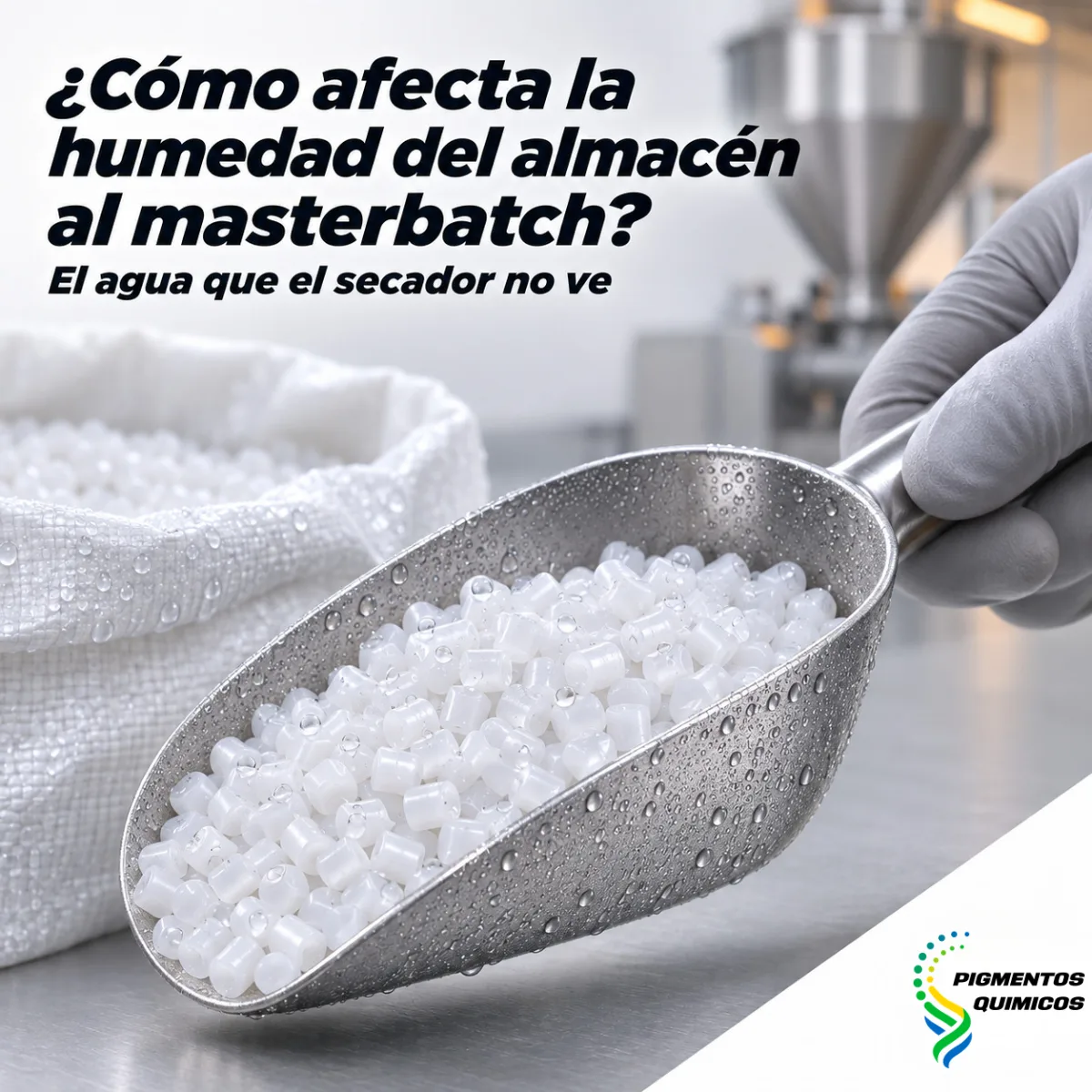
How Does Warehouse Humidity Affect Masterbatch?
Warehouse humidity damages your masterbatch in ways your dryer does not reach. Learn which ones they are and five practices that prevent them.
What Is the Carrier in a Masterbatch?
The carrier is the resin that forms the base of every masterbatch pellet. Learn what it does in your barrel and what it leaves in your part.

What Are Biodegradable Plastics?
A biodegradable plastic turns into water, carbon dioxide and biomass under defined conditions. Learn the resin families and how to process and color them.