
The Opacity Headache: How to Achieve Perfect Coverage in Thin-Wall Plastics
Thinner walls mean greater challenges for uniform coverage. Learn the pigment, dosing, and dispersion variables that determine opacity in thin-wall plastics.
The Opacity Headache: How to Achieve Perfect Coverage in Thin-Wall Plastics
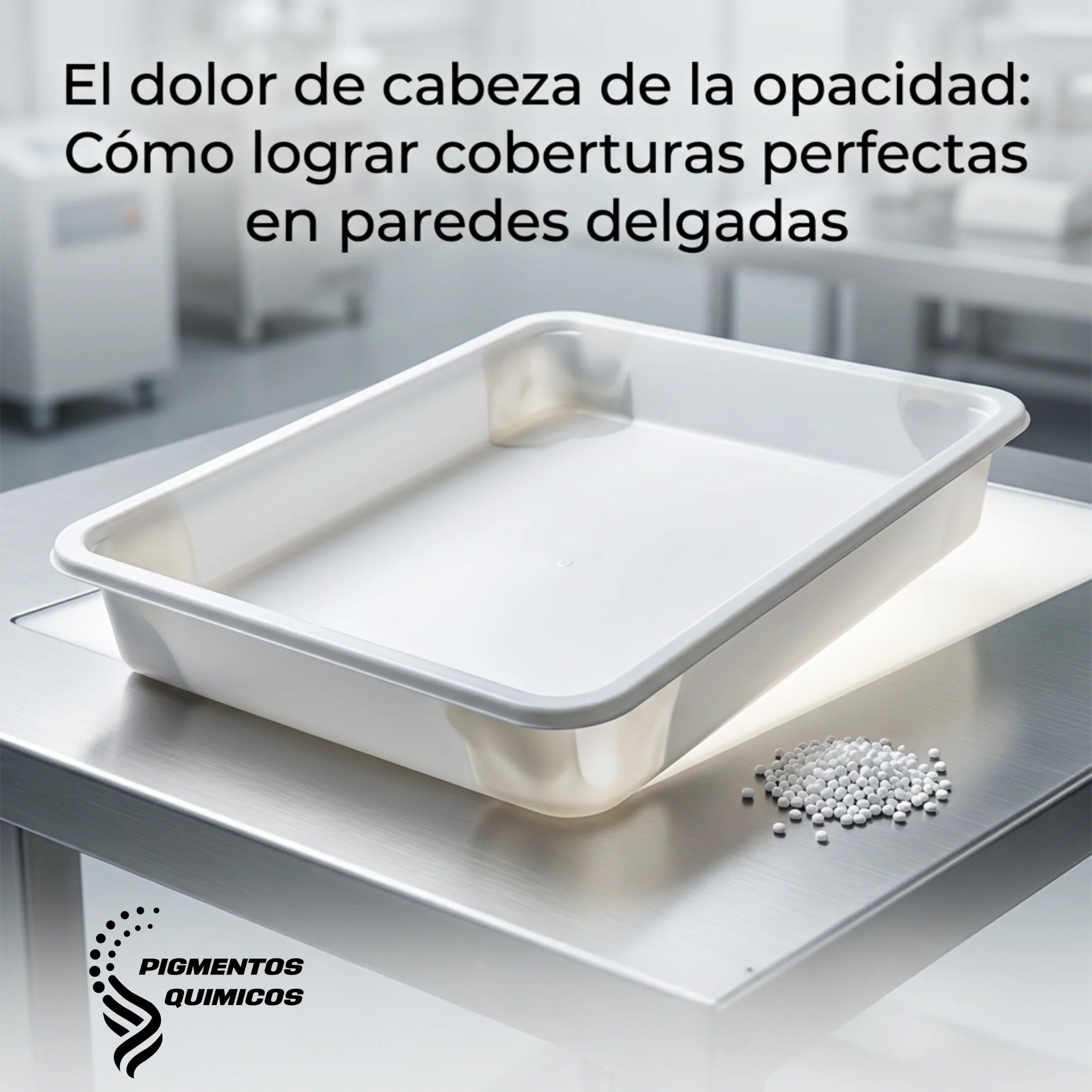
Thinner walls mean greater challenges for uniform coverage. The optical performance of a thin-wall plastic part depends on four interacting variables: pigment type (hiding power), particle size and dispersion quality, let-down ratio, and the optical properties of the base resin. Adjusting one without considering the others produces inconsistent results.
The trend toward wall thickness reduction — driven by material cost, weight, and sustainability targets — is accelerating in packaging, automotive, and consumer goods. Each reduction in wall thickness imposes a greater demand on the colorant system to deliver consistent opacity and hiding power in less material volume.
What Determines Opacity in a Plastic Part
Opacity in plastics is determined by the ability of the pigment system to scatter and absorb light before it passes through the material. Two mechanisms contribute: scattering (light deflection, which creates the white or opaque appearance) and absorption (light capture, which creates color depth). The ratio between these mechanisms — the scattering coefficient S and the absorption coefficient K — defines the tinting strength and hiding power of the colorant system according to Kubelka-Munk theory.
Titanium dioxide (TiO2) is the dominant hiding pigment because it has the highest refractive index of any white pigment (n ≈ 2.7 for rutile grade), maximizing light scattering. The optical efficiency of TiO2 peaks at a particle size of 200–250 nm — below or above this optimal size, scattering efficiency decreases significantly. This makes TiO2 dispersion quality critical: agglomerates of TiO2 > 1 μm scatter light far less efficiently than the same mass of well-dispersed 200 nm particles.
The Wall Thickness Problem
In a 3 mm wall, there is sufficient material depth for multiple light scattering events, producing good opacity even at moderate TiO2 concentrations (3–5%). In a 0.5 mm wall, the number of scattering events is proportionally reduced, and the light transmission through the part can increase by 5–8× compared to a 3 mm wall at the same pigment concentration. Simply increasing the TiO2 dosage to compensate is not linearly effective — above a critical concentration, TiO2 particles begin to crowd and interfere with each other's scattering efficiency (optical crowding), reducing the return on additional pigment.
The correct approach for thin-wall opacity is a multi-variable optimization: selecting TiO2 with the optimal particle size distribution for the processing conditions, ensuring maximum dispersion quality in the masterbatch, and specifying the let-down ratio based on optical simulation (Kubelka-Munk calculation) rather than empirical trial and error.
Resin Optical Properties and Their Effect on Opacity
The base resin's refractive index and crystallinity affect how TiO2 performs in the final part. Polypropylene (PP), with its semi-crystalline structure, creates internal interfaces that contribute to light scattering independent of the pigment — this 'natural turbidity' of PP makes it easier to achieve opacity with less TiO2 compared to amorphous resins like PETG or PS, which are inherently transparent. In transparent base resins, the entire opacity burden falls on the pigment system, requiring higher TiO2 concentrations and stricter dispersion control.
Measuring Opacity: Hiding Power and Contrast Ratio
Opacity is quantified by the contrast ratio (CR): the luminous reflectance of the part placed over a black background divided by the reflectance over a white background. A CR of 0.98 or above means 98% opacity — less than 2% of light passes through. Food packaging typically requires CR > 0.95; cosmetics packaging requires CR > 0.98; pharmaceutical blister packs may require CR > 0.99.
Measuring hiding power on production parts requires a spectrophotometer with a black/white backing tile standard. Visual assessment of opacity against a light source is not sufficiently accurate for specification purposes — a part that 'looks opaque' visually may fail the contrast ratio specification when measured. Requesting hiding power data from your masterbatch supplier for the specific wall thickness and resin is the correct approach before finalizing the formulation.
Frequently Asked Questions (FAQ)
Why does my white part look different in UV light versus regular light?
Fluorescent whitening agents (optical brighteners, OBAs) absorb UV radiation and re-emit it as visible blue-white light, making the part appear brighter and 'whiter' than its actual reflectance. Parts with OBAs look dramatically different under UV-rich illumination (daylight, UV lamps) versus incandescent light. If your white parts must be consistent under all lighting conditions, specify a formulation without OBAs and achieve whiteness through TiO2 concentration and particle size optimization alone.
Can I achieve opacity in thin walls without increasing TiO2 beyond the standard dosage?
Yes, by improving dispersion quality. A masterbatch with better TiO2 dispersion — smaller agglomerate size, more uniform particle distribution — delivers 15–25% more hiding power per kilogram of TiO2 compared to a poorly dispersed masterbatch at the same TiO2 concentration. Upgrading the masterbatch quality is almost always more cost-effective than increasing the TiO2 dosage, because TiO2 is a high-cost raw material and dispersion quality improvements do not add proportional cost.
What is the maximum practical TiO2 concentration in a masterbatch?
Standard white masterbatches contain 50–70% TiO2 by weight. Above 70%, the carrier resin is insufficient to fully wet and encapsulate the TiO2 particles, leading to dispersion problems during letdown into the base resin. High-concentration masterbatches (65–70% TiO2) are used specifically for thin-wall applications where the let-down ratio must be minimized to maintain resin properties — but they require higher-quality processing equipment and more careful handling.