

Why Can a Color Approved by Eye Get Rejected in Quality Control?
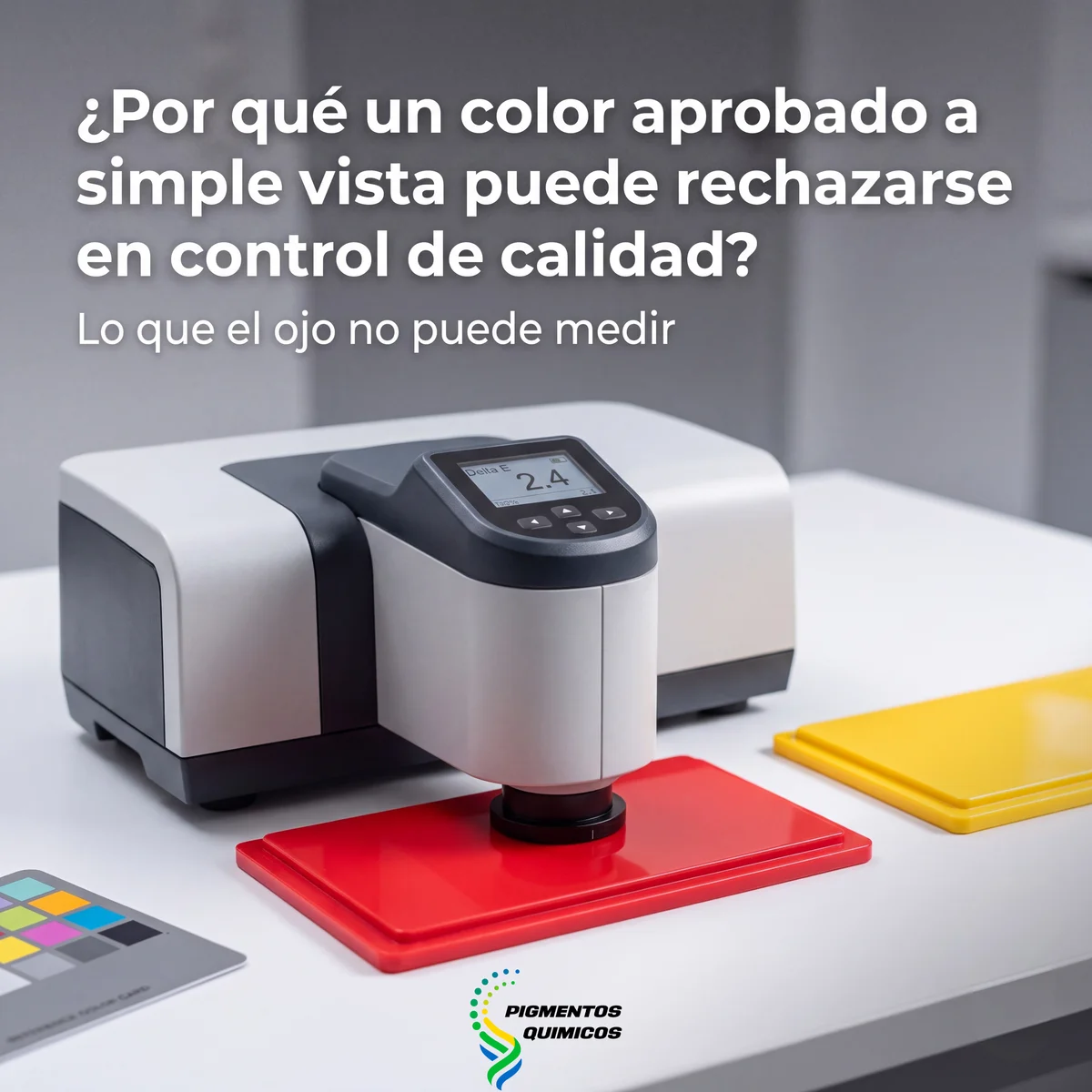
The human eye judges color inconsistently; a spectrophotometer measures it with Delta E, an objective number. That gap is why a color approved by eye can still get rejected in the lab.
The shift supervisor compared the freshly molded part to the reference sample under the plant's lighting and gave the go-ahead to continue production. Two hours later, the quality control lab measured the same part with a spectrophotometer and rejected it: the Delta E between the part and the reference exceeded the tolerance set by the client. They stopped the line, with several boxes of the rejected batch already produced, because the human eye had approved something the instrument couldn't accept.
The human eye detects color differences in a relative and variable way, depending on visual fatigue, ambient light, and the person observing. A spectrophotometer measures color objectively and numerically through Delta E, and can detect a real difference the human eye doesn't perceive as significant.
Why the human eye isn't a reliable measuring instrument
The human eye is an extraordinary instrument for many tasks, but it wasn't designed to measure color objectively and repeatably. Different people, and even the same person at different times of day, can perceive the same color slightly differently.
Color perception varies between people and throughout the day
Visual fatigue after several hours on shift, the eye's adaptation to ambient light, and even normal physiological differences between people affect how a color is perceived. Two different supervisors can reach different verdicts on the same part, without either one being wrong from their own perception.
Small color differences can go unnoticed by eye
A color difference that technically exceeds the tolerance set by the client can be imperceptible to the human eye under certain lighting conditions, especially in dark colors or finishes that scatter light in particular ways. That difference, imperceptible by eye, is still a real difference when measured instrumentally.
What a spectrophotometer actually measures, and what Delta E is
A spectrophotometer measures the amount of light a surface reflects at different wavelengths, and converts that measurement into numerical, comparable color coordinates.
Delta E translates the color difference into an objective number
Delta E is the numerical value that summarizes how different a color sample is from its reference, calculated from the color coordinates measured by the instrument. The lower the Delta E, the closer the sample is to the reference; the higher it is, the greater the real difference between the two colors.
Every industry and every client defines its own Delta E tolerance
There is no universal Delta E acceptable across the entire industry. Each client, based on how demanding their final product is and how it will be used, defines their own maximum tolerance before accepting a batch. The same Delta E can be perfectly acceptable for one application and grounds for automatic rejection for another, depending on how visible and how critical the color is to the finished product.
What happens when visual approval and instrumental measurement don't match
When visual approval in the plant doesn't match the quality control lab's instrumental measurement, the result is usually a partially produced batch that now has to be stopped or reprocessed.
The batch keeps moving through production before instrumental validation
If the plant's protocol allows production to continue with only the shift supervisor's visual approval, the batch keeps being produced while the sample travels to the lab for formal measurement. That window of time is exactly where the risk accumulates: by the time the lab rejects the sample, parts or boxes have already been produced under a color that doesn't meet tolerance. The longer that result takes to get back to the plant, the more parts pile up under the same error.
The cost of stopping the line after producing several boxes
Stopping the line after several boxes of the batch have already been produced means material, machine time, and labor hours invested in product that now has to be reprocessed or scrapped. That cost is avoidable if instrumental validation happens before authorizing full production to proceed, not after.
How to avoid late rejection in quality control
Reducing the risk of late rejection depends on changing the order in which validation happens, not on improving the shift supervisor's eyesight.
Measure with a spectrophotometer before giving the go-ahead for production
Measuring the first part or the first few parts of the run with a spectrophotometer, before authorizing full production to proceed, lets you catch an out-of-tolerance Delta E while the process can still be adjusted at minimal cost, instead of after an entire batch has been produced.
Define the Delta E tolerance with the client before starting the batch
Confirming in writing the Delta E tolerance the client requires, before starting the batch, keeps the approval criteria from being left open to interpretation between the plant supervisor and the client's quality control lab. That tolerance should be the same reference point for both sides of the process.
What changes when instrumental validation comes first
Moving instrumental measurement up to the start of the run changes the nature of the risk the plant takes on with every new batch.
Formula adjustment costs less when it happens before full volume
Adjusting the dosage or color formula when only a test part has been produced costs a fraction of what it costs to adjust after dozens or hundreds of parts have already been made under the same error. That cost difference is the main reason moving instrumental measurement up pays for itself the first time it prevents a late rejection.
At Pigmentos Químicos we support color development and instrumental validation from the start of the project, so the Delta E tolerance is defined before production, not discovered after a rejection. Get in touch about your case at https://pigmentosquimicos.com
Frequently asked questions
How reliable is visual approval when done by an experienced person?
Experience improves the ability to detect obvious color differences, but it doesn't eliminate the natural variability of human perception when it comes to small differences. Visual approval is still useful as a first filter, but it doesn't replace instrumental measurement before a full batch.
What Delta E is considered an acceptable color difference?
It depends on the application and the client. Some industries require very strict tolerances for products visible to the end consumer, while internal applications or less visible parts usually accept a wider range. That tolerance should always be confirmed with the client before production.
Do all spectrophotometers give the same Delta E reading?
Properly calibrated instruments with the same measurement geometry should give consistent readings with each other. Differences in calibration, instrument geometry, or measurement conditions can create variations that are worth checking when two different labs measure the same sample.