
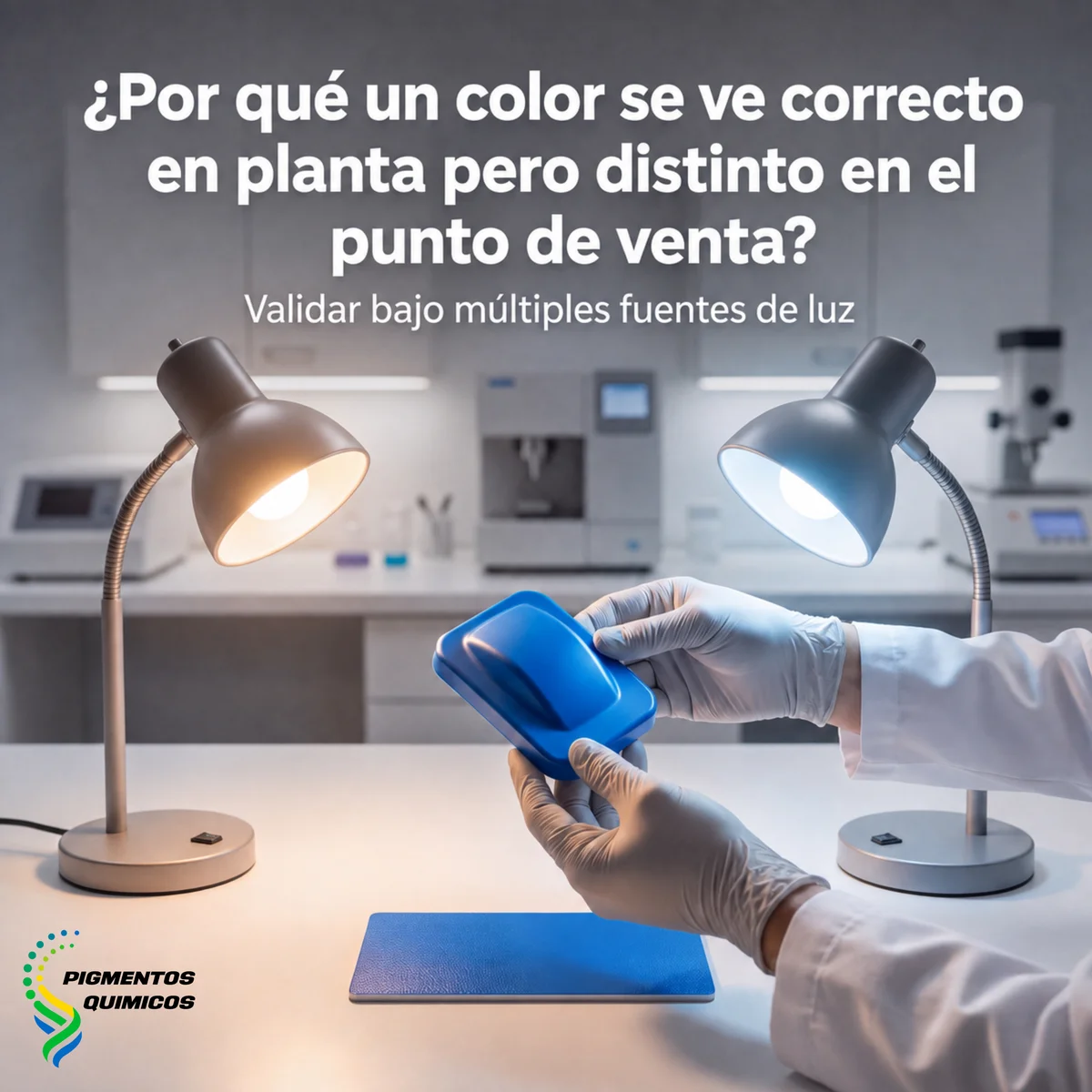
Why Does a Color Look Correct in the Plant but Different at the Point of Sale?
Two colors can look identical under the plant's light booth and different under the point of sale's lighting. That is metamerism, and validating under a single light source won't catch it.
The quality manager at a household plastic goods company approved a full batch of product under the plant's standard light booth. The color matched the reference sample perfectly. Two weeks later, the buyer at a department store chain rejected the same batch because, under the sales floor's LED lighting, the color looked visibly different from the sample they had originally approved. The material hadn't changed between the plant and the store. The light had.
The phenomenon is called metamerism: two colors can look identical under one type of light and different under another, because their pigment composition absorbs and reflects light differently depending on the source. At the point of sale, where lighting shifts from LED to natural light several times a day, that phenomenon becomes critical.
Why approval in the plant doesn't guarantee approval at the point of sale
A light booth in the plant reproduces controlled conditions, usually a single standard source, which confirms whether the color matches the reference under that specific light. The point of sale rarely has a single light source: it combines LED, natural light from display windows, and sometimes residual fluorescent light from older areas of the store.
The standard light booth doesn't reproduce a store's real lighting
Approval under a light booth confirms the color meets spec under that controlled condition, but it guarantees nothing about how it will behave under the real mix of lighting on a sales floor. That gap between controlled condition and real condition is exactly where metamerism shows up.
Two different pigment formulations can look the same under a single light source
It's possible to formulate a color with a pigment combination different from the original formula and have it look identical to the naked eye under the light booth. That match under a single light source doesn't mean both formulas have the same spectral behavior, and that difference shows up as soon as the lighting source changes.
What metamerism is and why it happens
Metamerism describes the phenomenon where two colors appear to match under one light source and look different under another, even though the human eye can't anticipate that difference without a specific test.
Each pigment reflects light differently based on its chemical composition
Every pigment has its own spectral reflectance curve: the proportion of light it reflects at each wavelength. Two pigment formulations can share the same visual result under a light source that emphasizes certain wavelengths, and separate visually under a different source that emphasizes different wavelengths.
Two color formulas can match under one light and diverge under another
This happens more often when two color formulas use different pigment combinations to reach the same apparent shade. The more different the pigment composition between the reference formula and the production formula, the higher the risk that metamerism will show up when the lighting condition changes.
How to validate a color so it holds up across different point-of-sale conditions
Validating a color for the point of sale requires going beyond visual approval under a single light source.
Validation under multiple light sources, not just one
The correct protocol validates the color under at least two or three different light sources that represent the real conditions of the point of sale: LED light, natural light, and, if applicable, fluorescent light. A color that matches the reference under all three conditions carries a much lower risk of rejection in-store.
Formulating with pigments that have a more stable spectral profile
Some pigments have a more stable spectral profile across different light sources than others, even when reaching the same apparent shade. Choosing that pigment combination from the color development stage reduces the risk of metamerism before the product reaches production.
What to ask your masterbatch supplier before approving a color for retail
Before approving a color destined for retail, there's specific information your masterbatch supplier should be able to provide.
Request validation under the point of sale's real lighting type
Ask for the color validation to be done under the type of lighting you'll actually find at your client's point of sale, not just under the lab's standard light booth source. That information is usually available if you ask the retail team or the buyer directly.
Ask for the metamerism index report, not just visual approval
An instrumental report that includes the metamerism index between the reference formula and the production formula gives an objective measure of the risk, beyond one person's visual approval under one light. That report is the difference between approving a color with evidence and approving it based on luck.
The cost of a point-of-sale rejection after plant approval
A point-of-sale rejection after the batch already left the plant approved carries a cost that goes beyond the returned material.
Product already manufactured, packaged, and shipped that comes back unsold
When the rejection happens in-store, the product has already gone through the entire production, packaging, and logistics process. That product returns to origin unable to be sold through the channel it was made for, and reformulating the color means repeating a good part of that process starting from batch development.
The damage to the commercial relationship with the chain's buyer
Beyond the direct cost of the material, a repeated color rejection affects the chain buyer's confidence in the company's ability to control its own process. That confidence takes time to rebuild, and it tends to weigh on the next volume or delivery-time negotiation.
At Pigmentos Químicos we formulate and validate color accounting for the real conditions where your product will be displayed, not just a lab's controlled condition. If your company has already had a color rejection at the point of sale after plant approval, we can review with you which part of the validation protocol was missing. Get in touch about your case at https://pigmentosquimicos.com
Frequently asked questions
Is metamerism a pigment defect or a normal phenomenon?
It's a normal physical phenomenon, not a manufacturing defect. It occurs whenever two colors with different pigment compositions reach a similar apparent shade under a specific light source.
What type of lighting is more likely to reveal metamerism?
The shift between LED light and natural light tends to reveal more metamerism than the shift between two similar artificial sources, because the spectrum of natural light covers a broader range of wavelengths than most artificial sources.
Can the risk of metamerism in a color be eliminated completely?
It can be reduced significantly by formulating with pigments whose spectral profile is similar to the reference and validating under multiple light sources, but eliminating it completely depends on how similar the pigment composition is between both formulas.