
Why Do Bubbles Appear in Nylon Parts with Fiberglass?
Bubbles in Nylon parts with fiberglass almost always come from residual moisture in the resin, not from the masterbatch: Nylon is a hygroscopic material.
A Nylon part with fiberglass comes out of the mold with a surface full of tiny bubbles, right in the batch where a new color was introduced for the first time. The first suspect, almost by reflex, is the masterbatch: the color changed and the bubbles showed up, so the color must be to blame. The quality team stops the line to review the color formulation while the real source of the problem, resin that wasn't dried enough before processing, keeps absorbing moisture from the air in the hopper.
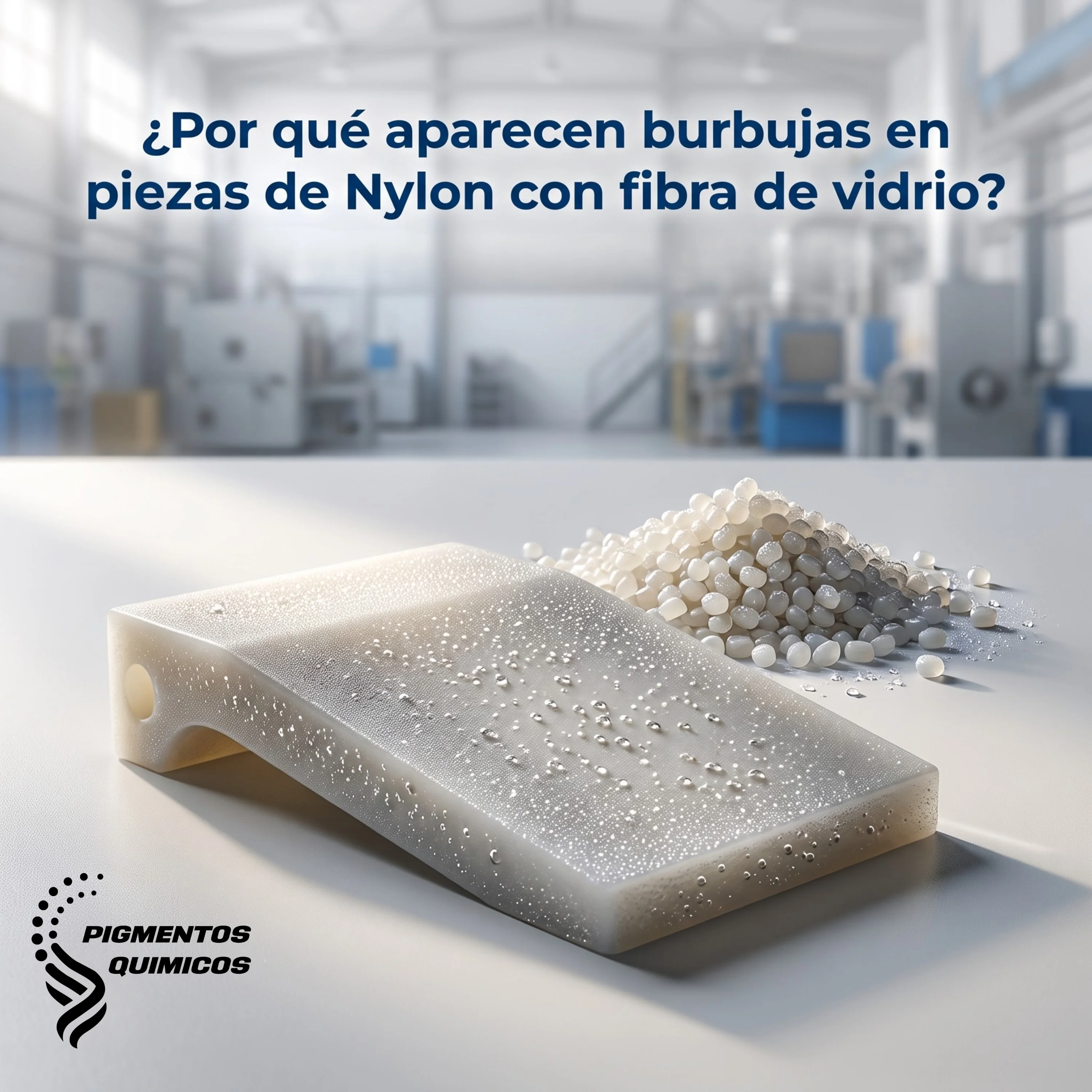
Bubbles in Nylon parts with fiberglass almost always originate from residual moisture in the resin, not from the masterbatch: Nylon is a hygroscopic material that absorbs water from the environment, and that water turns into vapor during processing.
The origin of the bubbles: it's almost never the color
When a part comes out with bubbles right after a new color is introduced, the coincidence makes the masterbatch the first suspect. But Nylon is hygroscopic by nature: it absorbs moisture from the air even during the time it sits in the hopper before entering the process. If that moisture isn't removed through proper drying, it turns into vapor when exposed to processing temperature, and that vapor gets trapped inside the part as a bubble.
Moisture in the Nylon as the main suspect
Nylon with fiberglass requires a specific drying time and temperature before processing, precisely because of its tendency to absorb moisture. When drying gets shortened to meet a delivery deadline, or when the resin stays exposed to the environment after drying, residual moisture remains available to generate bubbles as soon as the part is subjected to processing temperature.
Checking the drying process before questioning the pigment
Before switching color suppliers, confirm the drying time and temperature applied to that specific resin batch, and compare it against the resin manufacturer's specification. If drying didn't meet the parameter, that's the most likely origin of the problem, regardless of which color was used.
What visual pattern tells a moisture bubble apart from a dispersion defect
Moisture bubbles tend to spread out across the whole part, with no relation to the material flow path. A real masterbatch dispersion defect usually shows up as streaks or concentrated spots of color, a visually distinct pattern from a trapped vapor bubble.
What your masterbatch should guarantee so it doesn't add to the problem
Even though moisture is the most frequent cause, a masterbatch with poorly controlled moisture content of its own can also add extra bubbles to the process. At Pigmentos Químicos we control the moisture of every masterbatch batch before shipping it, so color is never an additional variable when your team is diagnosing a bubble problem in Nylon with fiberglass.
Frequently asked questions
How long should Nylon with fiberglass be dried before processing it?
It depends on that specific resin's manufacturer specification; always confirm the exact parameter with your resin supplier, because it varies by grade and fiberglass percentage.
Can masterbatch cause bubbles even if drying was correct?
It's uncommon, but it can happen if the masterbatch itself has high moisture content. That's why it's worth validating both factors, resin drying and masterbatch moisture, instead of assuming only one.
Do bubbles affect the part's mechanical strength?
Yes, an internal bubble represents a stress concentration point that can compromise the part's strength, especially in applications where fiberglass was chosen specifically to provide greater structural resistance.