
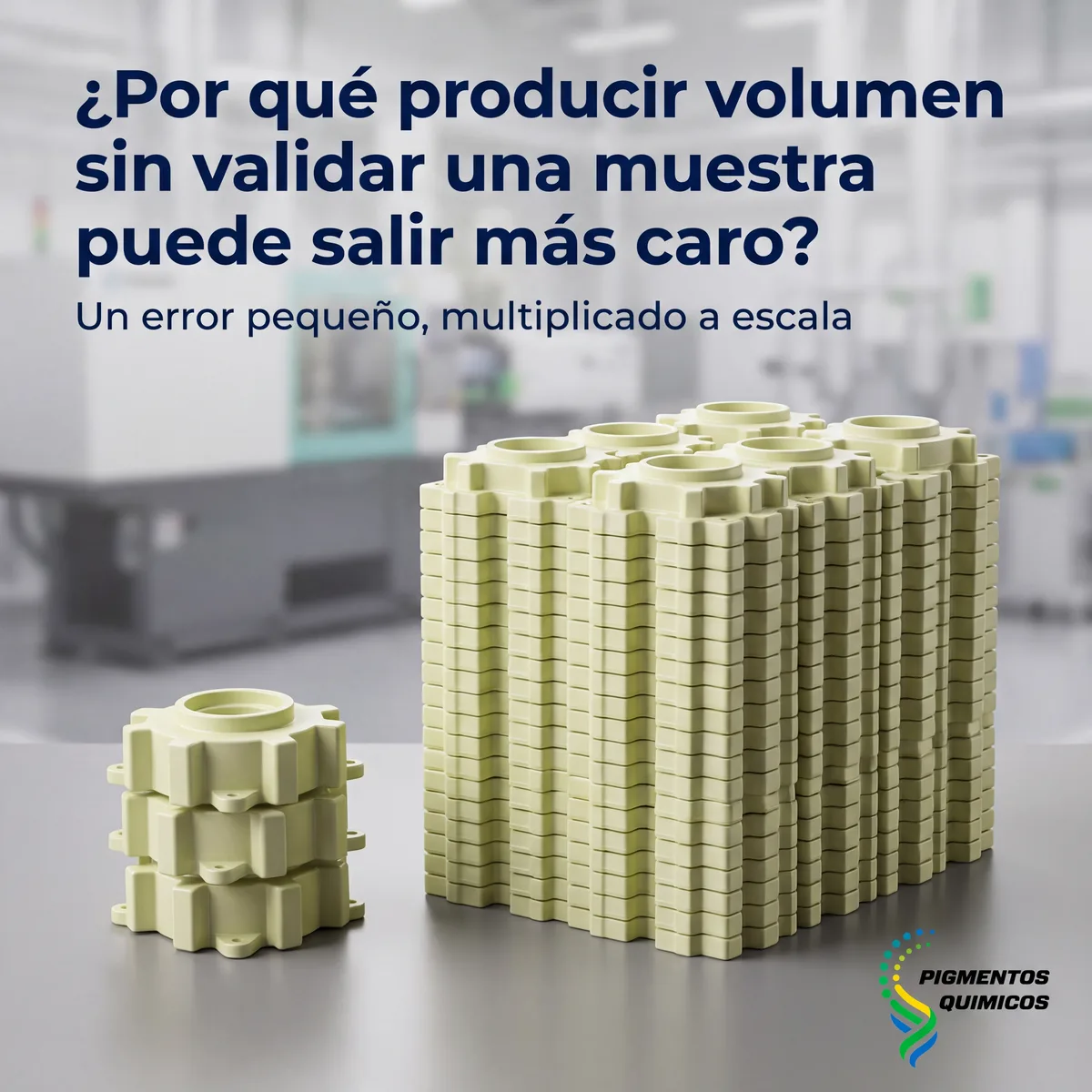
Why Can Producing Volume Without Validating a Sample Cost You More?
Skipping sample validation spreads any formulation error across the whole order. Reprocessing a batch costs far more than the time the shortcut saves.
Your plant approves a color formula internally without going through the supplier's sample validation, because the order is urgent and the client already confirmed a delivery date. The full batch ships with a shade variation that looks minor at a glance. When the client receives the finished product, the color difference between parts from the same order is obvious under their inspection light, and the entire volume gets held for reprocessing. What you were going to save in validation time turns into the cost of reprocessing or scrapping thousands of kilos of material that's already been transformed.
Skipping sample validation amplifies any formulation error across the entire order volume. The cost of reprocessing or scrapping a full batch far outweighs the time saved by skipping that upfront validation.
The delivery pressure that pushes your plant to skip a step that looks optional
At Pigmentos Químicos we've worked with masterbatch buyers who face the same dilemma: the end client is pushing for a delivery date, the production area has the line available that week, and sample validation gets treated as paperwork that can be shortened without serious consequences. That decision, made under calendar pressure, is the one that most often ends up generating the highest cost in the entire color purchasing process.
Sample validation exists precisely because a masterbatch formula behaves differently depending on the base resin, the extrusion or injection equipment, process temperature, and even the geometry of the final part. A lab sample approved under controlled conditions doesn't automatically guarantee the same result on your production line, with your machinery and your actual operating conditions. That's why a pilot sample run under your own plant conditions is the filter that catches any deviation before committing the full order volume.
What amplifies a formulation error when you skip that filter
When your plant authorizes producing the full volume without first running a pilot sample under your own conditions, any formulation deviation stops being a contained problem and becomes a scale problem. An error that in a sample of a few kilos would have meant adjusting the colorant dosing, in a full production batch means reprocessing tons of material, with the energy, labor, and line-time cost that involves.
Dispersion and dosing: the two mechanisms that fail without warning
The two technical mechanisms that most often generate this deviation are pigment dispersion in the carrier resin and dosing accuracy in your production equipment. Dispersion depends on the compatibility between the masterbatch's carrier resin and your base resin, and a wide gap in melt flow index between the two can create irregular color spots that are only detected once the material has already been transformed, not on the pigment's technical data sheet. Dosing, for its part, depends on the calibration of your volumetric or gravimetric feeder, and an incorrect setting can go completely unnoticed in a small sample, yet produce a cumulative, visible shade variation once it holds through an entire production run.
The pilot sample is the only point in the process where these two mechanisms can be observed under your plant's real conditions before committing the full volume. Without that step, your quality team discovers the problem only after the finished product has already gone through the entire line, and by then the fix is no longer a dosing adjustment: it's a full reprocess.
The real cost of reprocessing a batch versus the cost of validating a sample
The math rarely favors skipping validation. The time it takes to run a pilot sample on your line, generally somewhere between a few hours and one production shift, is minimal compared to the cost of stopping the entire line for cleaning and recalibration, the material scrapped or degraded by reprocessing, and the sales time your team spends explaining to the client why the order is delayed. On top of that comes the reputational cost: a client who receives a batch with visible color variation starts demanding additional validations on every future order, which permanently lengthens your sales cycle.
For a masterbatch buyer, the right operational question before authorizing the full volume is whether the pilot sample ran under your plant's real conditions, with your machinery and your base resin, and not only in the supplier's lab. That distinction determines whether the validation actually reduced risk or just checked a box on paper.
What a sample validation that actually reduces risk should include
An effective sample validation runs the masterbatch on the same equipment, with the same base resin, and within a temperature range equivalent to the one you'll use in the full production run. It also includes reviewing the color under the same inspection light source your client uses, because a shade that looks correct under plant lighting can show a perceptible difference under the light your client uses in their own quality control. At Pigmentos Químicos we work alongside your technical team during this stage, precisely so the sample that gets approved is representative of the volume you'll produce afterward.
How to protect your production volume without sacrificing delivery time
Sample validation doesn't have to be the step that delays your order if it's planned from the initial quotation. When your purchasing team requests the pilot sample at the same time it negotiates commercial terms and delivery times, validation runs in parallel with other stages of the process, instead of becoming an extra step at the end. That early planning is the difference between a production run that starts with the formulation already confirmed and one that starts with an unassessed risk.
Our operational recommendation for your plant is simple: never authorize the full volume of a masterbatch order without first running a pilot sample under your own production conditions. The time you invest in that validation protects your entire production run, your commercial relationship with the end client, and the real cost of every kilo of material you transform.
The factor most plants overlook: part geometry
Beyond base resin and machinery, there's a third factor that can alter the color result between the sample and the full volume: the geometry of the final part. A thin wall, a variable thickness, or a restricted flow zone inside the mold can create differences in temperature and material residence time inside the equipment, which in turn affects how the pigment disperses and how the color is perceived on the finished surface. A pilot sample run on a part different from the one you're ultimately going to produce can pass approval without issue and still show variation once it moves to the order's real geometry.
That's why, when your plant works with complex-geometry parts or non-uniform wall thickness, it's worth running the pilot sample directly on the mold or die that will be used in the full production run, rather than on a generic lab test specimen. That difference, which looks like a minor detail at the quotation stage, is frequently the real cause behind a batch that passed the sample stage and failed at volume.
Recording the validation: the backing that protects your plant against any claim
A sample validation that isn't documented loses much of its value if a discrepancy with the client comes up later. Recording the process parameters used during the pilot sample (temperature, dosing speed, base resin batch, and equipment conditions) lets you compare those conditions against the full volume's when something doesn't turn out as expected, and quickly determine whether the deviation comes from the formulation, the process, or a change in raw material. At Pigmentos Químicos we deliver that record along with every validated pilot sample, so your quality team has full technical backing from the very first moment.
Your masterbatch supplier's role at this stage
Sample validation works better when your masterbatch supplier is actively involved in the process, instead of just shipping the product and waiting for sign-off. A supplier who reviews pilot sample results with you, adjusts the formulation when a deviation shows up, and documents every iteration, reduces the number of test cycles needed before approving the full volume. For your plant, that translates into less total time invested in validation, not more, because every adjustment is made with precise information instead of repeating the whole process blindly.
At Pigmentos Químicos, our technical team works alongside yours through this stage, from the first sample to the final color approval, because we understand validation is an investment that protects your production run, your relationship with the end client, and your plant's technical reputation. Get in touch about your case at https://pigmentosquimicos.com
Frequently asked questions
How long does it take to validate a masterbatch sample before producing the full volume?
It depends on the formula's complexity and the transformation process, but in most cases a pilot sample can be run and evaluated within one production shift, a minimal amount of time compared to the cost of reprocessing a full batch.
What if my supplier already validated the formula in their own lab?
The supplier's lab validation confirms the formulation is viable, but it doesn't replace a pilot sample on your own line, because your base resin, your machinery, and your process conditions can produce a different result than the lab's.
How do I know if a batch's color variation comes from dispersion or dosing?
An irregular color variation within the same part usually points to a pigment dispersion problem in the resin, while a constant, progressive shade variation across the production run usually points to a dosing calibration problem.