
What Are the Sustainability Trends in the Plastics Industry?
Five sustainability trends already appear in your customers' specifications. Learn how each one changes your color and your additives.
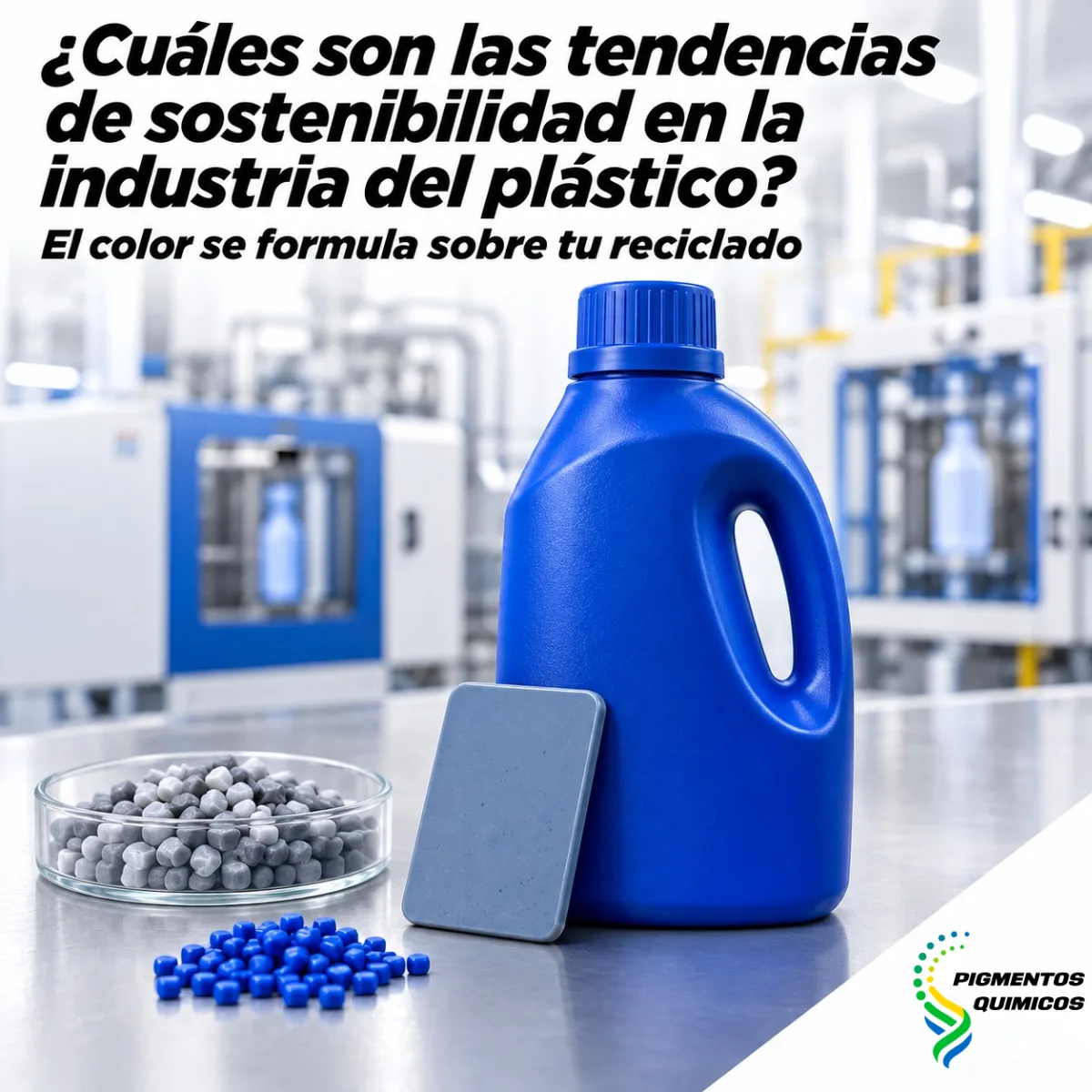
Your plant has been blow molding high-density polyethylene bottles for a household cleaning brand for eight years. At the last annual meeting, that brand's packaging manager handed you its new policy: starting next cycle, every bottle must contain a significant share of post-consumer recycled resin, be made of a single material so it is easier to recycle, weigh less than the current one and carry a validated recyclability symbol. Your team bought recycled resin from a local supplier, loaded the usual blue masterbatch and started the first trial production.
The bottles came out a grayish blue that shifted from one resin lot to the next, with black specks in the wall and a wall so thin that the bottle went oval when filled. The customer rejected all three trials and, at the fourth meeting, told you that a competitor had already delivered bottles within specification. You lost an account that represented a third of your installed capacity over a change that had been announced a year in advance.
Five sustainability trends already appear in your customers' specifications. Recycled content, design for recycling, less material, certified biodegradables and producer responsibility; each one changes your color and your additives.
Post-consumer recycled resin and the color that changes with every lot
The trend that carries the most weight in brand specifications is the content of post-consumer recycled resin. Large consumer goods companies have published targets for recycled material in their packaging, and those targets travel down the supply chain to the processor as a mandatory percentage per container. Meeting them requires solving two problems that virgin resin never posed.
A variable base tone that no stock color can offset on its own
Recycled resin arrives with a gray, yellowish or greenish base tone, depending on the containers it came from, and that tone changes from one lot to the next. A masterbatch formulated for virgin resin produces a dull color on that base, different in every production, like the grayish blue in the opening. The solution lies in the concentrate: a formulation with more hiding power, with titanium dioxide or a dark shade that absorbs the variation, and with a pigment loading calculated on the actual tone of the resin you will use. Dark, saturated colors are more forgiving; pastels and whites demand better quality recycled resin or a higher dose of concentrate.
Incoming inspection for a raw material that has already lived once
Post-consumer resin brings moisture, label residue, foreign polymers and a thermal history that has used up part of its antioxidants. Black specks, odors and loss of properties come from there. An incoming inspection that measures melt flow index, moisture, contamination and color on every lot, together with an antioxidant package that restores the lost protection, turns recycled resin into a raw material your line can schedule. A compatibilizer helps when the lot mixes polyethylene with traces of polypropylene.
Design for recycling and the end of packaging nobody can separate
The second trend starts at recycling plants. A package that combines several materials ends up as waste because no process can separate it at a reasonable cost. Brands are responding with design for recycling: every decision on material, color, ink and label is judged by what it does at the end of the container's life.
Mono-material instead of multilayer structures
Polyethylene structures with polyamide or polyester layers are giving way to single-material packaging, especially polyethylene or polypropylene, which the recycler recognizes and processes. For the processor, that means recovering barrier, stiffness or sealing properties through additives and container design instead of through layers of another polymer. Nucleating and clarifying agents in polypropylene, slip and antiblock agents in film and impact modifiers in polyethylene become part of the design from the start instead of a final adjustment.
Colors and inks the optical sorter can recognize
Recycling plants sort containers with near-infrared sensors that identify the resin type. Carbon black absorbs that light and makes the container invisible to the sensor, so the classic black container ends up in the fraction nobody recovers. That is why several brands are replacing carbon black with detectable blacks, formulated with pigments that let infrared light through, and are asking for light or clear colors when the product allows it. Inks, adhesives and labels that contaminate the recycling stream are also on that review list.
Less material per part and what that demands of your formulation
The third trend is the oldest one and the one that has accelerated the most: lightweighting. Every gram taken out of the container lowers the resin cost, the freight weight and the footprint the brand reports. The limit is set by the container's performance and the process that makes it.
A thin wall that does the same job as a thick wall
A container that loses wall thickness loses stiffness, drop resistance and stability during filling, like the one that went oval in the opening. That loss is offset with part design and with formulation: nucleating agents that increase the stiffness of polypropylene, impact modifiers that protect polyethylene in the cold and pigment dispersion free of agglomerates, because in a thin wall any poorly dispersed pigment particle becomes a weak point and a visible defect.
Precise dosing when every tenth of a percent shows
With less material per part, the ratio between masterbatch and resin becomes more sensitive. A small variation in dosing changes the shade and, in thin film, changes how the film behaves on the packaging machine. A gravimetric feeder and a concentrate with a high, stable pigment loading reduce that variation and let you lower the dose without losing coverage.
Certified biodegradables instead of printed promises
The fourth trend is maturing in a clear direction: biodegradable and compostable resins are accepted when a certification supports the claim and when the application has a real composting destination. Fresh food packaging, bags for organic waste and agricultural film account for the projects that make sense. For the processor, the practical rule is to treat color as part of the certified formulation: a carrier compatible with the resin, pigments within the heavy metal limits of the standard and the masterbatch documentation included in the file the certifier evaluates.
Extended producer responsibility, already moving through your supply chain
The fifth trend is regulatory. Extended producer responsibility schemes make brands pay for the collection and recycling of the packaging they place on the market, and they charge less for packaging that is easy to recycle. In Europe these schemes already operate with fees that vary by material and design, and in Mexico the subject is under discussion in legislative initiatives and industry agreements. While Mexican law is still taking shape, brands with international operations are already passing those criteria on to their suppliers, which is why packaging questionnaires ask about recyclability, recycled material and weight. The processor that measures those three variables for every product arrives prepared for the annual negotiation.
Lot traceability as proof of what you claim
All of these trends share one requirement: proving with documents what the container says. The percentage of recycled resin, the absence of heavy metals in the pigment, the weight of the container and the compostability certification are backed by records for each production lot. A quality system that links each lot of parts to the resin lot and the masterbatch lot that made it turns sustainability into a verifiable specification.
How we prepare your color for these trends at Pigmentos Químicos
At Pigmentos Químicos we formulate masterbatch, pigments and additives for PE, PP, PS, PC, PET and ABS. When your customer asks for recycled content, we develop the color on a sample of your actual post-consumer resin instead of virgin resin, with the hiding power its base tone requires. When it asks for a detectable black, mono-material packaging or a thin wall, we adjust pigment, carrier and additives to your process and to the test your customer will apply.
A custom development starts with a free 1 kg sample so you can validate it on your line, with a minimum order of 100 kg and an estimated lead time of 7 to 10 business days after approval. Every order ships with a quality certificate, technical data sheet and safety data sheet, and we operate under an ISO 9001:2015 certified quality management system, with traceability by production lot.
Recycled content, design for recycling, less material per part, certified biodegradables and producer responsibility are the five trends that already appear in your customers' specifications. Each one changes the color and the additives your part needs. At Pigmentos Químicos we develop your color on your actual recycled resin and adjust the formulation to the test your customer will apply. Send us your customer's packaging policy and a sample of your resin through our color development page.
Frequently asked questions
Can I use the same masterbatch in virgin resin and in recycled resin?
In dark, saturated colors it can work with a dose adjustment. In light shades, pastels or whites, the base tone of recycled resin dulls the color and shifts it from one lot to the next, so a concentrate formulated on your actual recycled resin, with more hiding power, is the better option.
Why does my customer reject carbon black if it is the cheapest black pigment?
Because carbon black absorbs the near-infrared light that optical sorters at recycling plants use, and the container becomes invisible to them. A detectable black, formulated with pigments that let that light through, allows the container to be sorted and recycled.
Does reducing the wall thickness of my container mean changing the formulation?
In most cases, yes. With a thinner wall, the part loses stiffness and drop resistance, and any pigment agglomerate becomes a weak point. Nucleating agents, impact modifiers, fine dispersion and precise dosing recover the performance the extra thickness used to provide.
Related articles
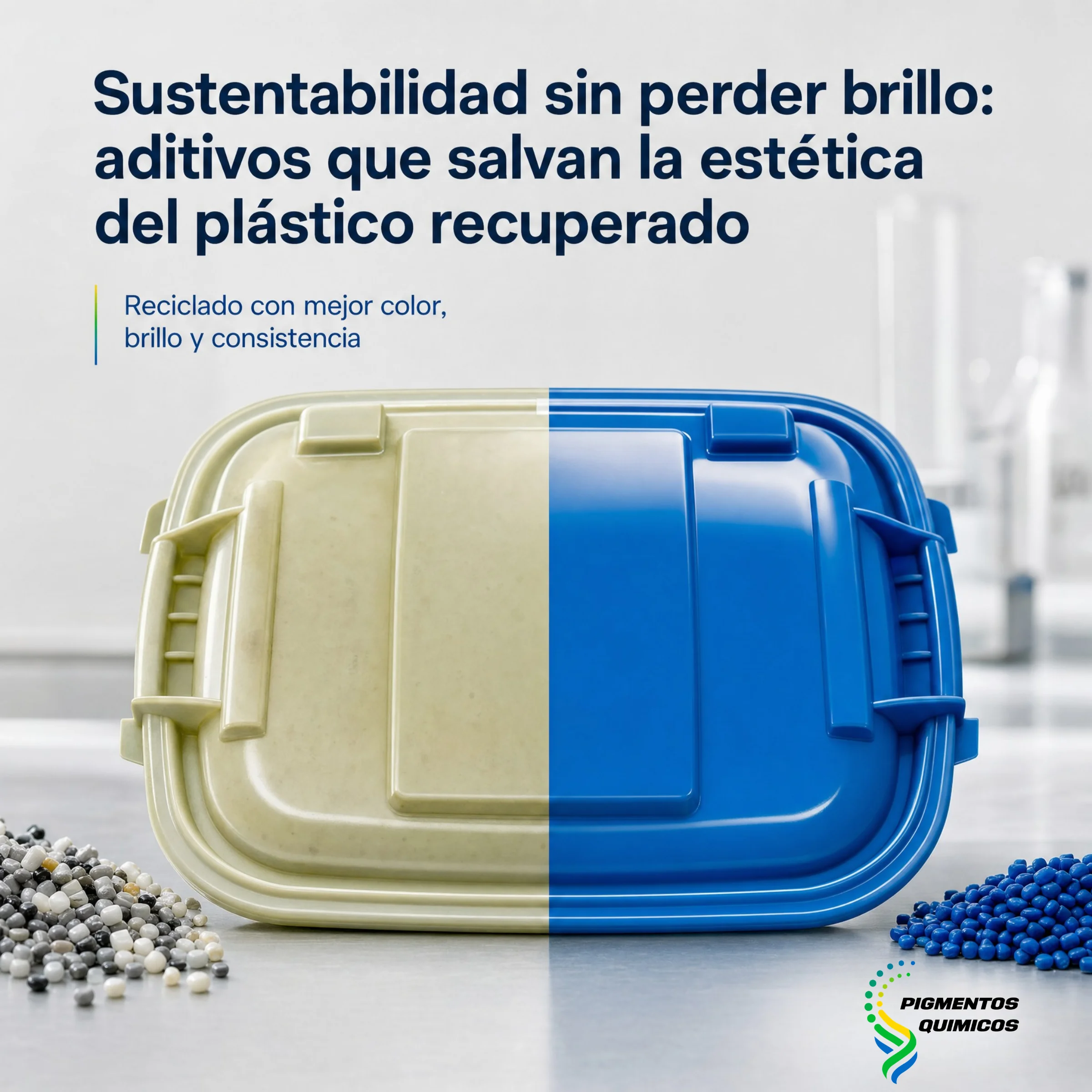
Additives for Recycled Plastic: How to Recover Color and Performance
Recycled plastic does not have to mean an opaque or inconsistent color, and more pigment does not fix it. Which additive categories actually do.
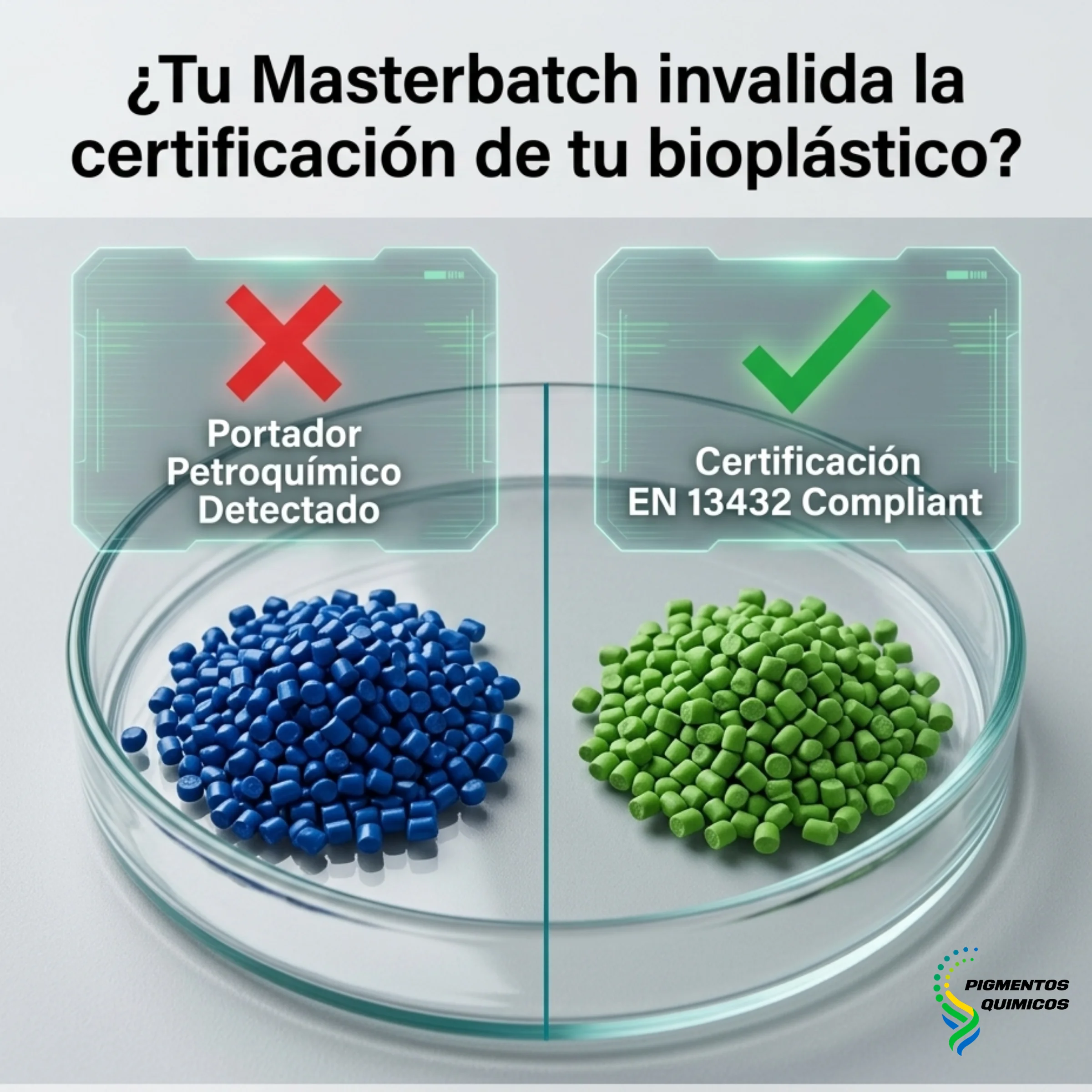
Is Your Masterbatch Invalidating Your Bioplastic Certification?
Warning: using non-biodegradable carriers in your masterbatch can void the compostable certification of your final product.
Sustainability and Plastics: The Strategic Role of Additives in the Circular Economy
Only 10% of plastic waste is recycled globally. Additives are both the biggest obstacle and the most powerful catalyst for circularity in plastics.