
Additives for Recycled Plastic: How to Recover Color and Performance
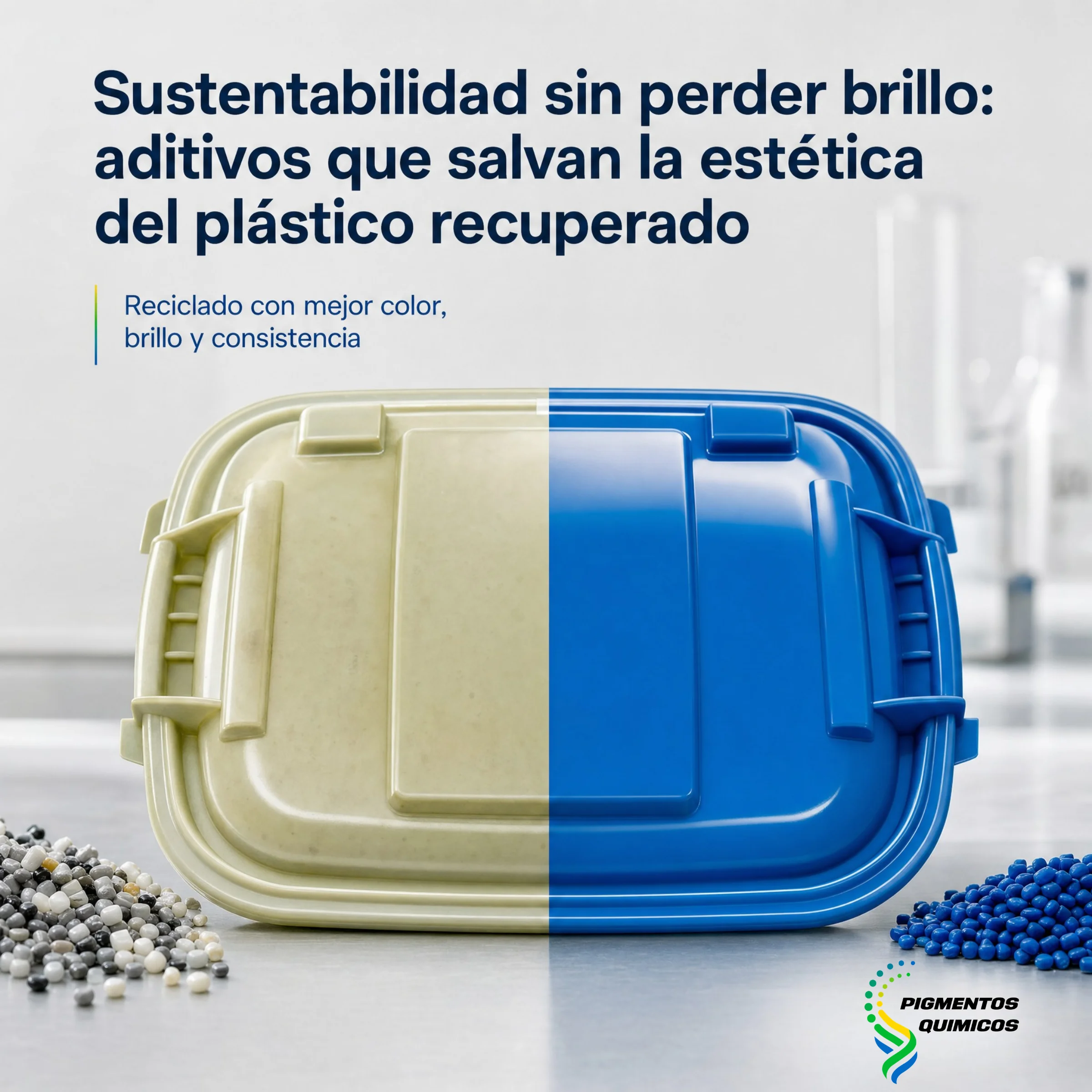
Using recycled plastic should not mean settling for an opaque product or inconsistent color. The challenge is not solved by simply adding more pigment either. There are additive categories that, used with clear criteria, help recover both appearance and performance.
Using recycled plastic should not mean settling for an opaque product with inconsistent color or degraded performance. The problem is also not solved simply by adding more pigment.
Why Recycled Plastic Loses Appearance and Properties
During processing, plastic is subjected to extreme conditions: high temperatures, pressure, and shear forces. Combined with ambient oxygen, these conditions break polymer chains and generate free radicals. The result is a material with lower molecular weight, more susceptible to further degradation, and with properties that differ from the original.
In practice, this shows up in two ways:
- Mechanical loss: the material may become more rigid, more brittle, or lose impact resistance.
- Aesthetic loss: opacity, loss of gloss, yellowing, or inconsistent color between batches of recycled material.
Add to this that recycled plastic has already gone through at least one heat and processing cycle before arriving at a new processing machine. Each additional cycle accumulates damage to the polymer chain. The result is a material that starts from a different condition than virgin resin, with less margin to absorb the new process conditions without further deterioration.
The Additional Challenge: Blending Polymers That Are Not Always Compatible
Another factor complicating recycled plastic aesthetics is that recycled material streams are rarely 100% pure. In practice, post-consumer or post-industrial streams may contain blends of different polymers that are not miscible with each other. When these polymers are processed together without an agent to facilitate integration, the result is a material with phase separation, structural weak points, and irregular appearance.
Which Additive Types Help Recover Appearance and Performance
There is no single additive that solves every recycled resin. But there are additive categories that, used with clear criteria, help improve both the appearance and performance of the material:
Properly combined, these additive families can meaningfully improve the appearance and consistency of a product made with recycled content — without sacrificing the sustainability advantage that using that material provides.
What an Additive Cannot Do on Its Own
An additive cannot compensate for an inadequate base resin. The final part is composed primarily of the base resin. In injection-molded or extruded parts, that resin can represent 95% to 98% of total mass, while masterbatch or additive typically represents 1% to 5%.
This does not mean additives are not worthwhile. It means expectations should be calibrated to what the additive can actually do: improve, stabilize, and partially compensate for the limitations of the recycled material — without replacing a resin of insufficient quality.
How to Validate Whether a Recycled Formulation Works for Your Product
Before running volume production with recycled material, a sample validation is advisable. This allows you to check whether the achieved color is consistent, whether the part retains the mechanical properties required for its end application, and whether the result is stable across different batches of recycled material.
This validation is especially relevant when partially or fully substituting a virgin resin with a recycled one in an existing product. Approval criteria should be defined before the trial, not after seeing the result.
Frequently Asked Questions
Why does recycled plastic look different from virgin plastic?
Because it has already gone through at least one cycle of heat, pressure, and processing, which can cause gloss loss, opacity, or color shifts. The recycled stream may also contain blends of different polymers that affect the final appearance.
Can additives restore the original color of recycled plastic?
They can help improve and stabilize appearance, but they cannot guarantee an exact color match if the base resin has a high degree of degradation or if the polymer blend is highly heterogeneous. Expectations should be calibrated based on the quality and consistency of the recycled stream being used.
What is a compatibilizer and what does it do in recycled material?
It is an additive — typically a copolymer — that helps two different polymers present in a recycled stream integrate better with each other, improving the mechanical resistance and visual uniformity of the finished part.