

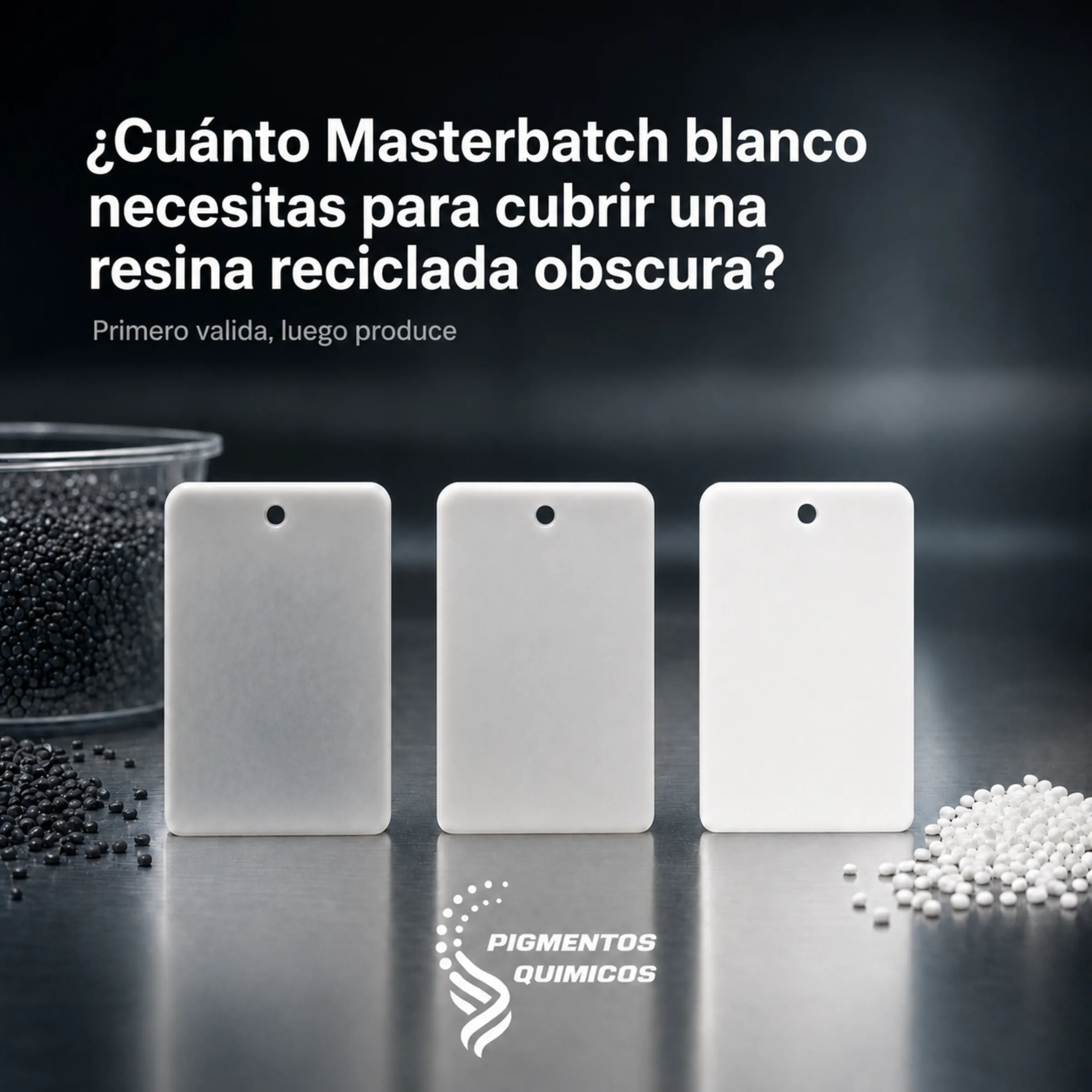
How Much White Masterbatch Do You Need to Cover a Dark Recycled Resin?
There is no single dosage. It depends on the base tone of the recycled resin, part thickness, the type of titanium dioxide, and the process. Validate a sample.
A plant starts a production run of several hundred kilos with recycled resin and the white masterbatch dosage that always worked with virgin material. Half an hour in, the supervisor stops the line: parts come out with a greyish, translucent tone that lets the shadow of the mold show through. The team raises the dosage on the fly, first double and then a bit more, until the color covers. The batch ends up out of weight specification, with a pigment cost far above budget, and the customer rejects the delivery. The error was not in the masterbatch: the base resin changed and nobody recalculated how much coverage was needed.
There is no single dosage. The amount of white masterbatch depends on the base tone of the recycled resin, part thickness, the type of titanium dioxide and the process. It is determined by validating a sample before producing.
Why the Dosage That Works With Virgin Resin Fails With Recycled Material
The Starting Point Changed and the Calculation Stayed the Same
When you dose white masterbatch over virgin resin, you start from a translucent or naturally light material, so the pigment only has to provide opacity and whiteness. Recycled resin arrives with its own base tone, which can range from beige to dark grey, the result of the mix of colors in the recovered material it came from. The white pigment now has two jobs: covering that background and also delivering the final white. The dosage that solved the first scenario falls short in the second, and the difference is not proportional, because covering a dark background demands far more pigment than intuition suggests.
The Base Tone of Recycled Material Varies Between Lots
The additional challenge with recovered material is consistency. Two lots of recycled resin from the same supplier and the same specification can arrive with different base tones, depending on what material entered each recovery run. A dosage calibrated against last month lot can turn out insufficient with this week lot, and the defect appears in production. That is why validating the recycled resin you are going to use has to be part of the receiving protocol, with the same rigor you apply to the pigment.
The Four Variables That Determine How Much White You Need
The Base Tone of the Resin and Its Contamination Load
The first variable is how dark the starting point is. Post industrial recycled material from a single source usually arrives with a light and stable tone, while mixed post consumer material carries traces of multiple colors and arrives considerably darker. Between those two extremes, the amount of white needed to reach the same target can multiply several times over. Before calculating any dosage, the data you need is the real tone of the resin you are going to run, measured and not assumed.
Part Thickness
Opacity depends on how much material light passes through. A thick walled part accumulates pigment across its thickness and reaches coverage with moderate dosages, while a film or a thin wall offers very little path for the pigment to do its job, and therefore demands higher concentrations to achieve the same visual result. The same masterbatch, over the same resin, can cover perfectly in a thick part and let the background show through in a thin one. Part thickness is a data point that must be on the table before defining the dosage.
The Type and Quality of Titanium Dioxide
The hiding power of a white masterbatch depends on the titanium dioxide that forms it and on how well it is dispersed. Not all whites perform the same at the same dosage, and that is where a price per kilogram comparison between suppliers becomes misleading. A cheaper masterbatch with lower concentration or lower pigment quality may need twice the dosage to reach the same white, and the cost per finished part ends up higher. The comparison that matters is the cost per part that meets specification.
The Transformation Process and the Carrier Resin
The process determines how much mixing energy the masterbatch receives and therefore how well the pigment disperses before taking its final shape. The carrier resin of the masterbatch must be compatible with your base resin and its melt flow index must match the process, because a large difference produces irregular dispersion and the pigment stops delivering what it should. Two plants with the same material and the same dosage can obtain different results if their process conditions differ.
The Method to Determine the Dosage Without Burning a Batch
Validate a Sample Before Committing Volume
The only reliable way to know how much white you need over a recycled resin is to run a sample with your material, your process and your thickness, and measure the result. Validation is done in a ladder: several dosages are tested over the same resin lot, real parts are produced and the color is measured with a spectrophotometer against the approved standard. The result indicates the minimum dosage that meets specification, with the certainty that it was measured under your conditions. Producing volume without that step amplifies a formulation error across the entire batch.
Raising the Dosage on the Fly Has a Limit
The instinctive reaction when a part comes out translucent is to raise the masterbatch percentage until it covers. That adjustment by eye has consequences that appear later: excess load affecting the mechanical properties of the part, risk of pigment migration, parts out of weight specification and a material cost that rises without being recorded anywhere. The upper dosage limit of a masterbatch is determined by the formulation and not by what the part appears to show at a glance.
At Pigmentos Químicos we formulate color masterbatch with the real recycled resin of each customer and validate the dosage against the standard before the plant commits volume. We measure color with a spectrophotometer, deliver a certificate of analysis, technical data sheet and safety data sheet with every order, and support validation at the plant when the project requires it. Check your case at https://pigmentosquimicos.com
Frequently Asked Questions
Can a pure white be achieved starting from a dark recycled resin?
It depends on how dark the base tone is. With light and stable recycled material it is possible to reach high whites with reasonable dosages. With heavily mixed post consumer material, reaching a pure white may require a pigment load that affects cost and part properties, and in those cases it is worth evaluating an achievable target tone before committing it with the end customer.
Why will my supplier not give me an exact dosage over the phone?
Because the figure depends on your resin, your thickness and your process, and a recommendation without that data would be guesswork. An indicative range serves for budgeting, and the definitive dosage comes from validation with your material. Committing to a number without validating transfers the risk to your production.
Is it worth comparing white masterbatch by price per kilogram?
That comparison can lead to the wrong decision. A white with lower concentration or lower titanium dioxide quality costs less per kilogram and may require twice the dosage for the same result. The figure worth comparing is the cost per part that meets the color specification.