
What Is a Plastic Resin and How Is It Classified in the Industry?
A plastic resin is the polymeric base of every plastic product. Its classification defines process, temperatures, properties, and masterbatch compatibility.
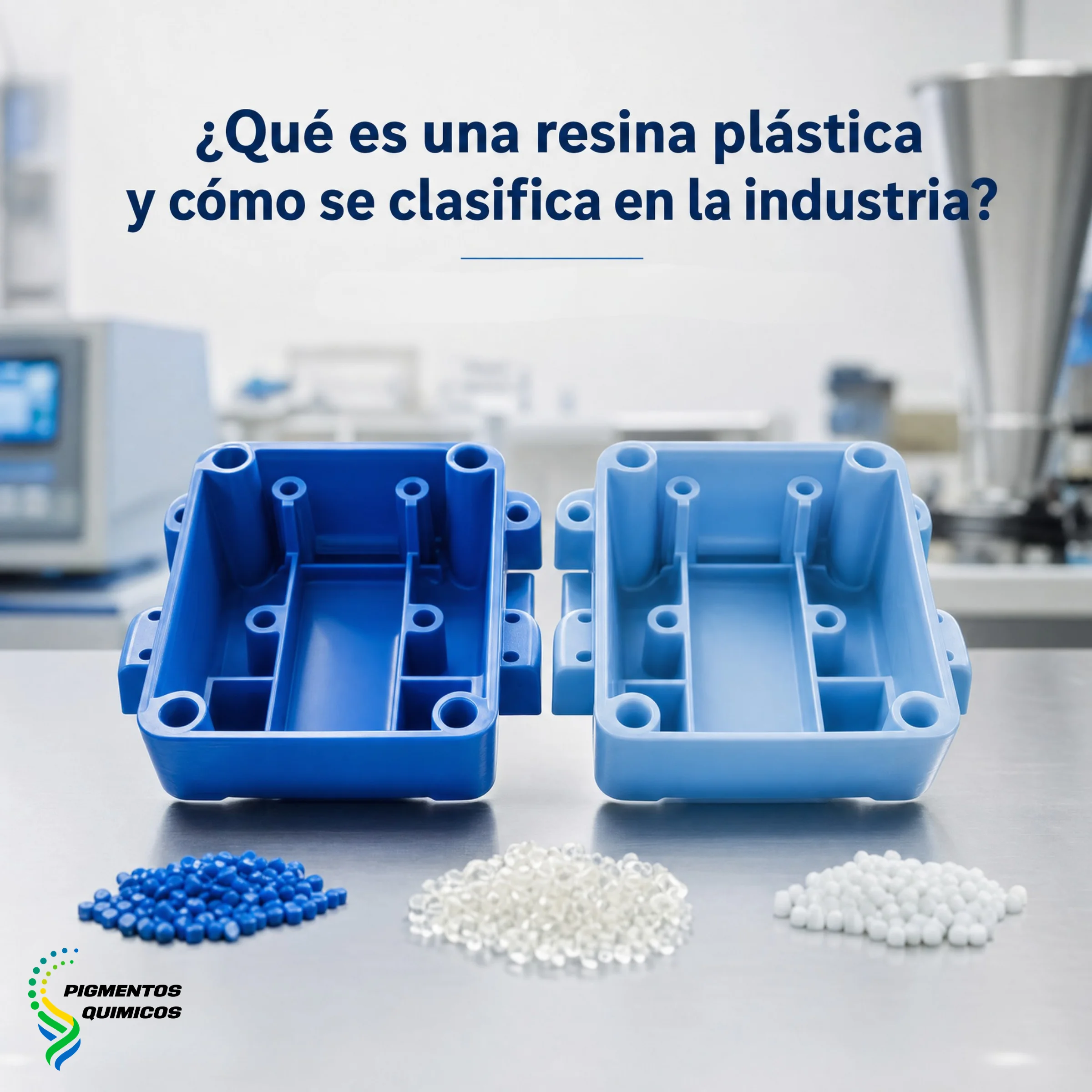
A quality manager receives a production sample with a complaint: the blue on the new batch does not match the previous order. The operator used the same masterbatch, the same dosing, and the same process. The difference was in the resin: the polypropylene supplier had changed, and the new commercial grade had different whiteness and melt flow index. That scenario shows why understanding what a resin is and how it is classified is not just basic industry knowledge: it is a technical variable that directly affects coloring, processing, and the performance of the final product.
What is a plastic resin
A plastic resin is the polymeric base material used as raw material in plastic transformation processes. The term polymer describes a molecule formed by the repeated bonding of smaller units called monomers. When those polymers are processed as pellets, powders, or melts to manufacture parts, packaging, films, or pipes, they are called plastic resins in industrial terminology.
The resin is not just the carrier of color or additive. In an injected or extruded part, the resin represents between 95% and 98% of the total product mass. Its mechanical, thermal, and optical properties define the behavior of the final product more than any other component of the formulation. An additive or masterbatch cannot compensate for a resin that was poorly selected for the application.
The fundamental division: thermoplastics and thermosets
The most relevant classification for the plastics transformation industry separates polymers by their behavior under heat. Thermoplastics melt with heat, can be molded and re-solidified, and can be reprocessed multiple times without altering their fundamental chemical structure. Injection molding, extrusion, blow molding, and rotational molding all work with thermoplastics.
Thermosets form irreversible chemical bonds during curing. Once cured, they cannot be re-melted or reprocessed. Epoxy, phenolic resin, and some types of polyurethane are thermosets. Color and additive masterbatches are formulated for use with thermoplastics, since they require heat processing in machine.
Semicrystalline vs. amorphous: how molecular structure affects color
Within thermoplastics, there is another important classification for coloring: semicrystalline and amorphous. Semicrystalline thermoplastics have ordered molecular regions that give them properties such as chemical resistance, hardness, and a defined melting point. They are opaque or translucent in their natural state. Polyethylene, polypropylene, PET, and nylon are semicrystalline.
Amorphous thermoplastics lack that ordered structure, which allows them to be transparent or completely clear in their natural state. Crystal polystyrene, polycarbonate, and ABS are amorphous. This difference directly affects color results: the same blue applied to opaque polypropylene looks different from the same blue in crystal polystyrene. The optical base of the resin modifies how color appears, and that is why color must be validated in the actual resin of the process.
The most commonly used thermoplastic resins in industry
How the resin defines masterbatch selection
The base resin defines three technical variables that determine which masterbatch can be used. The first is carrier compatibility: masterbatch is formulated with a polymeric vehicle that must be compatible with the client's resin. A masterbatch with a PE carrier may not disperse well in polypropylene if viscosities are incompatible. The second is the temperature window: the masterbatch must be stable at the processing temperatures of the base resin. A pigment that withstands 220°C may degrade at 290°C, which is polycarbonate's processing range.
The third variable is optical appearance: the whiteness, translucency, or transparency of the resin modifies how the final color is perceived. The same blue pigment gives a different visual result in milky polypropylene than in crystal polystyrene. That is why color cannot be approved solely from a Pantone or RAL reference: it must be validated in the actual resin of the process. If the resin, process, or raw material supplier changes, color must be reviewed.
Melt flow index: the most underestimated variable
The melt flow index, or MFI, measures how easily a molten resin flows under specific conditions of temperature and load. A resin with high MFI flows easily and fills complex molds quickly. A resin with low MFI is more viscous, more structural, and requires more pressure to flow through the equipment.
Masterbatch cannot fully modify the behavior of a resin. If the melt flow index is not adequate for the process, productivity and mold filling can be affected. Therefore, changing resin grade or supplier may require revalidating dosing and masterbatch behavior, even if color and formulation are identical.
Frequently asked questions
Are all thermoplastic resins compatible with color masterbatch?
In general terms, masterbatch can be used with the most common thermoplastics in industry, provided the masterbatch carrier is compatible with the base resin and the pigment can withstand the processing temperatures. However, resins with special fillers such as fiberglass, or with very high or very low temperature windows, may require a custom formulation. Compatibility should be evaluated before volume production.
Which resin is the easiest to color?
Polypropylene and high-density polyethylene are the resins most frequently worked with in industrial coloring, partly because they have well-established processes, varied suppliers, and a wide range of masterbatches available in the market. However, ease of coloring also depends on the target color, the required color tolerance, and the conditions of the transformation process.
Why does the same color look different in polypropylene and polycarbonate?
Polypropylene is semicrystalline and opaque in its natural state. Polycarbonate is amorphous and can be completely transparent. Those optical differences cause the same pigment to interact differently with light in each resin. Processing temperatures also differ, which can affect pigment behavior. To achieve the same visual color in two different resins, a different masterbatch formulation is generally required.
Are biodegradable resins classified as thermoplastics?
Yes. Resins such as PLA, PBAT, and TPS are thermoplastics that can be melted and processed in injection, extrusion, and blow molding equipment. Their difference from conventional thermoplastics lies in origin and degradation: they are formulated to break down under specific conditions according to standards such as EN 13432 or ASTM D6400. Masterbatch compatibility for biodegradable resins has its own technical considerations related to processing temperature and certification.