
UV Protection in Plastics: How Long Will Your Part Hold Up in the Sun
There is no single answer. A plastic part can start discoloring in weeks or hold up for years, depending on the resin, pigment, wall thickness, and exposure conditions. What does exist are the variables that determine that difference.
There is no single answer. A plastic component can begin discoloring within weeks or remain in good condition for years, depending on the resin, pigment, wall thickness, and actual exposure conditions.
For anyone manufacturing parts, packaging, or components that will be used outdoors, the right question is not 'how long will my plastic last' but 'what variables are accelerating or slowing degradation in my specific case.'
What UV Actually Does to Plastic
UV radiation does not just wear down plastic from the surface. It triggers a process called photooxidation: the energy from ultraviolet light breaks chemical bonds within the polymer structure and generates free radicals. Those radicals initiate a chain reaction that continues degrading the material even without additional direct exposure.
In practice, this shows up in two ways:
- Aesthetically: color loss, discoloration, opacity, or loss of gloss.
- Mechanically: brittleness, surface cracking, and loss of strength — to the point where a part can detach or break easily.
The problem is not always immediately visible. A part can still look acceptable while having already lost a significant portion of its mechanical resistance.
Why There Is No Single Answer for How Long It Lasts
Mexico is geographically exposed to high UV radiation for much of the year. However, intensity varies significantly by region. A part installed in Sonora or the Riviera Maya does not receive the same radiation load as one in Mexico City or in a region with more frequent cloud cover.
This means the same part, made from the same resin, can degrade at different rates depending on where in the country it is used. The geographic location of the end application is a design variable, not just background information.
Variables That Determine the Rate of Degradation
Before asking how long it lasts, it is worth reviewing which variables are in play:
What UV Stabilizers Do (and What They Do Not Do)
Properly combined, these additives can significantly delay color loss and mechanical property degradation. What they do not do is make plastic permanently immune to solar radiation. The effect is one of delay and protection within an exposure range — not indefinite invulnerability.
When UV Protection Is Worth Formulating For (and When It Is Not)
UV protection should not be added out of habit. It should be justified when the end application will be exposed to solar radiation or relevant outdoor conditions throughout its expected service life.
If the product will be used indoors or its cumulative solar exposure will be minimal, formulating with UV protection can add cost without a real benefit.
Examples where it typically makes sense:
- Tools, furniture, or components for permanent outdoor use.
- Packaging or labels stored or displayed outdoors.
- Industrial parts installed in yards, rooftops, or uncovered areas.
Examples where it may not be necessary:
- Components for exclusively indoor use.
- Parts with occasional or very short solar exposure.
- Non-critical prototypes or tests where long-term performance is not the objective.
A Real Case: TPU Hammer Handles Under Extreme Sun
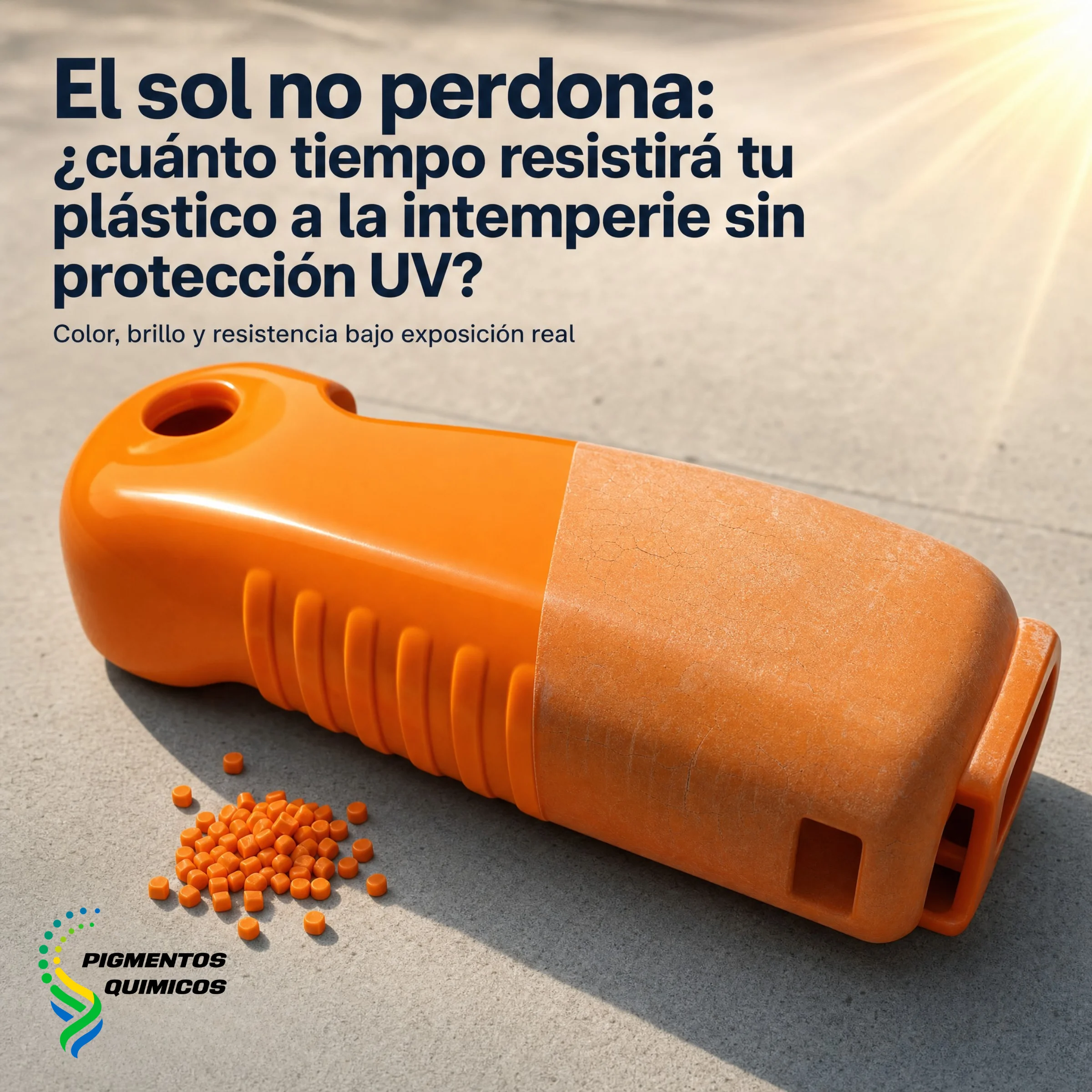
In one real development, hammer handles were manufactured in orange TPU (thermoplastic polyurethane). Due to its elastomeric nature, similar to rubber, this material can degrade and crack relatively quickly when exposed to outdoor conditions and direct solar radiation.
Pigmentos Químicos formulated an orange masterbatch with a UV stabilizer package to improve the material's outdoor performance. The development was sent to an external specialized laboratory, where plaques underwent accelerated aging in a weathering chamber for 78 continuous hours. Results showed measurable improvement in color retention and surface condition compared to unprotected samples.
This case does not mean every orange TPU part needs the same additive package, nor that 78 hours of accelerated aging is a universal standard. What it illustrates is something more general: UV protection decisions are driven by the actual combination of resin, color, and exposure conditions — not by aesthetics alone.
Frequently Asked Questions
Does every plastic exposed to the sun need UV protection?
Not necessarily. It depends on how many actual hours of solar exposure the part will receive and whether that exposure is continuous or intermittent. A component that spends most of its time indoors or under cover may not need UV stabilizers. The decision should be based on the real application, not on a generic precaution.
How long does it take for plastic to degrade from sun exposure?
There is no fixed time. It depends on the resin, pigment, wall thickness, color, and radiation intensity in the area where the product is used. Without stabilizers, some thermoplastics can show visible changes within months. With the right formulation, service life can be extended significantly.
What is the difference between a UV absorber and a HALS?
A UV absorber captures radiation and converts it into heat before it damages the polymer. HALS do not block radiation directly — they neutralize the free radicals generated during degradation. Both can be combined in a single formulation for broader and longer-lasting protection.