
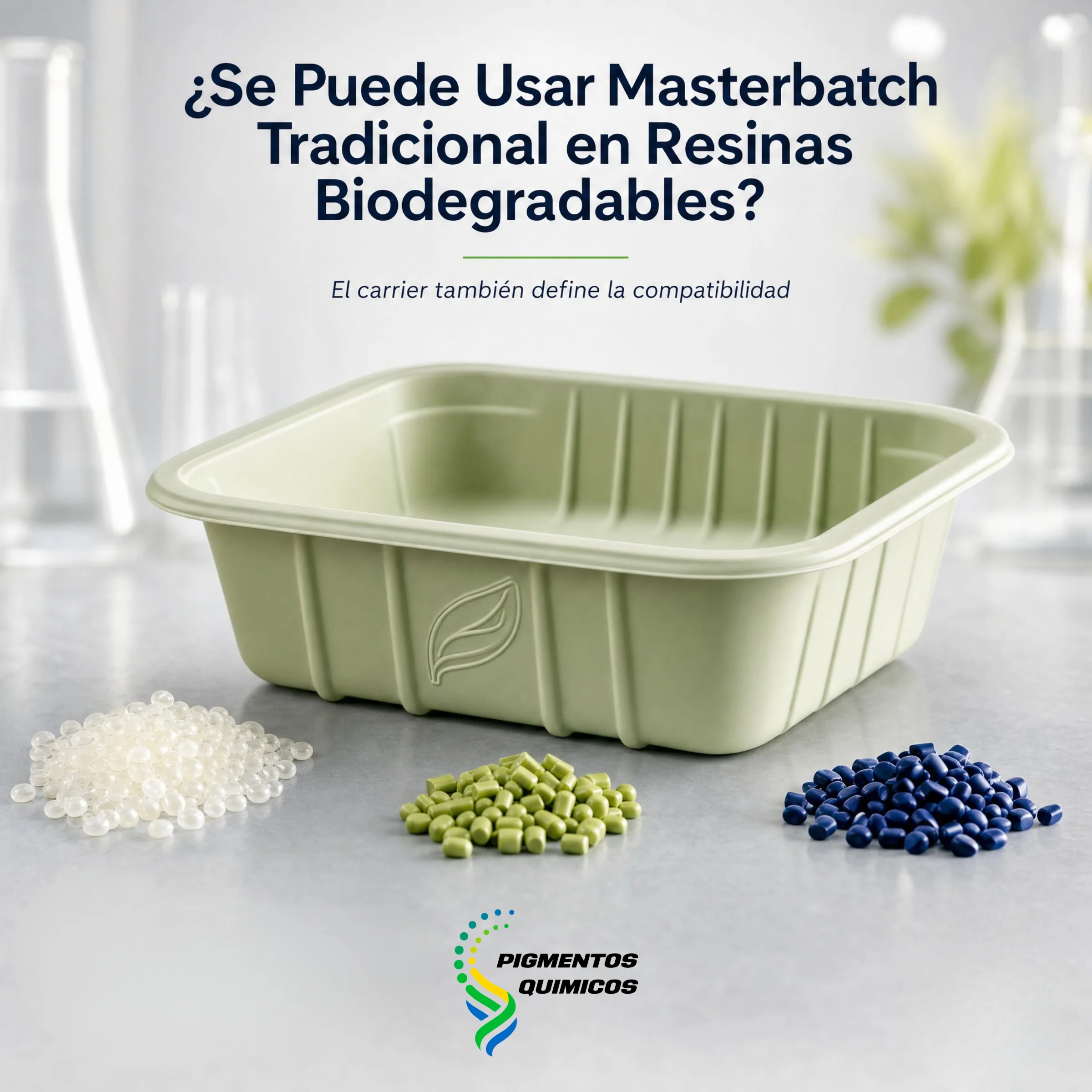
Can Traditional Masterbatch Be Used with Biodegradable Resins?
It depends on three variables: the type of biodegradable resin, the processing temperature, and whether the application requires compostability certification.
A plastics processor working with PLA for packaging faces a concrete question: can they use the same green masterbatch they use for polypropylene? The color is the same, the dosing is the same, and the supplier is the same. The question seems straightforward until the masterbatch carrier is reviewed: polypropylene, a resin that processes between 220°C and 270°C. PLA, by contrast, has a processing window of 160°C to 210°C. That temperature gap is the first signal that the answer requires technical evaluation, not an assumption based on pellet appearance.
What technically distinguishes biodegradable resins from conventional ones
Biodegradable resins are polymers engineered to break down under specific conditions of temperature, humidity, and microbial activity, following standards such as EN 13432, ASTM D6400, or NMX-E-255. The most common in the Mexican industry are PLA (polylactic acid), PBAT (polybutylene adipate terephthalate), and TPS (thermoplastic starch). Each has distinct mechanical, thermal, and chemical properties compared to petroleum-based resins.
What links them technically is that they process at lower temperatures than most conventional thermoplastics and their processing window is typically narrower. A 20°C variation above the upper limit can initiate PLA degradation before the part exits the mold. That thermal sensitivity is one of the key factors that determines which masterbatch can be incorporated into these resins.
The masterbatch carrier and its effect on compatibility
Conventional masterbatch is formulated with a polymeric carrier: the base resin in which the pigment or additive is dispersed. The most common carriers in industry are polyethylene and polypropylene, both petroleum-based resins that process between 180°C and 270°C depending on the commercial grade.
When that masterbatch is incorporated into a biodegradable resin, the carrier becomes part of the final product. In terms of dosing, its proportion is low: at 2% dosing, the masterbatch carrier represents a small fraction of total mass. However, that fraction has two technical implications. The first is thermal compatibility: the carrier and the biodegradable resin must process within compatible temperature ranges to ensure proper dispersion. The second is certification: in applications where the final product must be declared compostable, the presence of a petrochemical carrier can compromise that declaration.
Processing temperature as the first technical filter
PLA processes between 160°C and 210°C. PBAT between 120°C and 160°C. A conventional masterbatch with a polypropylene carrier is formulated to process between 220°C and 270°C. If that masterbatch is incorporated into a PLA resin at 180°C, the carrier may not melt completely, resulting in poor dispersion: color spots, streaks, or tone variation in the finished part.
On the other hand, if temperature is raised to improve carrier flow, PLA can begin to degrade before the part is formed. The result may be a material with discoloration, premature brittleness, or bubbles from outgassing. PLA's processing window does not tolerate the same temperature margin as polypropylene.
When conventional masterbatch can work with biodegradable resins
Conventional masterbatch can technically be processed with biodegradable resins when specific conditions are met. The first is temperature compatibility: the masterbatch carrier and the biodegradable resin must have compatible processing ranges that allow proper melting and dispersion without degrading either material.
The second condition is the absence of certification requirements: if the final application does not require the product to be declared biodegradable or compostable under any technical standard, and the only objective is achieving the desired color in the part, conventional masterbatch may be a viable option provided it is validated in-machine beforehand. The third condition is melt flow index compatibility: the masterbatch viscosity must be compatible with the biodegradable resin to ensure the material flows and mixes correctly in the barrel.
When a masterbatch with biodegradable carrier is required
When the application requires compostability or biodegradability certification, the masterbatch must also be formulated with a compatible carrier (such as PLA or PBAT) according to the applicable standard. In that case, a conventional masterbatch is not the technically indicated option, regardless of whether color and dosing are similar. Certification evaluates the total product, not just the base resin.
Compatibility is not guaranteed by catalog. It is evaluated based on resin, process, temperature, and the requirements of the final application. Before incorporating masterbatch into a biodegradable resin, it is worth confirming the concentrate's carrier, validating behavior in-machine, and determining whether the application has specific regulatory requirements.
Variables needed before evaluating compatibility
Frequently asked questions
Does conventional masterbatch make a biodegradable resin non-biodegradable?
Technically, the presence of a petrochemical carrier at low dosing levels does not significantly alter the degradation properties of the base resin. However, in applications that require compostability certification under standards such as EN 13432 or ASTM D6400, the masterbatch must also meet the criteria of that standard. If the carrier does not qualify, the final product's certification may be compromised. The answer depends on the end use and the requirements of the market the product is intended for.
Is there masterbatch specifically formulated for biodegradable resins?
Yes. Masterbatches formulated with PLA, PBAT, or other biodegradable resin carriers exist, allowing work within the processing temperature windows of these resins and compatibility with compostability certifications. Availability may vary by market and production volume. For certified applications, this is the technically appropriate alternative.
Can the same masterbatch be used for both PLA and polypropylene?
In most cases, using the same masterbatch in both resins without prior validation is not recommended. Differences in processing temperature, viscosity, and melt flow index between PLA and polypropylene mean that dispersion and color behavior may differ significantly in each resin. A masterbatch formulated for PP may not disperse correctly in PLA, and vice versa.
Does dosing level affect the biodegradability of the final product?
At standard dosing levels of 1% to 3%, the masterbatch represents a small proportion of the final product. For applications without certification, that proportion rarely affects the product's general properties. In applications with compostability certification, every component of the product is evaluated, including the masterbatch. In those cases, the certification criteria apply to all incorporated materials, regardless of percentage.