Why Does the Same Blue Look Different in PP vs. ABS?
Polymer chemistry and crystalline morphology determine how we perceive color. Never use the same masterbatch for different resins.
Why Does the Same Blue Look Different in PP vs. ABS?
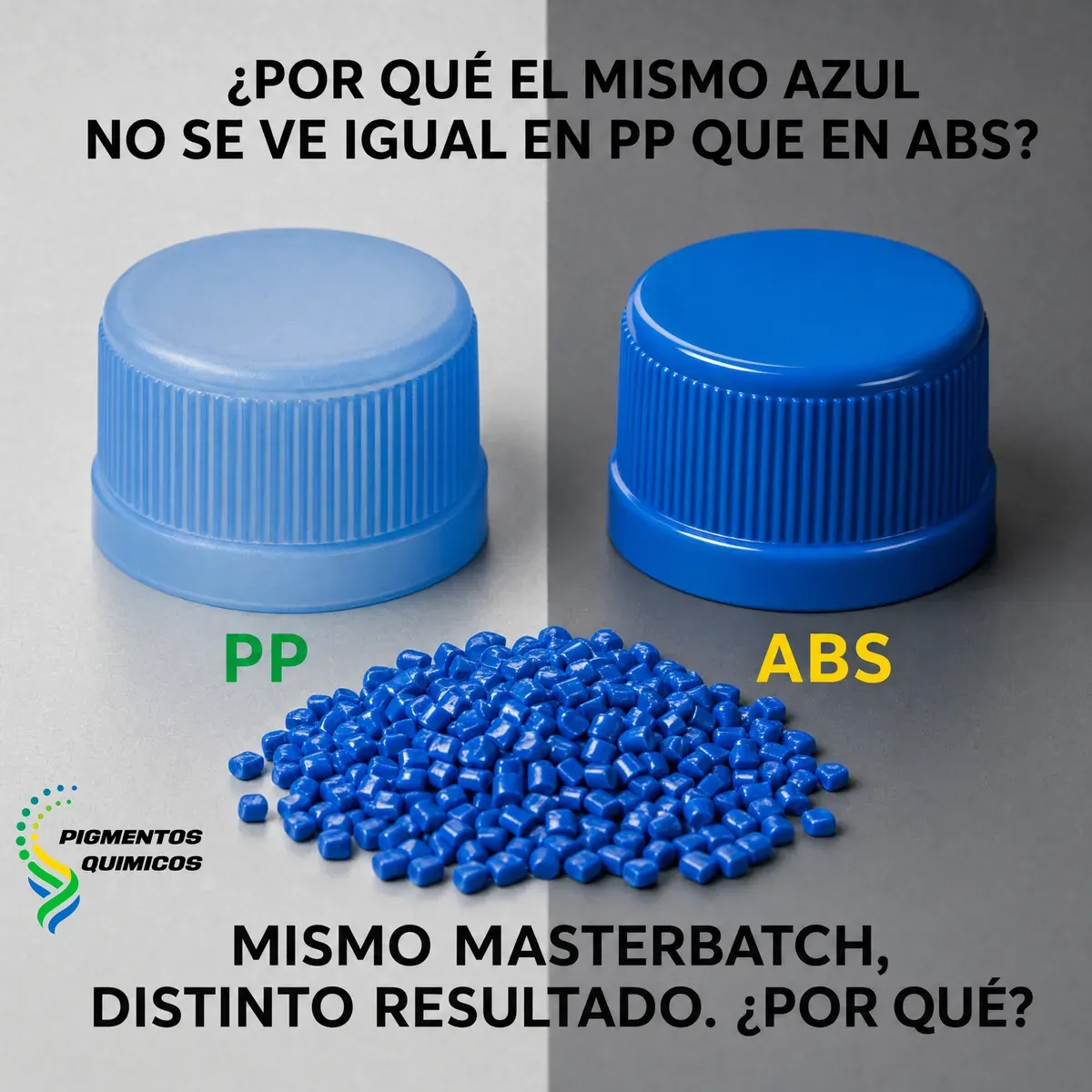
The same blue pigment produces visually different shades in polypropylene (PP) and ABS because each resin has a different molecular structure, refractive index, and processing temperature, which alters how light interacts with the dispersed pigment.
In our experience accompanying plastics processors throughout the production chain, one of the most frequent — and most underestimated — challenges is color inconsistency between parts made from different resins. The question that causes the most confusion in formulation and quality control is precisely this: if the masterbatch has the same pigment formulation, why does the blue look different in PP than in ABS? The answer involves polymer chemistry, material optics, and mastery of the processing method.
1. The Resin Is Not Merely a 'Container' for Pigment
When we talk about coloring plastic, attention usually focuses on the pigment: its concentration, purity, thermal stability. However, we have confirmed on the production floor that the base resin plays a fundamental optical role that goes far beyond being the dispersion medium.
Each polymer has its own molecular structure. Polypropylene (PP) is a semicrystalline polymer with a density of 0.90–0.91 g/cm³; ABS is an amorphous terpolymer with a density of 1.04–1.10 g/cm³. This structural difference determines how light enters, travels through, and exits the part, and consequently how we perceive the final color.
Polymers have different refractive indices: PP is around 1.49, while ABS, due to its styrene-acrylonitrile phase and dispersed butadiene, can reach values close to 1.54. The higher the refractive index, the greater the deflection of light and, therefore, the greater the risk that color perception changes even when the pigment is identical.
2. Crystalline Morphology vs. Amorphous Structure: The Decisive Factor
We have documented that the crystallinity of PP creates zones of diffuse light scattering within the polymer mass. Those crystalline microspheres act like small prisms that 'soften' the color and produce a more muted tone of lower depth and brightness. ABS, being amorphous, lacks those crystalline zones, which allows the pigment to express its color with greater saturation and surface uniformity.
Our experience indicates that, under standard D65 illumination conditions, the same concentration of phthalocyanine blue pigment at 1.5% can yield a colorimetric difference ΔE (measured in CIE Lab) of between 3 and 8 units between PP and ABS — well above the threshold of human perception (ΔE > 1). In rigorous quality control, this difference is unacceptable without a prior formulation adjustment.
3. Process Temperature: The Third Invisible Factor
PP is generally processed between 200 and 230°C, while ABS requires temperatures of up to 250°C. This thermal gap is decisive: the higher the processing temperature, the greater the risk of organic pigment degradation, with a consequent loss of luminosity and a shift toward greenish or gray tones.
In our technical evaluation we have confirmed that phthalocyanine pigments (blues and greens) are generally stable up to 300°C, but organic dioxazine-type pigments (intense violets and blues) show color shift starting at 240°C, making them incompatible in ABS without a protected masterbatch formulation. This is one of the most costly errors in the industry: migrating a PP formula to ABS without reviewing the thermal stability of each masterbatch component.
4. Masterbatch Compatibility: Carrier Resin and Host Resin
A masterbatch is not universal. We have observed that the masterbatch's carrier resin (the base polymer that encapsulates the concentrated pigment) must be compatible with the processor's host resin. A masterbatch formulated with a PP carrier can present dispersion problems, color bands, or migrations if dosed directly into ABS, given that both resins have different polarities and melt viscosities.
Standard masterbatch dosage is around 2% over the base resin. However, in our work with clients in the automotive and appliance sectors, we have confirmed that when switching from PP to ABS while keeping the same masterbatch formula, the final part can present streaks or a completely different color saturation — even when the addition percentage is identical.
5. How to Ensure Color Consistency Across Different Resins
From our technical development team, we recommend a five-stage protocol to ensure color reproducibility when changing or combining resins:
- Verify the Melt Flow Index (MFI) of the masterbatch vs. the host resin to ensure rheological compatibility.
- Ask the supplier for a masterbatch with a carrier resin specific to the target resin (ABS-based or PP-based).
- Conduct thermal stability tests on the pigment at actual process temperatures, with representative residence times.
- Measure the final color with a CIE Lab spectrophotometer under D65 illuminant and 10° observation angle, before validating the batch.
- Adjust the masterbatch concentration based on resin opacity, since semicrystalline PP requires higher pigment loading to compensate for internal light diffusion.
Conclusion: Color Does Not Start with the Pigment — It Starts with the Resin
We have learned that color is the result of a complex equation where the base resin is not a minor factor, but the primary determinant of how the pigment expresses its visual identity. Switching from PP to ABS (or vice versa) without reformulating the masterbatch is the number-one cause of color rejection in the plastics industry.
Our solution is always the same: define the polymer first and design the color after. Never the other way around.
Frequently Asked Questions (FAQ)
Why does the same blue masterbatch produce a different shade in PP and ABS?
Because each resin has a different refractive index, molecular structure, and processing temperature, which modifies how light interacts with the pigment and, consequently, the perception of the final color.
What optical difference between PP and ABS affects color?
PP is semicrystalline: its crystalline zones scatter light internally and produce more muted tones. ABS is amorphous and allows greater color saturation because it does not generate that internal light diffusion.
What is ΔE and why is it important in plastic color control?
ΔE is the colorimetric difference measured in CIE Lab space between two samples. A ΔE greater than 1 is perceptible to the human eye. We have recorded differences of ΔE 3 to 8 between the same color in PP and ABS, confirming the need for reformulation when changing resins.
Can I use the same masterbatch in PP and ABS?
Not recommended. The masterbatch carrier resin must be compatible with the host resin. A PP-based masterbatch can present dispersion problems, streaking, or color shift in ABS due to rheological and polar incompatibilities.
What processing temperature most affects color in ABS?
ABS is processed between 230 and 250°C. Organic pigments such as dioxazine (blue-violet) can degrade from 240°C, producing color shift. In PP, processed at lower temperatures, this risk is lower.
How do you guarantee color reproducibility between PP and ABS parts?
By using masterbatches with a carrier resin specific to each polymer, validating the thermal stability of pigments at the actual process temperature, and measuring color with a CIE Lab spectrophotometer under D65 illuminant.