
Line Stoppages from Poor Dispersion: The Hidden Cost Not in Your Budget
Poor masterbatch dispersion causes streaks, spots, and color variations that lead to line stoppages and rework. Learn how to diagnose and prevent it.
Line Stoppages from Poor Dispersion: The Hidden Cost Not in Your Budget
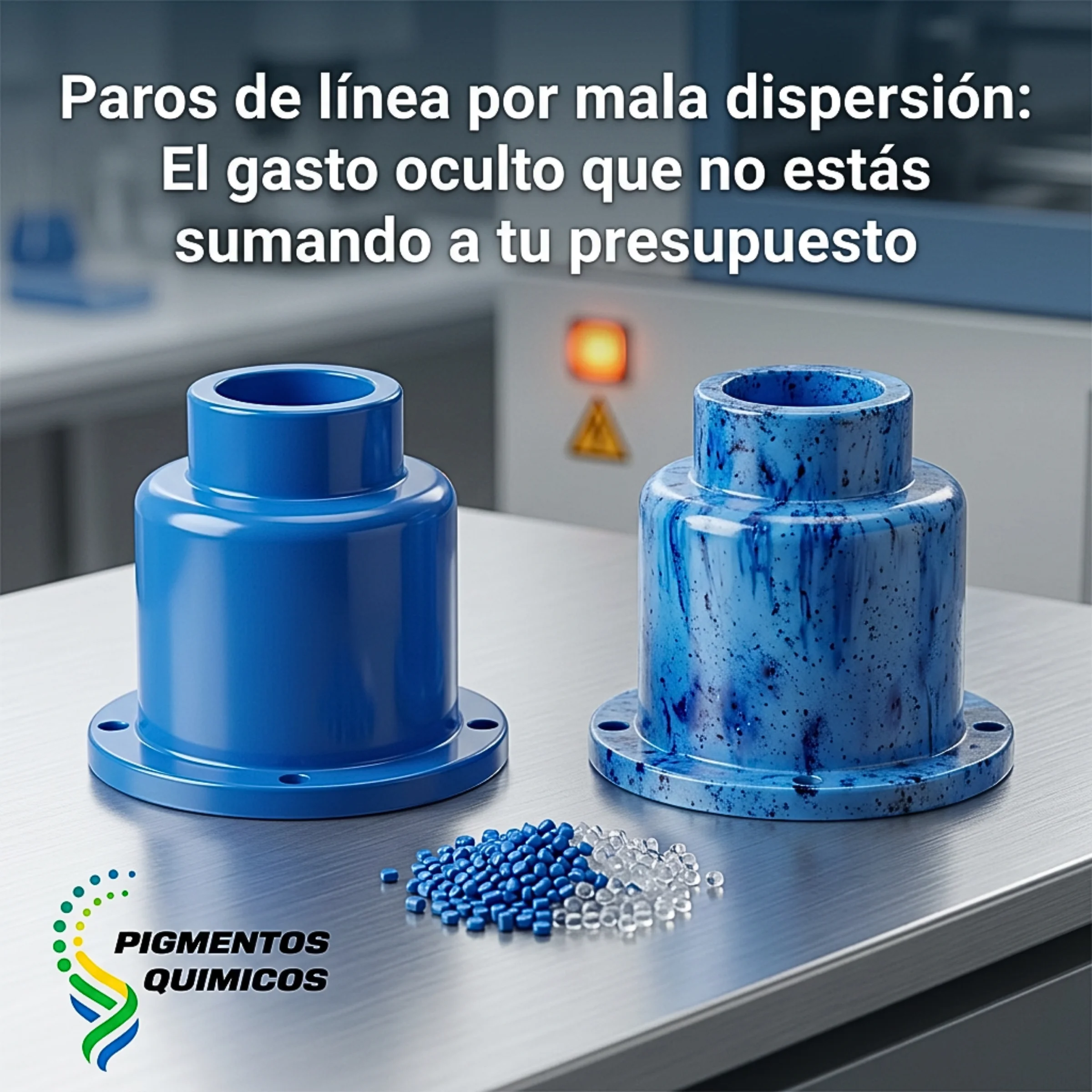
Poor masterbatch dispersion generates color streaks, spots, and batch-to-batch variation that appear as rejected parts. But the financial impact extends beyond material scrap: production stoppages for mold purging, operator time for defect sorting, delivery delays, and client returns are the real costs of a dispersion problem — and they rarely appear in the masterbatch cost column of the budget.
The procurement comparison that costs processors the most is evaluating masterbatch suppliers on price per kilogram while ignoring the downstream cost of dispersion quality failures. In our work with medium and large plastics processors, we have quantified dispersion-related rework costs between 3 and 12 times the cost of the masterbatch itself in affected production runs.
The Hidden Cost Structure of Dispersion Failures
A dispersion failure generates costs across six categories that are rarely tracked together: (1) Direct material scrap — rejected parts and purge material. (2) Machine time — stopping the line, purging the barrel and runner system, and restarting, typically 45–90 minutes per event. (3) Mold risk — disassembling a hot mold for cleaning creates thermal shock risk; repeated events accelerate mold wear. (4) Energy cost — purging with virgin resin at production temperature consumes material and energy without producing saleable parts. (5) Delivery risk — if the line stops during a committed production window, the delay cost may include expedited logistics or client penalty clauses. (6) Quality sorting labor — in visual defect scenarios, parts must be inspected individually.
A single line stoppage event in a high-cavity injection tool running at 500 cycles/hour typically represents a direct cost of $200–$800 in machine time, purge material, and labor — before accounting for delayed delivery consequences. A processor experiencing one dispersion-related stoppage per week on a single machine is absorbing $10,000–$40,000 per year in hidden costs that never appear in the masterbatch cost line.
Root Causes of Dispersion Failure
The three most common technical causes of dispersion failure are carrier-resin incompatibility, insufficient shear in the plastication stage, and pigment particle size above the quality specification.
Carrier incompatibility is the most frequent root cause in cases where dispersion failure appears after a masterbatch supplier change. If the new masterbatch has a carrier MFI that is too close to or lower than the base resin MFI, the two materials do not mix efficiently in the screw — the masterbatch pellets are transported without fully melting into the resin matrix. The result is color-concentrated regions separated by under-colored zones, appearing as streaks or bands in the finished part.
Diagnosing the Source: Machine vs. Masterbatch
The fastest diagnostic test is a material swap: run a known-good masterbatch (from a previous approved lot or a different supplier) in the same machine with the same parameters. If the dispersion defect disappears, the cause is the masterbatch. If it persists, the cause is the machine or process setup: investigate back pressure (too low is the most common machine-side cause of streaking), barrel temperature profile, screw geometry, and residence time.
A systematic dispersion evaluation uses a filter pressure value (FPV) test or a flow spiral mold — both produce quantitative dispersion data rather than subjective visual assessment. If your masterbatch supplier cannot provide FPV data for their product, that is a quality documentation gap worth addressing.
Preventing Dispersion Failures Proactively
- Require MFI data for the masterbatch carrier and verify the ratio against your base resin before ordering (optimal: carrier MFI = 1.5–3× base resin MFI at processing temperature).
- Request a filter pressure value (FPV) certificate for each masterbatch lot — this is the definitive dispersion quality measurement.
- Define and document your machine's minimum back pressure for each masterbatch. Operators reducing back pressure to increase cycle speed is a frequent cause of intermittent dispersion failures.
- Audit the let-down ratio at the dosing unit during production. Under-dosing reduces dispersion by reducing the concentration gradient that drives mixing; over-dosing can overwhelm the mixing capacity of the screw.
Frequently Asked Questions (FAQ)
What back pressure setting prevents dispersion failures?
Back pressure requirements vary by machine, screw geometry, and material, but a starting point of 80–120 bar hydraulic back pressure is typical for color masterbatch in standard injection molding. If streaks are present, increase back pressure in 10-bar increments until the defect disappears. If increasing back pressure requires reducing cycle time, the machine may have insufficient mixing capacity for the masterbatch in question — consider a screw with a dedicated mixing zone.
Is dispersion failure always visible on the part surface?
No. In some cases, poor dispersion creates internal pigment agglomerates that are not visible on the surface but create stress concentration points that reduce impact resistance and fatigue life. This is particularly critical in structural applications where the part is not visually inspected. Carbon black agglomerates > 50 μm can reduce impact strength by 15–30% in polyolefins. Requesting an FPV test for mechanical-critical applications is not optional — it is a quality requirement.