
Process Aids in Plastics: What They Do and When to Use Them
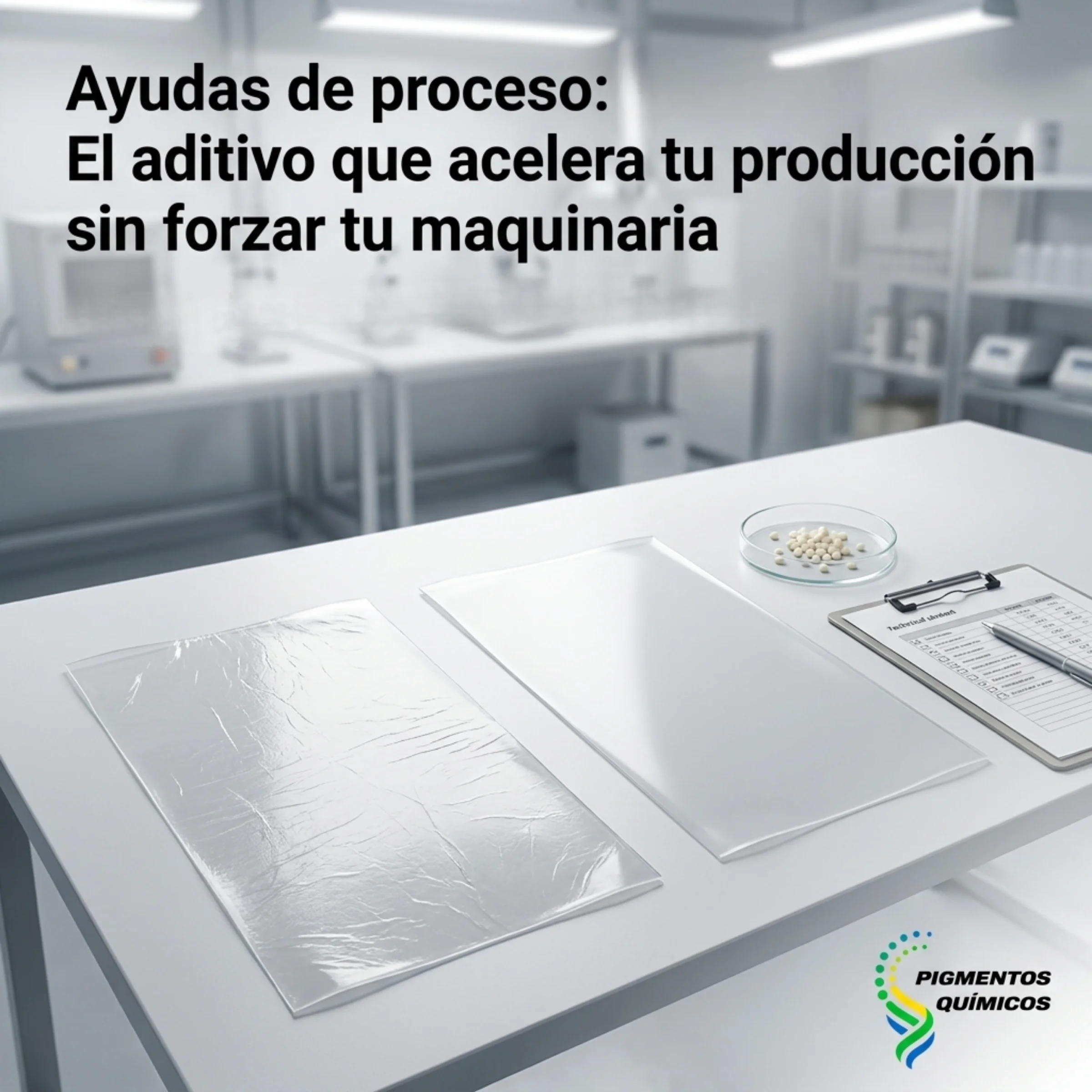
Process aids are additives that reduce melt friction against equipment, improve surface finish, and can lower line pressure. They do not fix structural process problems, but in the right context they make a measurable difference.
Some production problems show up in the finished part, not in the equipment. A surface that turns irregular at certain line speeds. A finish that varies without the operator changing anything. Process pressure that climbs higher than expected with no obvious cause.
This article explains what process aids are, how they work, when it makes sense to incorporate them, and what they cannot fix on their own.
What Is a Process Aid?
A process aid is an additive incorporated into a thermoplastic polymer to improve its behavior during transformation. Its primary function is to reduce friction between the melt and the metal surfaces of the equipment — the barrel, screw, die, or mold, depending on the process.
It does not modify the chemical composition of the base polymer or significantly alter its final properties. It acts primarily at the melt-metal interface, facilitating flow and reducing adhesion of the material to the equipment walls.
Several families of process aids exist. The most common include formulations based on fluoropolymers, silicones, metallic stearates, and organomodified copolymers. Each family has a working temperature range, a preferred resin compatibility, and a distinct mechanism of action.
Common Problems They Can Help Reduce
Process aids are most frequently used when a process shows one of these symptoms:
How They Are Incorporated Into the Process
Dosage varies depending on the type of process aid, the resin, the process, and the specific problem being addressed. The technical recommendation is to run trials within the dosage range specified by the supplier, evaluating results under real production conditions.
Variables That Determine Which Process Aid to Use
There is no universal process aid. Selection depends on multiple factors:
- Resin type: polyethylene (LDPE, HDPE, LLDPE), polypropylene, PVC, ABS, nylon, and engineering resins each have different requirements.
- Process temperature: each additive family has an effective working temperature range.
- Process type: film extrusion, profile extrusion, injection molding, blow molding, and thermoforming present different flow and pressure conditions.
- Line speed: higher speed means greater shear stress on the melt.
- Compatibility with other additives: pigments, UV stabilizers, flame retardants, and other additives may interact with the process aid.
What They Cannot Fix on Their Own
Process aids are a tool for optimizing melt behavior. They do not correct structural equipment problems, base formulation errors, or out-of-range process conditions.
If melt fracture is caused by processing temperatures well below what the resin requires, adjusting temperature may be more effective and economical than adding an additive. If die build-up comes from material degradation due to excessive residence time, the line setup needs to be reviewed first.
The first step before evaluating a process aid is to clearly understand where the problem originates and whether it has a correctable cause without additives. When the root cause is identified and a process aid is the right tool, the results can be significant.
Frequently Asked Questions
Do process aids work with any resin?
No. Effectiveness depends on the compatibility between the additive and the base resin. Some formulations are designed specifically for polyethylenes, others for polypropylene or PVC. Using a process aid in a resin it was not formulated for may have no effect or generate additional compatibility problems.
Can they be used in injection molding, not just extrusion?
Yes. Although many technical references associate them primarily with extrusion, formulations exist for injection molding and blow molding. In injection, they can help reduce injection pressure, improve mold filling, and facilitate demolding in complex geometries.
Are they compatible with pigments and colorants?
In many cases yes, but compatibility must be evaluated. Some additives can affect pigment dispersion or modify the gloss and color tone of the part. When combining with color masterbatch, a compatibility trial before volume production is recommended.