Powder Pigment or Masterbatch: A Technical Dosing Analysis
We analyze the transition from pure pigments to pre-dispersed systems.
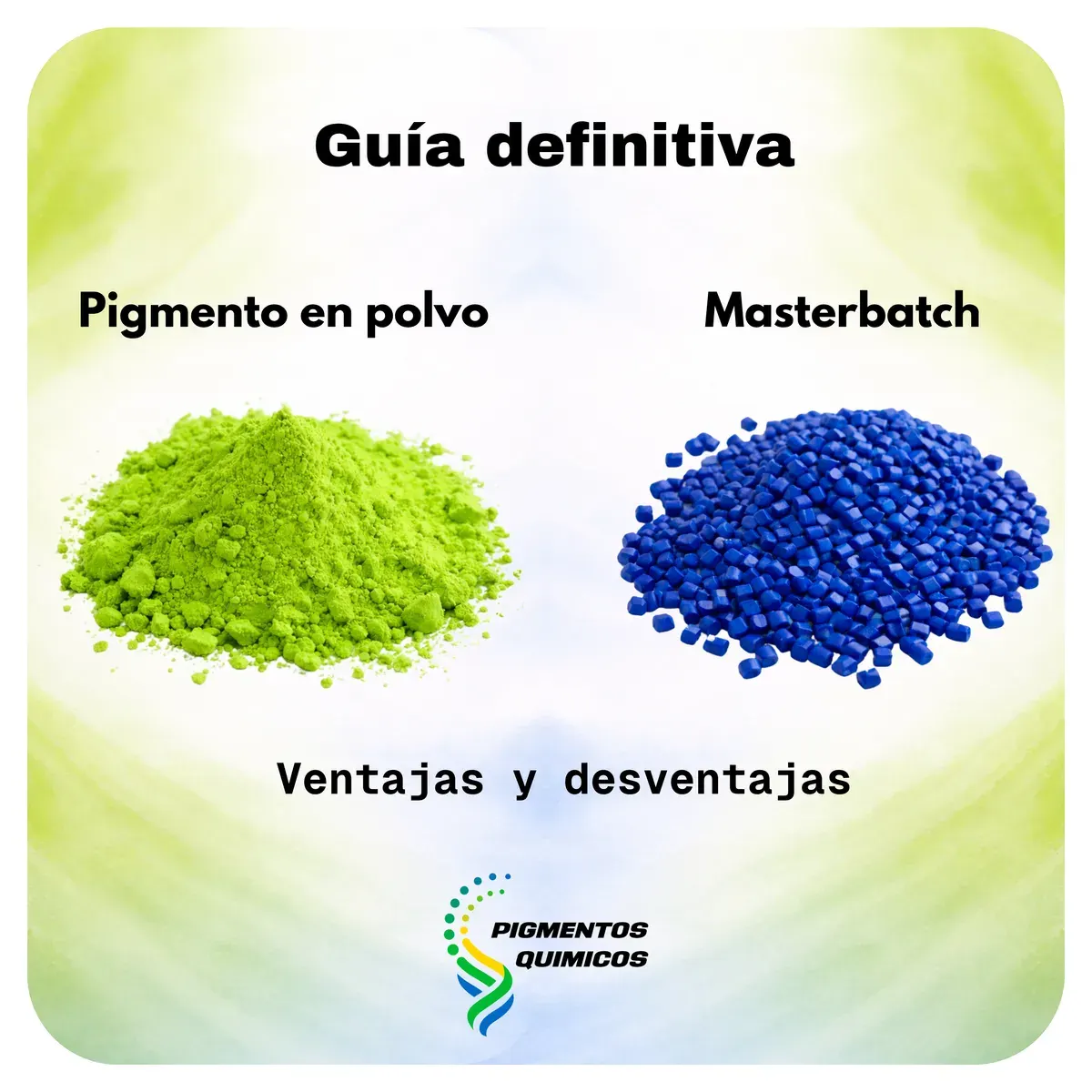
For process engineers and materials specialists who manage the complexity of mass coloring, the technical analysis of the transition from pure pigments to pre-dispersed systems is fundamental. Although in theory powder pigment represents the purest and most economical form of coloring, the reality on the production line reveals that the lack of a carrier vehicle compromises melt homogeneity, generates cross-contamination risks, and dramatically increases uncertainty in chromatic repeatability.
Dispersion Dynamics and Shear Energy
Using powder pigments requires the screw of the extruder or injection molding machine to perform additional mechanical work to break primary agglomerates. If the shear energy is insufficient, non-dispersed color spots are produced that act as mechanical stress concentrators in the part.
In contrast, Masterbatch has already gone through a twin-screw extrusion process, which guarantees that the pigment particles are pre-dispersed and 'wetted' by a carrier resin. This ensures immediate integration into the polymer matrix, optimizing residence time and avoiding variations in final opacity.
Industrial Hygiene and Process Stability
One of the most overlooked technical challenges of powder pigment is its volatility. Fine particles have high surface energy and tend to migrate through air currents, causing contamination in adjacent machines and safety risks for the operator.
Masterbatch, being in pellet format, eliminates airborne contamination and allows exact gravimetric dosing. This reduces human error and feeding fluctuations, which are the main cause of ΔE deviations in long production runs.
Thermodynamic Interaction and Pigment Protection
High-performance organic pigments are sensitive to direct thermal degradation. In the case of powder, the pigment comes into immediate contact with the hot barrel walls. Masterbatch acts as a thermal shield; the carrier resin encapsulates the pigment, providing a more controlled temperature transition.
For materials engineers, it is vital that the Melt Flow Index (MFI) of the Masterbatch carrier is compatible with the base resin. An MFI incompatibility will result in poor color distribution, affecting both the aesthetics and the surface tension of the finished part.