
Piano Black Finish Without Paint: How to Achieve It in Plastics
Three technological routes —high-gloss resins, variotherm control, and IMD— deliver high-gloss black without a single coat of paint, eliminating VOC and painting booth costs.
Piano Black Finish Without Paint: How to Achieve It in Plastics
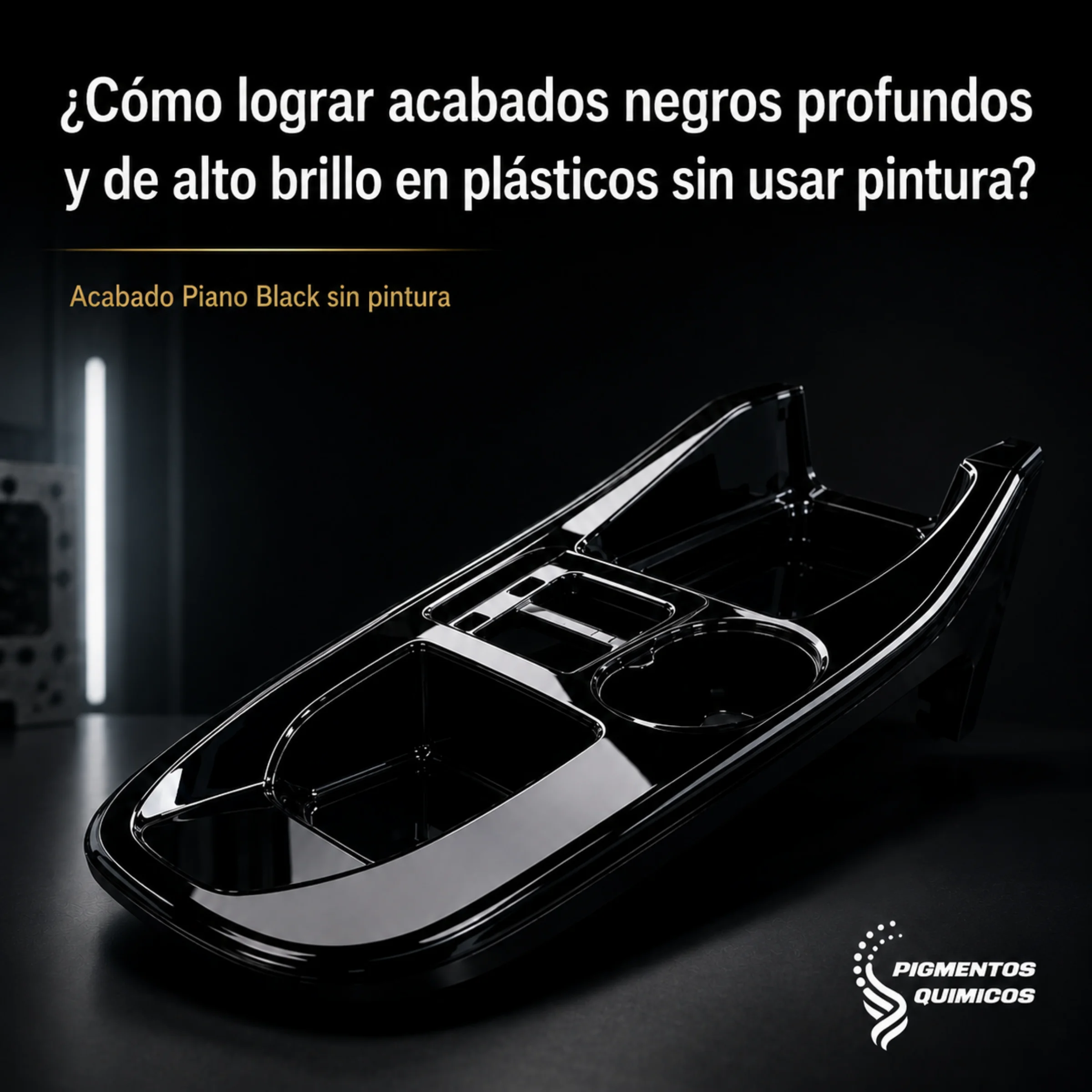
Three technical routes — high-gloss PC/ABS resins, variotherm mold temperature control, and in-mold decoration (IMD) — make it possible to produce deep, mirror-like Piano Black finishes in plastic without a single coat of paint. Each route eliminates VOC emissions, painting booth costs, and the color consistency variation inherent in post-process paint operations.
Piano Black is the benchmark high-gloss finish in automotive interior design, consumer electronics, and premium home appliances. Until a decade ago, achieving it reliably in plastics required a multi-step painting process. Today, three technically mature routes achieve the same visual result directly in the molding process — with better long-term consistency than paint.
Route 1: High-Gloss PC/ABS Resins
Specially formulated PC/ABS grades — marketed as 'high-gloss', 'mirror-finish', or 'piano-quality' by major resin suppliers — are designed to produce surface gloss above 95 GU (Gloss Units at 60°) directly from an injection-molded surface against a high-polish mold. These resins contain flow modifiers and surface-active additives that reduce viscosity in the final flow front, allowing the polymer to replicate the mold surface texture with exceptional fidelity.
The critical mold requirement is a surface finish of SPI A1 or A2 (mirror polish, Ra < 0.025 μm). Any scratch, polishing mark, or micro-texture on the mold surface is replicated on the part. The masterbatch specification for this route requires carbon black of ultra-fine particle size (<15 nm) with maximum dispersion quality — any undispersed carbon black agglomerate > 5 μm will create a visible surface defect under the high-gloss finish.
Route 2: Variotherm Mold Temperature Control
Variotherm technology controls mold surface temperature dynamically throughout the injection cycle: the mold surface is heated to near the polymer's heat deflection temperature (HDT) during injection — preventing premature solidification of the flow front — then rapidly cooled for part ejection. This prevents the surface 'freeze-off' that creates flow marks, weld lines, and micro-texture that reduce gloss.
The result is surface gloss comparable to a painted finish (95–100 GU) using standard injection molding resins that would produce only 60–70 GU with conventional mold temperatures. Variotherm is implemented via steam heating (fastest cycle, highest investment), induction heating (medium cost, very fast response), or hot-water/oil systems (lowest investment, slower cycle).
Route 3: In-Mold Decoration (IMD)
IMD places a pre-printed decorative film into the mold before injection. The resin bonds to the back of the film during injection, and the film's front surface becomes the visible surface of the finished part. For Piano Black, the film provides both the color and the gloss — the resin underneath provides structural support. IMD produces finishes of 95–100+ GU with perfect consistency across all shots because the finish comes from the film, not the mold surface or the resin rheology.
IMD is particularly suited for complex geometries where achieving uniform high-gloss across the entire surface is difficult with Routes 1 or 2, and for designs that combine Piano Black with other graphic elements (logos, metallic accents, texture zones) in a single manufacturing step.
Masterbatch Specification for Paint-Free Piano Black
Regardless of the route chosen, the carbon black masterbatch specification determines the final depth and consistency of the black color. Piano Black requires: carbon black with primary particle size < 15 nm (jet black quality); measured jetness (My value) > 220; fully dispersed with no agglomerates > 5 μm; formulated in a carrier compatible with the host resin. Any compromise on dispersion quality creates a surface that appears dark gray rather than deep black in direct comparison — unacceptable in Piano Black applications.
Frequently Asked Questions (FAQ)
What is the gloss level of a true Piano Black finish?
A Piano Black finish measures 95–100 GU (Gloss Units) at 60° per ASTM D523 or ISO 2813. Standard injection-molded black surfaces typically measure 60–80 GU. The additional 20–40 GU difference is clearly visible as a mirror-like depth rather than a flat gloss. In automotive interiors, 95+ GU is the specification for Piano Black trim, and any surface below 90 GU will be rejected.
Does a paint-free Piano Black finish scratch more easily than painted Piano Black?
It depends on the route and the resin. PC/ABS high-gloss grades typically have scratch resistance slightly below that of a high-quality two-component paint system. This can be improved by adding a scratch-resistant additive masterbatch to the formulation. IMD-based Piano Black has excellent scratch resistance because the hardcoated film provides the surface. Request scratch resistance data per the OEM's specific test method from your resin or masterbatch supplier.