
Masterbatch vs. Liquid Pigments: Technical Analysis to Decide Correctly
Choosing between solid masterbatch and liquid pigment is not about unit price. Dosing stability, color consistency, and changeover cost decide the real cost.
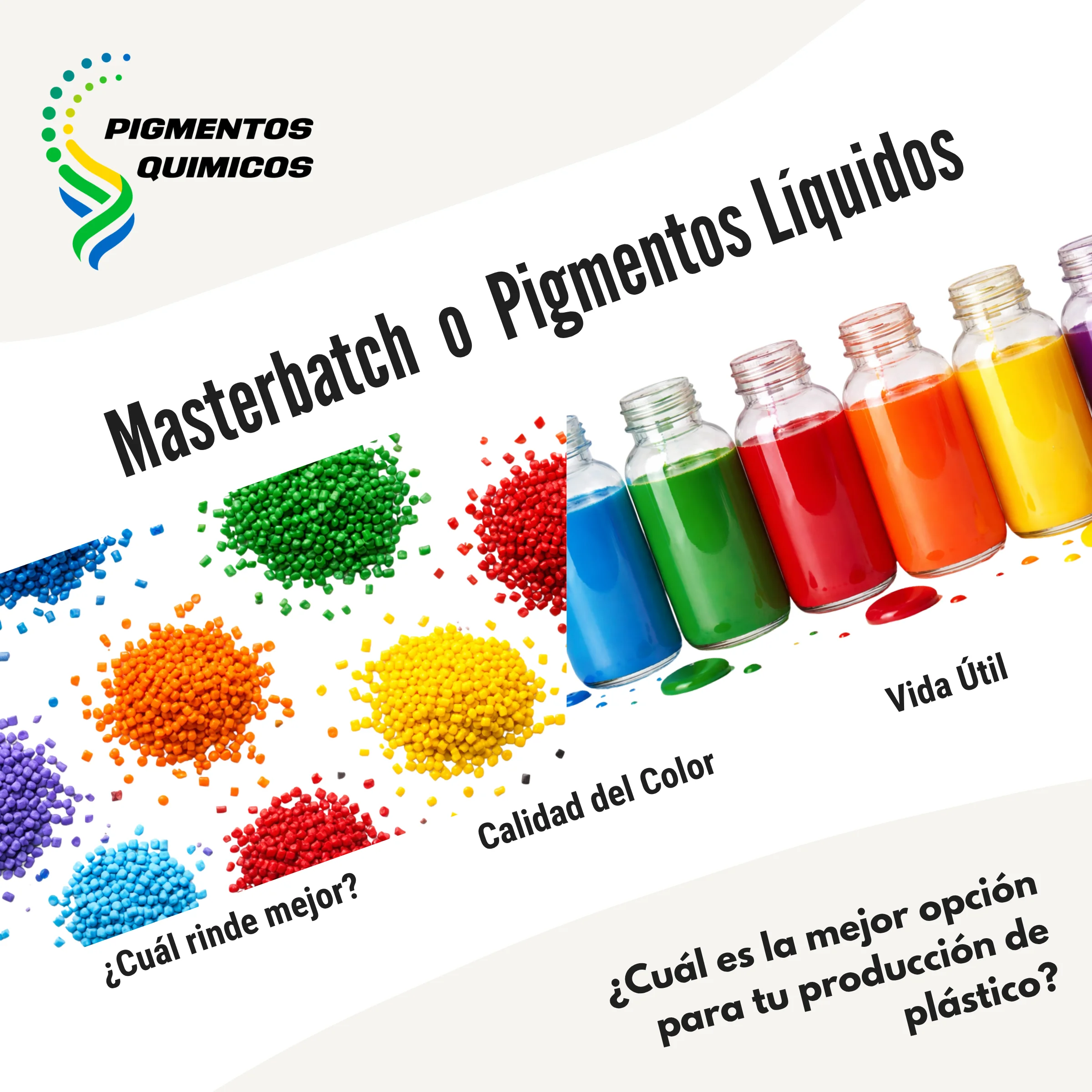
When it comes to coloring plastics at industrial scale, two technologies dominate the market: solid masterbatch and liquid pigments (also called liquid colorants). Each has a specific technical and economic profile, and selecting the wrong one for a given process generates hidden costs that rarely appear in the initial price comparison.
Solid masterbatch: concentrated and precise
Masterbatch is a solid concentrate of pigments and/or additives in a carrier resin. Its main advantages: it is in pellet format (easy to handle, store, and dose), delivers consistent dosing via gravimetric systems, and offers batch-to-batch color repeatability superior to liquid systems.
Its limitation: the pellet dispersion process requires adequate shear energy in the processing machine. In machines with low L/D ratios or low screw back-pressure, poor masterbatch dispersion can produce color spots or streaks.
Liquid pigments: flexibility at a process cost
Liquid pigments are dispersions of organic or inorganic pigments in a liquid carrier (oil, plasticizer, or polyol). Their advantage is incorporation speed and versatility for low-volume runs or processes where minimal residence time in the screw is needed.
Their critical limitation: dosing accuracy depends on the viscosity of the liquid carrier, which varies significantly with temperature. A 10°C difference in ambient temperature can produce 5–15% variation in the volume of pigment delivered by the dosing pump. This variation translates directly to color inconsistency in the finished part.
When to choose each
Masterbatch is the correct choice for opaque or transparent solid colors requiring guaranteed lot-to-lot color consistency, for high-SKU-rotation operations where color change downtime matters, and for any environment where liquid handling represents a hygiene or contamination risk (food packaging, medical, toys).
Liquid pigments are technically justified for metallic or pearlescent effects where particle orientation must be preserved, for very short production runs where the flexibility of not purging outweighs the dosing variability, and for specific processes with minimal screw residence time.
Frequently Asked Questions from production and quality management
Can masterbatch be used on machines originally set up for liquid color?
Yes, with an adaptation of the dosing system. Machines set up for liquid color can be adapted to solid masterbatch dosing by installing a gravimetric pellet doser on the machine hopper. The investment in dosing equipment should be weighed against the projected savings in color consistency and changeover cost.
What advantages does liquid color have in very short production runs?
In very short production runs, liquid color can offer flexibility advantages because the color change happens without an extensive purge and colorant consumption is adjusted without masterbatch scrap. That advantage must be compared against the cost of cleaning the liquid dosing system at the end of the run.
How do I compare the real tinting strength of a masterbatch against a liquid colorant?
A correct comparison requires producing control plaques under identical process conditions, measuring the color intensity achieved with each system at equivalent dosing. Real tinting strength is expressed as the dosing needed to reach a Delta E of 1.0 or less against the approved color standard. At Pigmentos Quimicos we run this comparison as part of the development process when a customer needs a documented decision between the two technologies.