
Masterbatch for Plastics: How to Achieve UV-Resistant World Cup Green
Green for outdoor sports infrastructure requires high-fastness pigments, second-generation HALS, and ASTM G155 validation. An incorrect formulation triggers penalty clauses.
Masterbatch for Plastics: How to Achieve UV-Resistant World Cup Green
Green for outdoor sports infrastructure — seating, barriers, profile cladding, artificial turf accessories — is not a color selection. It is an engineering specification. The pigment type, HALS generation, UV absorber chemistry, and validation standard (ASTM G154/G155) are the four technical decisions that determine whether that green holds its appearance for the required service life or degrades visibly within two seasons.
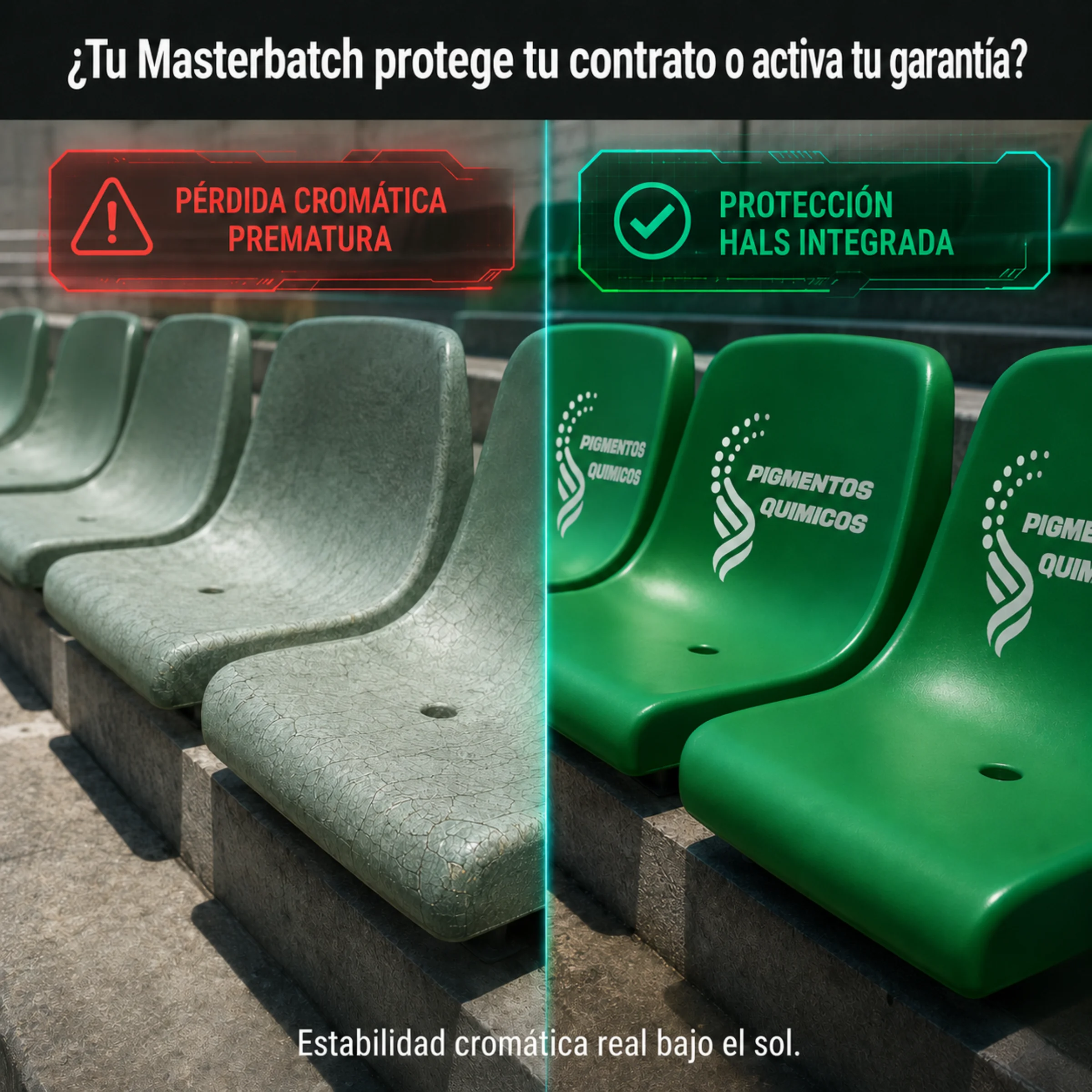
Stadium and sports venue infrastructure increasingly specifies institutional green tones tied to team colors, league standards, or sponsor brand requirements. Each specification has a colorimetric tolerance that the manufactured part must meet at installation — and must continue to meet throughout its warranty period. A formulation error that produces a color within specification at delivery but fails after 12 months of outdoor exposure creates contractual liability.
The Green Pigment Technical Landscape
Green in plastics is almost always achieved by mixing blue and yellow pigments — typically phthalocyanine green (PG7 or PG36), or combinations of phthalocyanine blue (PB15) with organic yellow (PY138, PY147, PY150). Phthalocyanine greens offer excellent UV stability (lightfastness 7–8 on the Blue Wool Scale) and thermal stability up to 300°C, making them the preferred choice for outdoor applications.
Organic yellow pigments vary significantly in UV stability. PY138 (quinophthalone) has moderate stability; PY147 and PY150 offer significantly better outdoor durability. The critical risk in a green formulation is that the yellow component degrades faster than the green, shifting the final color toward blue-green or teal over the part's service life. This shift is particularly damaging in stadium applications where color consistency across hundreds of seats is a visual requirement.
HALS Selection for Outdoor Green
For outdoor sports infrastructure, the minimum specification is a second-generation polymeric HALS (e.g., Tinuvin 622, Chimassorb 944, or equivalent) at 0.3–0.5% over the base resin. First-generation monomeric HALS are insufficient for multi-year outdoor warranties because they volatilize during high-temperature processing and extract from the polymer surface under rainfall.
An important compatibility note: some HALS types — specifically those with basic nitrogen groups — are deactivated by acidic pigments common in green formulations (certain azo yellows have an acidic surface that reacts with HALS and reduces its efficacy). Specify HALS compatibility with the specific pigment combination to your masterbatch supplier.
UV Absorber Specification
Benzotriazole UV absorbers (e.g., Tinuvin 328, 329, 360) are the standard complement to HALS in outdoor plastic formulations. They provide the primary UV screening mechanism while HALS handles the radical interception. In green-pigmented parts, the UV absorber also protects the pigment from direct photodecomposition — a mechanism independent of the polymer matrix protection that HALS provides.
Hydroxyphenyltriazine UV absorbers (e.g., Tinuvin 1577) offer superior migration resistance compared to conventional benzotriazoles, making them preferable in thin-profile applications (seat backs, profile cladding) where extraction by rain and cleaning agents is a concern.
Validation: ASTM G155 (Xenon Arc)
ASTM G155 simulates broadband solar radiation including UV, visible, and near-infrared wavelengths. It is the international standard for outdoor durability validation of plastics intended for high-UV environments (tropical, equatorial, desert, high altitude). The test measures ΔE (color shift), gloss retention, and mechanical property retention at defined exposure intervals (500, 1000, 2000, 3000 kJ/m²).
For a 10-year outdoor service life warranty in a mid-latitude climate, a ΔE < 2.0 at 2000 kJ/m² xenon exposure is the generally accepted threshold. Any formulation that cannot meet this criterion should not be specified for outdoor stadium infrastructure. Request ASTM G155 test data from your masterbatch supplier for the specific color and polymer combination before committing to a specification.
Frequently Asked Questions (FAQ)
What is the difference between ASTM G154 and ASTM G155 for outdoor plastic testing?
ASTM G154 uses fluorescent UV lamps (UVA-340 or UVB-313) and simulates the UV portion of the solar spectrum. It is faster and less expensive, suitable for comparative screening and quality control. ASTM G155 uses a xenon arc lamp that simulates the full solar spectrum (UV + visible + near-IR) more accurately, making it the preferred standard for final specification validation and warranty documentation. For outdoor sports infrastructure, ASTM G155 data is the technical requirement.
Can an incorrect masterbatch invalidate a color warranty for stadium components?
Yes, and this has real contractual consequences. Stadium contracts frequently include color performance clauses with ΔE tolerances and mandatory replacement provisions for parts that deviate beyond the specified tolerance within the warranty period. A formulation that was not validated under the specified test standard provides no technical basis for defending against a warranty claim. Documentation of ASTM G155 test results at time of specification is the required evidence.