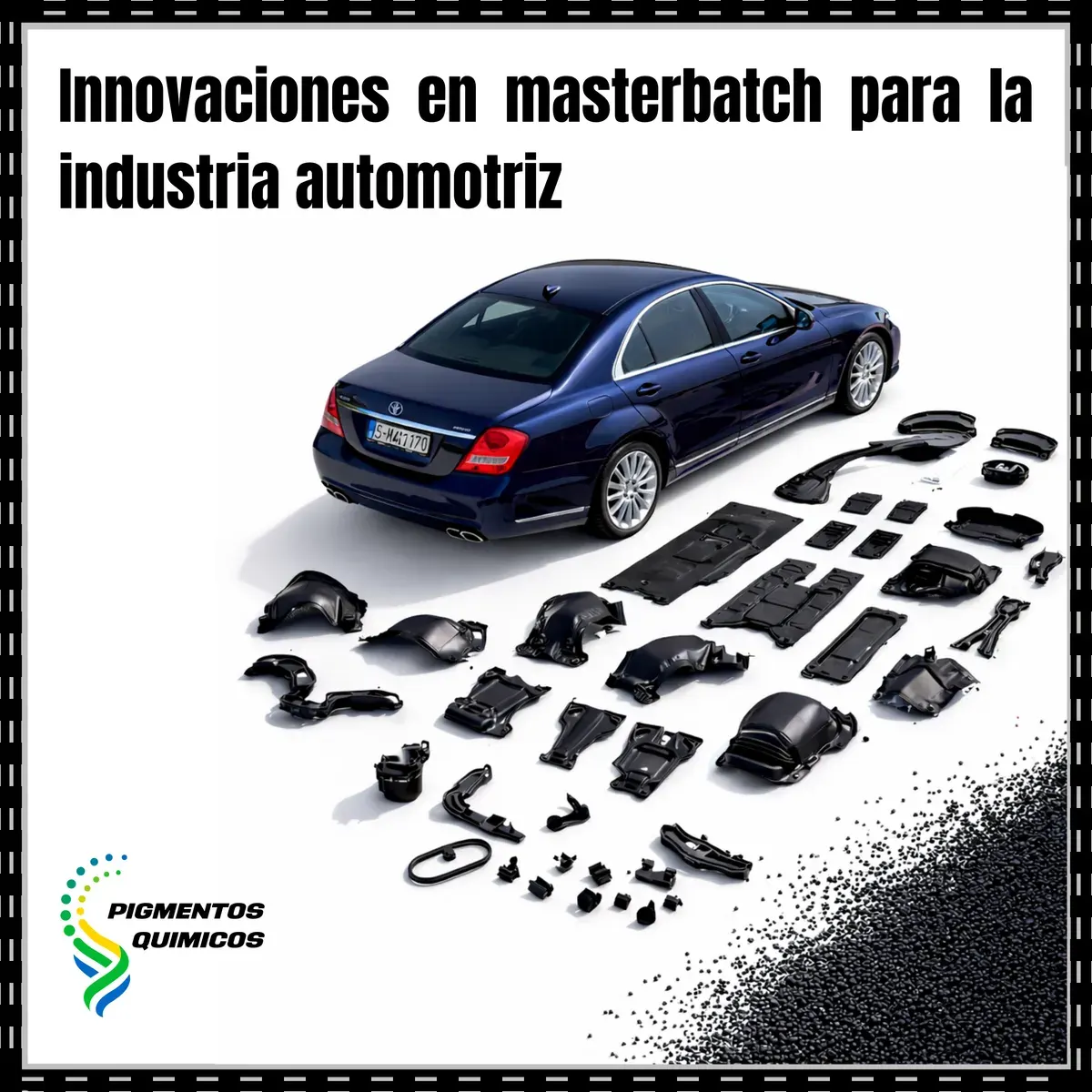
Masterbatch Innovations for the Automotive Industry
The global automotive industry is undergoing rapid transformation driven by electric mobility and increasingly strict environmental regulations. In this landscape, Masterbatch is a multifunctional technological solution that determines whether a plastic component is viable.
The global automotive industry is undergoing rapid transformation, driven by electric mobility and increasingly strict environmental regulations. In this landscape, Masterbatch is no longer understood as 'just color': today it is a multifunctional technological solution that delivers performance, stability, and regulatory compliance.
1. Light-weighting: foaming agents and weight reduction
In electric vehicles, every gram matters. Less weight means more range and better energy efficiency. That is why Masterbatch with next-generation chemical foaming agents (CFA) has become a key tool for optimizing plastic parts without sacrificing performance:
- Density reduction: part weight reduction of 5% to 20%, maintaining the structural integrity of the component.
- Fewer surface defects and better finish: improved flow in the mold, especially in thick-wall parts, achieving more stable and aesthetic surfaces.
- Shorter cycles: controlled expansion within the polymer matrix allows cooling times to be reduced, increasing injection productivity.
2. Paint replacement: Mold-in-Color (MIC) finishes
One of the most important advances in efficiency and sustainability is eliminating painting processes. Mold-in-Color finishes reduce costs, simplify the production chain, and decrease VOC (volatile organic compound) emissions.
3. Thermal stability and advanced UV resistance
Automotive interiors and exteriors are exposed to aggressive thermal cycles, constant solar radiation, and accelerated aging. That is why modern systems integrate light stabilizers (HALS) and UV absorbers within the Masterbatch to ensure:
- Polymer integrity: protection against molecular chain degradation in PP and other engineering plastics.
- Color permanence: control of chromatic deviation (ΔE) to remain within OEM standards even after aging tests of more than 2,000 hours.
4. Challenges of recycled resin (PCR) and how to solve them
The circular economy is driving the use of post-consumer resin in non-structural parts. However, PCR brings real challenges: residual odor, tone variations, and a less stable visual base. Today's automotive Masterbatch incorporates specific solutions such as:
At Pigmentos Químicos, we develop and supply Masterbatch and additives for automotive applications, focused on process efficiency, premium aesthetics, and technical compliance.