
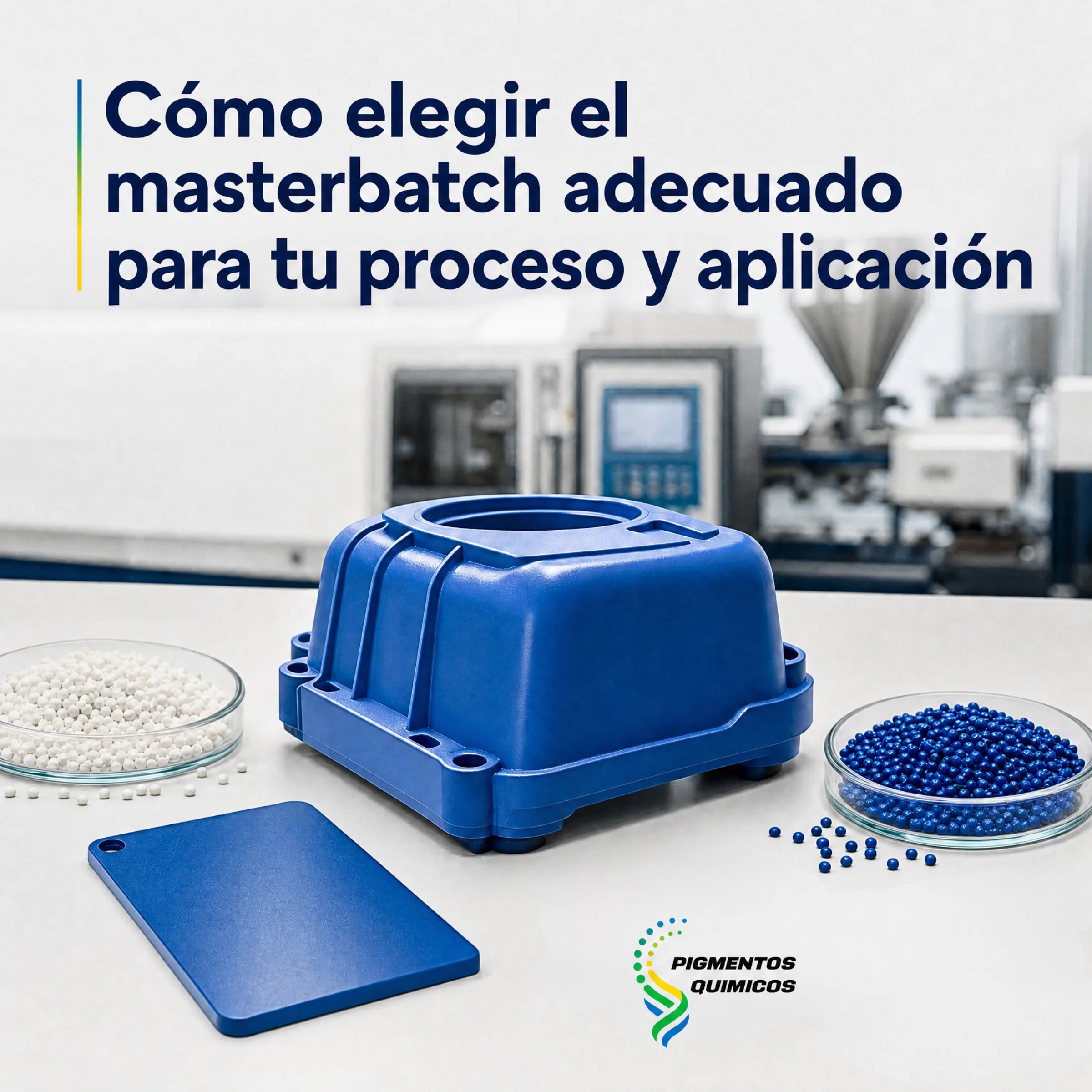
How to Choose the Right Masterbatch for Your Process and Application
Choosing the right masterbatch requires four inputs before the color: base resin, transformation process, processing temperatures, and the final application of the product.
The most common mistake when selecting masterbatch is starting with the color and leaving the resin and final application for later. Those two variables determine whether the masterbatch will actually perform in process. Color is the result; process conditions determine whether that result can be achieved consistently and repeatably.
Variable 1: the resin
The client's base resin is the first data point that defines which masterbatch can work. Compatibility between the masterbatch's carrier resin and the client's base resin is critical. If that compatibility fails, problems can appear: poor dispersion, visual separation, surface defects, or color variation between lots. Pigmentos Químicos masterbatch is compatible with PE, PP, PS, PC, PET, and ABS. For other resins, specific compatibility evaluation is recommended before defining a formulation.
The resin does not just define technical compatibility — it also affects how color is perceived in the finished part. A clear, translucent, or milky resin may make the same masterbatch look different than in an opaque resin. A Pantone or RAL reference is a starting point, not a final approval: color must be validated in the actual client resin and process before approving for production.
Resins sometimes contain fillers or modifiers — fiberglass, talc, or mineral fillers — that can affect masterbatch compatibility and behavior during processing. A development for Nylon 66 with fiberglass filler illustrated this: the client reported bubbles and streaks in finished parts as if there were a pigment problem. Technical analysis showed the fiberglass was not integrating correctly with the polyamide and the thermal process parameters were causing degassing. The solution required reviewing process parameters and reformulating the masterbatch for the actual processing window of that blend. Knowing the complete resin composition, including any fillers, is part of a technically correct recommendation.
Variable 2: the transformation process
Temperature, residence time, and mechanical stress vary between injection molding, extrusion, blow molding, and film production. Each process imposes different demands on the masterbatch and can affect pigment dispersion, stability, and the visual outcome of the finished part.
Variable 3: temperature and residence time
Processing temperature and residence time are the most underestimated variables and the ones that generate the most defects when not controlled. If the plastic exceeds its thermal range or spends too long in the hot barrel, it can burn, generate streaks, become brittle, or compromise additive performance. When this happens, the problem is often attributed to the pigment — when the root cause is actually the process.
Before modifying masterbatch, always review temperature, residence time, and general process conditions when a visual defect appears. This also applies when working with pigments that have lower thermal resistance, such as fluorescents or vivid colors: the pigment type within the formulation also responds to the thermal conditions of the process.
Variable 4: the final application
The product's final application determines whether the masterbatch needs additional properties beyond color. Without this information, the recommendation may result in a material that reaches production without meeting finished product requirements.
Line masterbatch vs. custom development: when to use each
Why evaluating only price per kilo can cost more
In plastic coloring, price per kilo does not tell the full story. If the material generates scrap, requires constant adjustments, or causes process problems, the real cost can be much higher than the initial masterbatch price. A poorly selected masterbatch or one with insufficient technical support can cause color variations that result in rejections, reprocessing, or machine adjustments — costs that do not appear in the initial quote but do appear in production.
Frequently asked questions
Can I use the same masterbatch if I change resin suppliers?
Possibly not. The resin affects how color looks and performs. If the resin or supplier changes, the development should be reviewed before volume production. The same formulation can produce different results with resin from a different source, even if it is the same polymer type and grade.
What happens if the part changes tone between lots?
It may be due to the resin, dosing, temperature, residence time, machine cleanliness, or even the light source under which the color is evaluated. Before modifying the masterbatch, review all process variables. The root cause is not always the pigment.
Do I need custom development if I already have a Pantone reference?
Generally yes, if the color must match precisely. A Pantone reference is a starting point, not a final approval. Color must be validated in the actual client resin and process before approving for production. A line color may match visually, but if the project requires exact matching, custom development is the appropriate path.
How long does a color development take?
Estimated time is 7 to 10 business days after sample approval. For validation, Pigmentos Químicos provides a 1 kg sample at no charge for custom developments.