How to Choose the Right Masterbatch for Your Base Polymer
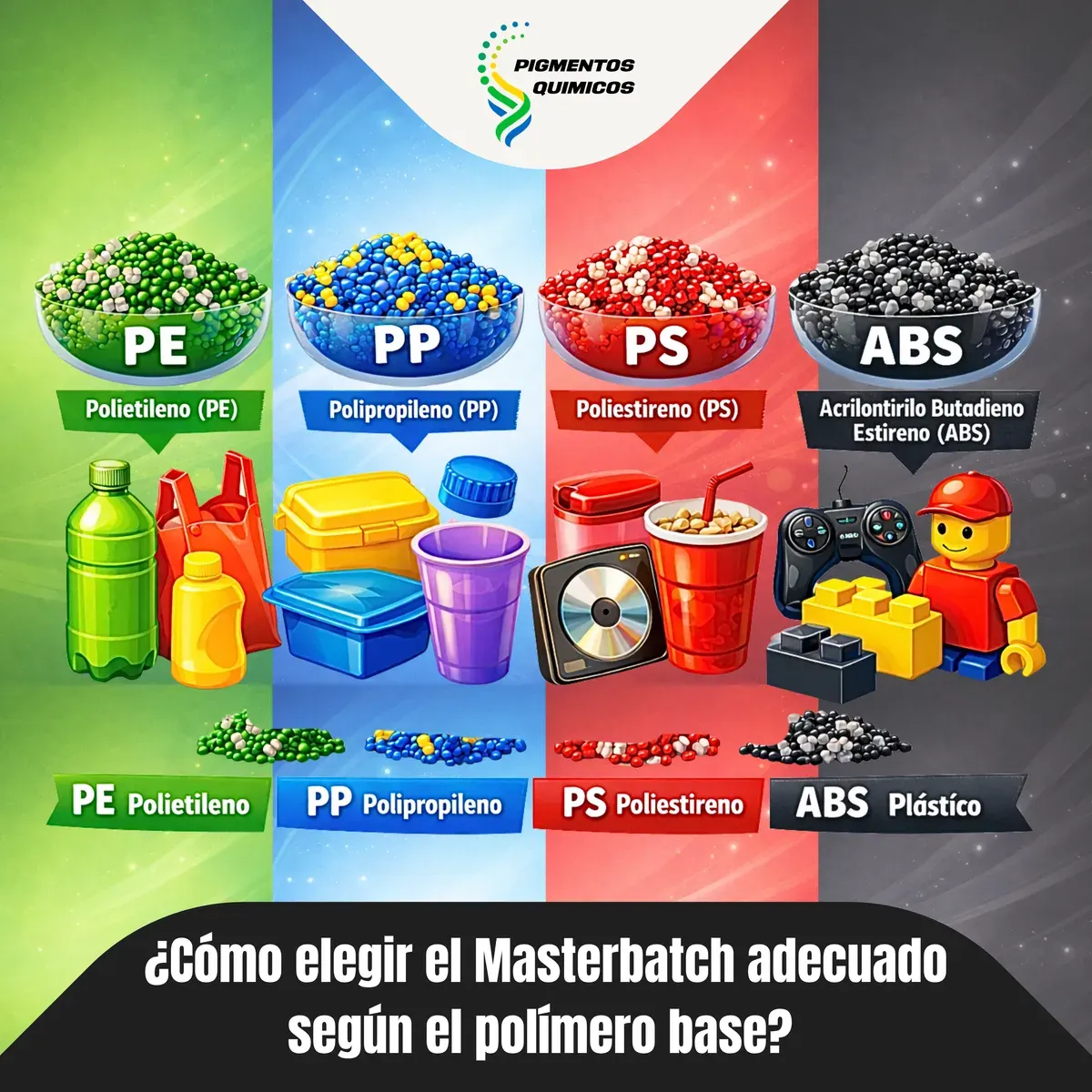
In plastics processing, coloring success does not depend solely on pigment concentration or quality. The decisive factor is usually the compatibility between the Masterbatch and the virgin resin.
In plastics processing, coloring success does not depend only on pigment concentration or quality. The decisive factor is usually something else: compatibility between the Masterbatch and the virgin resin. Choosing the wrong carrier resin can result in delamination, loss of mechanical properties, adhesion problems, or poor dispersion that ruins the final finish.
1) Chemical compatibility and polarity
The fundamental rule in development is simple: 'like dissolves like.' Molecular polarity determines whether the Masterbatch will be incorporated homogeneously or whether it will behave like a 'foreign body' within the polymer.
2) Melt Flow Index (MFI): dispersion and rheology
For real dispersion, rheology rules. In practical terms, the technical rule is: the MFI of the Masterbatch must be higher than that of the base resin.
- If the Masterbatch has a lower MFI (i.e., is more viscous), the concentrate does not 'open' correctly during mixing and streaks, color clouds, or marbling appear.
- When the Masterbatch has higher fluidity, it distributes rapidly during screw shear and achieves dispersion before the base resin reaches its process viscosity, generating uniform color and batch-to-batch stability.
3) Thermal stability and melting points
The Masterbatch carrier must have a melting point equal to or slightly lower than that of the base resin. This ensures that the concentrate melts early and disperses well from the initial stage of the process.
4) Universal carriers: when are they suitable?
There are Masterbatches with 'universal' carriers, designed to operate in a wider range of resins.