
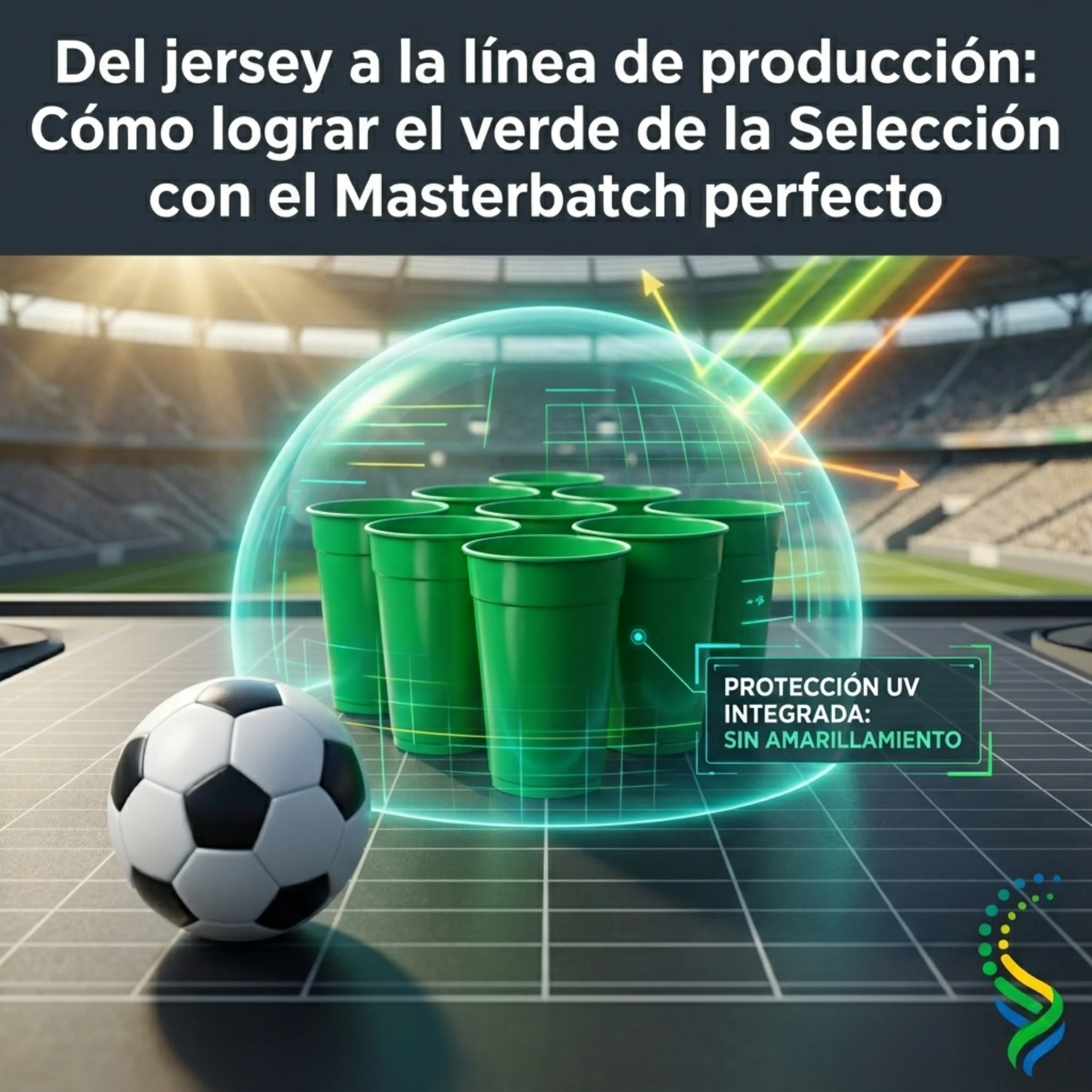
How to Achieve the National Team Green with the Perfect Masterbatch
Reproducing Mexico's national team green in plastic demands spectrophotometric control, Delta E below 1.0, and a pigment formulation validated for each resin and process.
How to Achieve the National Team Green with the Perfect Masterbatch
Reproducing an institutional green — Mexico's national football team jersey color, a league-mandated brand standard, or a sponsor's Pantone specification — in plastic demands spectrophotometric control, a Delta E below 1.0 under D65/10° illuminant, and a pigment formulation validated for the specific resin and process parameters. Visual approval is insufficient for this class of color.
Institutional color reproduction in plastic is one of the most technically demanding color matching challenges because it combines three variables that are each independently difficult to control: the spectral complexity of green formulations, the resin-dependent optical behavior of pigments, and the need for consistency across production batches that may span weeks or months.
Why Green Is the Most Demanding Color to Match
Green sits at the peak of human visual sensitivity (approximately 555 nm). The human eye can detect color differences in the green region of the spectrum at ΔE values as low as 0.5–0.8 — much smaller than for red or blue. This means a green that passes a ΔE < 1.0 tolerance in laboratory conditions may still appear slightly off to a trained observer under certain lighting conditions. Institutional greens for sports applications are typically defined with ΔE < 0.8 tolerances for approval.
Green formulations also require multiple pigments to achieve the target hue — typically a phthalocyanine green or blue combined with one or two yellow pigments — and the spectral behavior of each pigment interacts differently depending on the host resin's refractive index, crystallinity, and surface finish. A formulation that matches in PP may require different pigment ratios to match in ABS.
The Spectrophotometric Matching Process
Institutional color reproduction begins with a spectrophotometric scan of the target — the official jersey fabric, the approved Pantone chip in physical form, or a reference part from the brand's approved supplier. This scan generates the L*a*b* and spectral reflectance curve of the target color under defined illuminant conditions (D65/10° is the international standard for plastics color matching).
The formulation laboratory then builds a computer color match (CCM) starting from the target spectral curve. Modern CCM software selects pigment combinations from the available palette and predicts the combination that minimizes ΔE while also minimizing metamerism — the risk that the match holds under D65 but fails under incandescent (illuminant A) or fluorescent (F11) light. For institutional brand colors, metamerism index below 1.0 under all three standard illuminants is the professional requirement.
Let-Down Ratio and Batch Consistency
Once the formula is validated in the target resin, the let-down ratio must be fixed and controlled to ±0.05% in production. A dosing variation of 0.1% in a concentrated green masterbatch can produce a ΔE shift of 0.3–0.8 — enough to exceed tolerance in a tight institutional color specification. Gravimetric dosing systems are required for this class of application; volumetric dosers are not sufficiently accurate.
Batch-to-batch consistency requires that every masterbatch lot be measured spectrophotometrically against the approved master standard before release. The Certificate of Analysis (CoA) must include the ΔE value versus master under D65/10° and, for institutional colors, the metamerism index under illuminant A. Lots with ΔE > 0.8 versus master should be rejected or used only in non-visible areas.
Resin Qualification and the Color Consistency Rule
The institutional color formula must be qualified in the exact resin grade used in production — not just the resin family. A change of MFI grade within the same resin family (e.g., from PP MFI 12 to PP MFI 25) can produce a measurable color shift due to differences in crystallinity, processing temperature, and shear history. A formula re-qualification test is required any time the base resin grade changes.
Frequently Asked Questions (FAQ)
What ΔE tolerance is acceptable for institutional color in plastics?
For automotive interior, consumer electronics, and sports brand applications, ΔE < 1.0 under D65/10° is the standard tolerance. For very demanding applications — luxury brand packaging, high-visibility safety equipment, institutional sports colors — ΔE < 0.5 is specified. ΔE above 2.0 is detectable by any observer in direct comparison; above 3.5, it is detectable without a reference.
Can I reproduce a Pantone color in plastic directly from the Pantone number?
No. Pantone guides are printed on coated or uncoated paper and use ink-based colorant systems with spectral characteristics very different from plastic pigments. A Pantone number identifies a visual target, not a pigment formula. The correct process is to scan the physical Pantone chip spectrophotometrically and use computer color matching to find the best pigment formulation for your specific resin. The resulting plastic color may require a different L*a*b* value than the Pantone card to achieve the same visual appearance, due to the different surface and optical properties of plastic versus paper.