

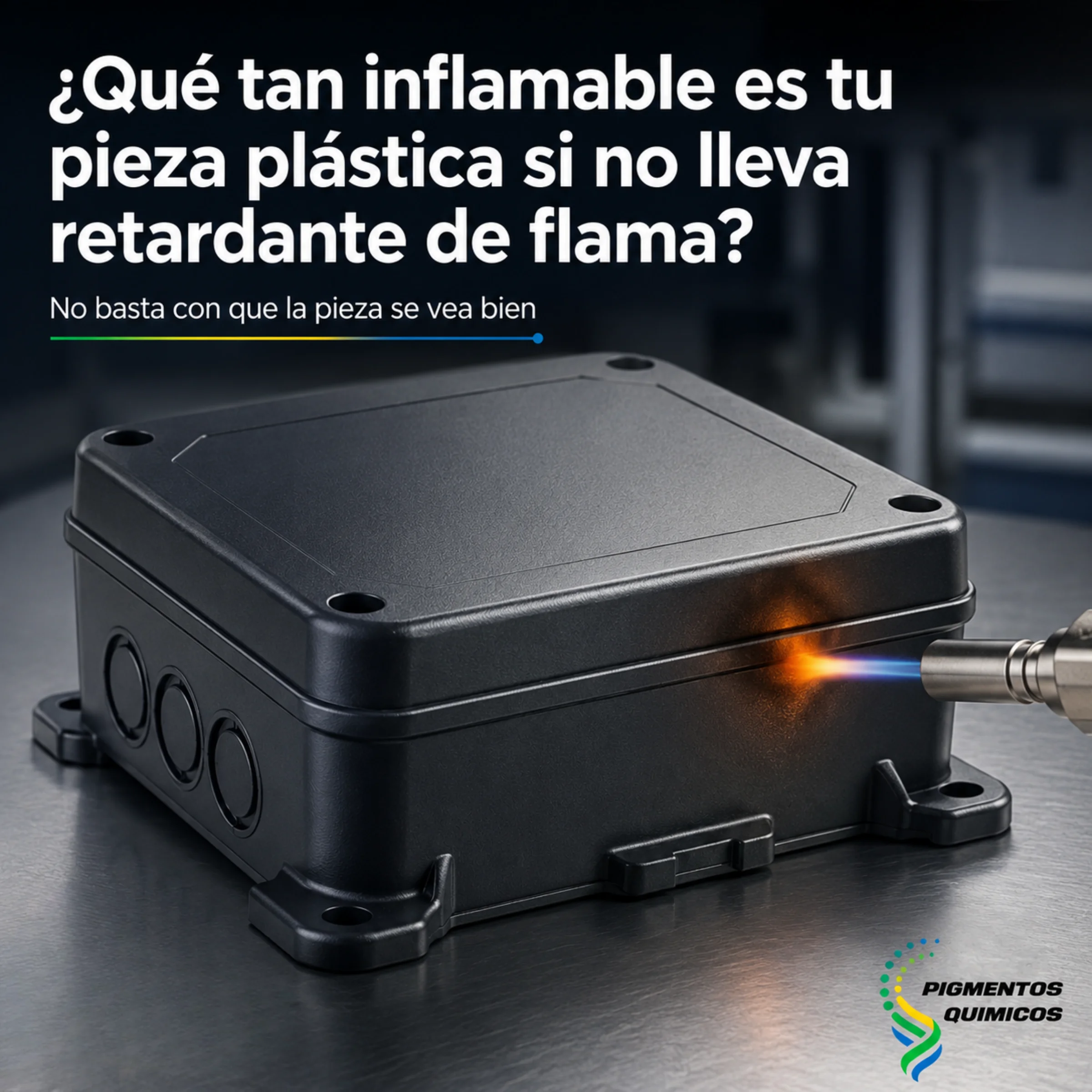
How Flammable Is Your Plastic Part Without Flame Retardant?
Most plastic resins are combustible by nature. We explain when your part needs flame retardant and what variables define its formulation.
An electrical enclosure molded in polypropylene can pass every dimensional, assembly, and finish inspection, and still fail approval if it doesn't survive the flammability test the end client requires. When that happens, it isn't a single part that gets rejected: the assembly line stops while the component is reformulated, the entire production run for the period is lost, and the plastics supplier gets dropped from the next quote. For a company manufacturing electrical, electronic, or heat-exposed components, that test isn't a formality. It's the difference between keeping the contract or losing it.
Most plastic resins are combustible by nature. Flame retardant is a functional additive that slows fire propagation, and whether you need it depends on the part's end application, not on the type of product you manufacture.
The risk most processors discover too late
Polypropylene, polyethylene, ABS, and most industrial-grade resins don't come with flame protection by nature. Without a specific additive, these resins behave like any organic material near fire: they ignite easily and propagate flame quickly.
That behavior isn't always a problem. An indoor decorative part with no exposure to heat sources or electrical current may not need flame retardant at all. The risk appears when the end application involves electricity, heat, enclosed spaces with limited ventilation, or sector-specific safety regulations, and nobody evaluated that variable before defining the formulation.
The cost of discovering that gap during a client's final test, or after the product has already been installed, is usually far higher than the cost of evaluating the additive during development.
How a flame retardant acts during combustion
In general terms, a flame retardant intervenes at some stage of the combustion reaction: it can interrupt the chemical reaction that sustains the flame, form a charred layer that isolates the material from oxygen, or release compounds that dilute the flammable gases generated during burning.
The specific mechanism that makes sense depends on the resin type, the transformation process, and the safety standard the part must meet. That's why a flame retardant isn't chosen for its function alone; it's selected together with the resin, the process, and the product's end application.
Which applications can't risk skipping this additive
Some applications concentrate most of the risk when this additive is left out:
Just like with UV protection, adding flame retardant to a part that doesn't need it only raises the cost of the formulation without delivering any real benefit. Before deciding, it's worth asking whether your part will be exposed to electrical current, heat, or sector regulations, rather than assuming the answer out of habit.
Why flame retardant isn't added to just any resin
Flame retardant is an additive, and an additive on its own can't compensate for a poorly selected resin. The resin accounts for most of the final part's mass, while the additive occupies a smaller fraction of the formulation. If the base resin isn't compatible with the type of retardant the application requires, the additive's performance is compromised from the start.
Before recommending a flame-retardant formulation, four data points are needed: the exact base resin, the transformation process, the temperature and residence time in the machine, and the product's end application. Without that information, any technical recommendation is incomplete.
Flame retardant dosing isn't defined at random either. It depends on the level of protection the application requires and the applicable regulation, and it should be evaluated together with the technical supplier before moving to production.
When it makes sense to evaluate a flame-retardant development
If your part has regulatory requirements, exposure to electrical current, or heat conditions during use, a custom development allows the flame retardant to be formulated around your resin, your process, and your end application, instead of starting from a generic solution.
At Pigmentos Químicos, a custom development starts with a 1-kilogram sample at no cost for validation, a 100-kilogram minimum order, and an estimated turnaround of 7 to 10 business days after sample approval. That prior validation confirms the additive's performance before committing a full production batch.
Common mistakes when requesting a flame-retardant development
The most frequent mistake is requesting "a plastic that won't burn" without specifying the end application or the standard the part must meet. Without that data, it's impossible to know what level of protection is needed or what type of retardant is compatible with the resin.
Another common mistake is assuming the same flame retardant performs identically across every process. An additive formulated for injection molding can behave differently in extrusion or blow molding, because temperature and residence time change between processes.
Producing volume without validating a sample first is also a risky practice. If there's an error in the formulation or the dosing, that error replicates across the entire batch, which can result in parts that fail the flammability test after production has already been committed.
Frequently asked questions
Does any color masterbatch include flame protection?
No. Flame retardant is a functional additive independent of color. If your part needs both properties, they must be evaluated and formulated together from development.
Does flame retardant change the color or final appearance of the part?
It can affect appearance depending on the type and loading of the additive used. That's why it's worth validating with a sample before approving production, as with any custom development.
What information should I share to evaluate whether my part needs flame retardant?
The product's end application, whether it will be in contact with electrical current or heat sources, the applicable regulation if any, and the exact base resin you use.