
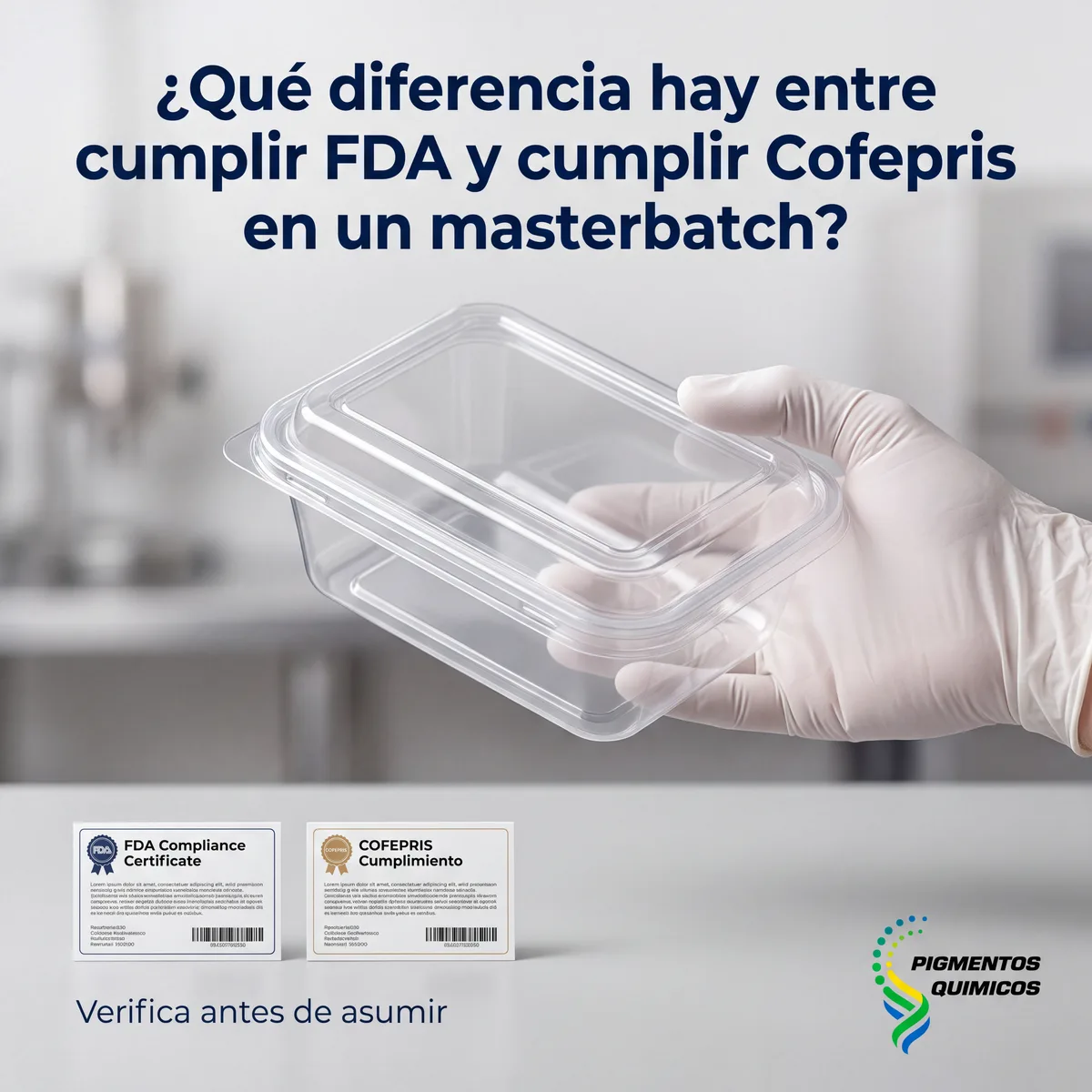
What's the Difference Between FDA and Cofepris Compliance for a Masterbatch?
FDA compliance certifies the additive in the United States. Cofepris demands extra documentation and traceability. A masterbatch can meet one and not the other.
Your supplier hands you the masterbatch technical data sheet stamped "FDA compliant," and you assume that same batch can go straight into packaging for the Mexican market without any observations. Weeks later, your client's quality team sends the entire order back because the colorant additive lacks the backing Cofepris requires for food contact within Mexican territory. The batch sits stalled in your warehouse, the client reschedules its filling line, and your sales team has to explain why a product "approved in the United States" isn't valid for sale in Mexico.
Meeting FDA requirements certifies the additive under the U.S. regulatory framework. Meeting Cofepris requirements demands additional documentation and traceability to sell in Mexico. A masterbatch can meet one without automatically meeting the other.
Why assuming "FDA compliant" solves everything can cost you an entire contract
At Pigmentos Químicos we frequently see the same confusion among masterbatch buyers: they treat FDA compliance and Cofepris compliance as if they were the same paperwork under a different name, when in reality they're two independent regulatory frameworks, with different authorities, different evaluation criteria, and different documentation. When your plant buys a colorant additive for food packaging assuming one stamp is interchangeable with the other, the risk doesn't stay on paper: it turns into a rejected batch, a failed client audit, or a merchandise return that already traveled halfway through the distribution chain.
The FDA (Food and Drug Administration) regulates, under the U.S. Code of Federal Regulations, specifically Title 21, which substances can come into direct or indirect contact with food. An "FDA compliant" pigment or additive meets the migration, purity, and composition limits that framework requires for the U.S. market. Cofepris, the Federal Commission for Protection against Sanitary Risks, is the equivalent Mexican authority, but it operates under its own regulatory framework, referencing the Normas Oficiales Mexicanas that apply to materials in contact with food and beverages. An ingredient being FDA-authorized doesn't mean Cofepris automatically recognizes it for commercial use in Mexico.
Where the misunderstanding comes from: the regulatory equivalence that doesn't exist
The mistake keeps happening because, in technical practice, many of the pigments and additives that meet FDA requirements are also suitable for Cofepris compliance once the correct documentation is generated. That frequent overlap leads buyers, and even some suppliers, to assume compliance transfers automatically with no additional paperwork. The operational reality is different: Cofepris requires the manufacturer or importer to submit its own documentary evidence, in many cases with specific migration tests and technical data sheets aligned to Mexican regulations, without the U.S. certificate substituting for that requirement on its own.
For your plant, this means the question that actually matters always centers on the regulatory framework and the destination market under which the evidence was generated, beyond whether the masterbatch "is food-grade" in the abstract. A product you export to the United States under FDA backing, and that same product you distribute within Mexican territory, require two separate compliance files, even if the masterbatch formula is identical.
The three points where a Mexican plant loses time and money by mixing both frameworks
We've identified three moments in the purchasing process where this confusion generates the highest operational cost. The first happens at the quotation stage, when the buyer requests "food-grade certification" without specifying whether they need FDA backing, Cofepris backing, or both, and the supplier responds with whatever documentation is on hand without validating whether it matches the finished product's actual destination market. The second happens at raw material receiving, when the plant's quality team accepts an FDA certificate for a product that will be sold exclusively in Mexico, without requiring the corresponding Cofepris backing. The third, the most costly, happens during the end client's audit: a food or beverage brand that audits its packaging supplier and discovers the masterbatch used in the package lacks the Mexican regulatory traceability its own quality framework requires.
Documentary traceability: the file Cofepris asks for that the FDA doesn't always require the same way
Documentary traceability is the technical mechanism that separates apparent compliance from real compliance. Cofepris tends to request a more detailed file about the origin of each masterbatch component, including pigments, additives, and carrier resin, with safety data sheets and evidence that each individual substance is permitted for food contact under current Mexican regulations. The FDA, while it also requires traceability, structures its evaluation differently and doesn't always require the same level of per-component documentation that the Mexican authority asks for. When your plant only keeps the FDA certificate and not the Cofepris file, any audit from your client in Mexico is going to find that documentary gap, regardless of whether the product itself is safe for food contact.
At Pigmentos Químicos we build both files in from the masterbatch's development stage whenever the product's commercial destination requires it, precisely so your quality team doesn't have to reconstruct traceability after the client asks for it.
What not distinguishing these two frameworks before signing the order costs your plant
The cost of this confusion isn't only regulatory: it's commercial and reputational. A production batch that gets stopped at customs or in your client's warehouse for lack of Cofepris backing means rescheduling the client's filling line, absorbing the logistics cost of the return, and in many cases, renegotiating commercial trust with a brand that had already approved your product at the sample stage. For a packaging or finished-product manufacturer, a single incident like this can mean losing a recurring contract, because quality teams at major food and beverage brands document these compliance failures as part of their supplier history.
Our operational recommendation is simple: before approving a masterbatch for a food-contact product, your purchasing team should explicitly ask which market the finished product is headed for and request the documentary backing that matches that market, without assuming an international stamp automatically covers the Mexican requirement.
How to keep this mistake from reaching your production line
The protocol we apply at Pigmentos Químicos for food-grade masterbatch starts by identifying the finished product's destination market from the quotation stage, not after production. We document FDA backing when the client exports to the United States, Cofepris backing when the destination is the Mexican market, and both files when the client distributes in both markets simultaneously. That upfront validation keeps your plant from discovering the documentary gap at the most expensive stage of the process, which is when the product is already manufactured and in transit to your client.
A masterbatch properly documented from the start protects your operation from an avoidable rejection, and it also protects the commercial relationship with your client, who trusts that your plant delivers the correct color along with the regulatory backing their own business needs to operate without surprises.
The extra risk for your plant when you export to the United States and also sell in Mexico
A growing number of Mexican packaging manufacturers simultaneously serve clients that export to the United States and clients that distribute exclusively in the domestic market. For your plant, this means the same tank of masterbatch can end up in two different regulatory destinations depending on the order, and the compliance file needs to reflect that operational reality, not a generic "food-grade" assumption meant to cover both cases equally.
When your production line supplies both types of clients, documentary control becomes an internal responsibility of your plant, not just your masterbatch supplier's. Your quality team needs to know, order by order, which file corresponds to which destination, so they can show the correct backing within minutes when a client requests it, instead of reconstructing traceability after an audit has already started.
Normas Oficiales Mexicanas: the technical reference behind the Cofepris file
The backing Cofepris requires for food-contact materials rests on the Normas Oficiales Mexicanas that apply to containers, packaging, and materials that come into direct or indirect contact with food products. These standards set the migration limits for substances into food and the composition criteria every masterbatch component must meet, from the pigment to the carrier resin. A complete Cofepris file explicitly references these standards and documents how the product meets them, rather than simply declaring in generic terms that the material is "food-safe."
When your masterbatch supplier knows this regulatory reference and builds it in from the formula's development stage, your plant receives a product that already comes with the technical language your own client is going to ask for in their audit, without your team having to translate or complete the documentation on its own. Get in touch about your case at https://pigmentosquimicos.com
Frequently asked questions
Can a masterbatch with an FDA certificate be used in a product sold only in Mexico?
It can be used technically if the formula meets the safety criteria, but to sell the finished product in Mexico you need the documentary backing Cofepris requires, which isn't generated automatically by the FDA certificate.
What documents should I request from my masterbatch supplier to prove Cofepris compliance?
You should request the product's technical data sheet, evidence that each individual component is permitted for food contact under Mexican regulations, and, when applicable, the migration test results corresponding to the product's end use.
Can I ask my supplier for both backings, FDA and Cofepris, for the same masterbatch?
Yes, and it's the recommended practice when your finished product is distributed in both the United States and Mexico, because it lets you handle client audits in both markets with the same production batch.