
Complete Guide: What Is Masterbatch, Its Types and How It Works
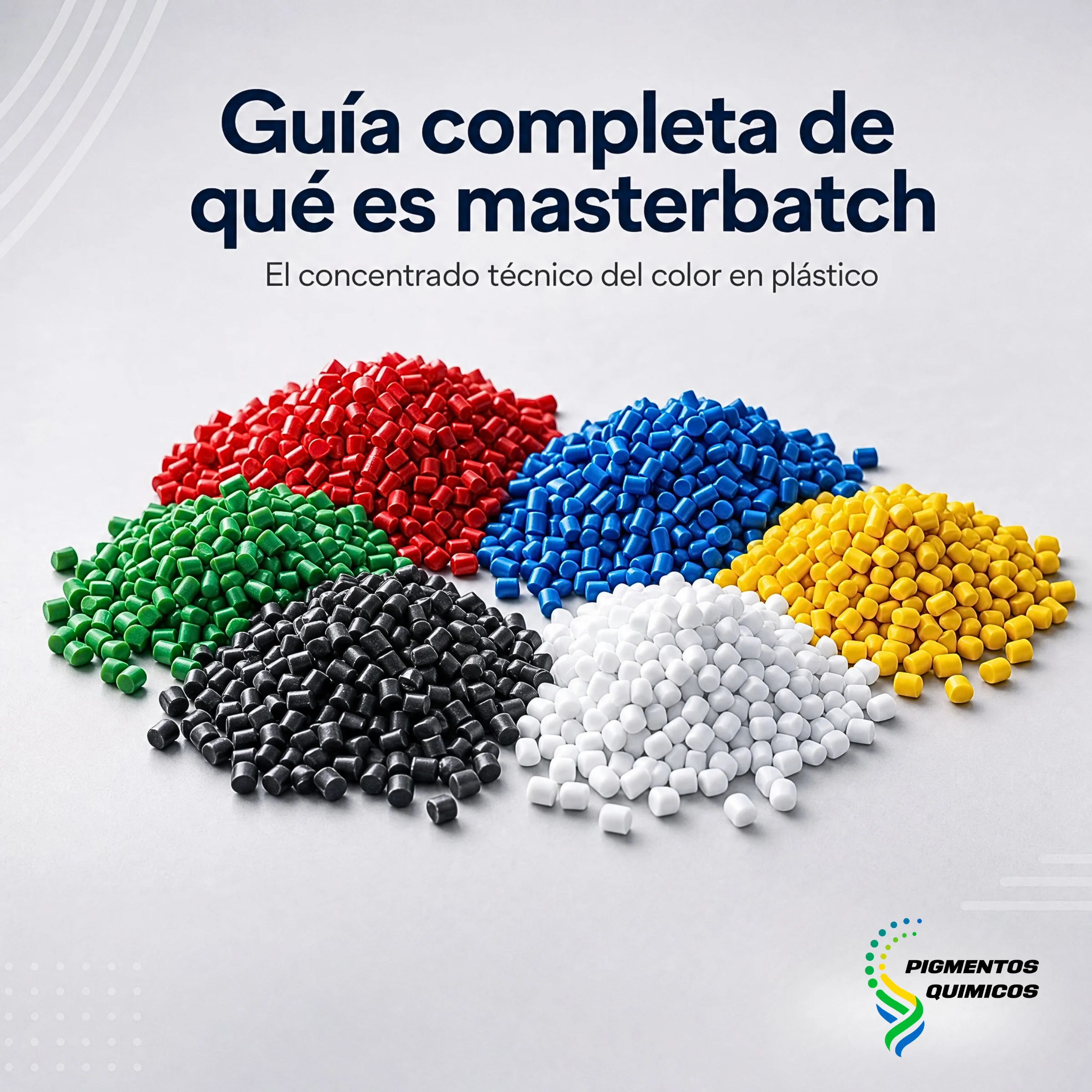
Masterbatch is a concentrate of pigment or additive dispersed in a carrier resin, produced in pellet form. Its performance depends on the resin, the transformation process, and the final application of the product.
Masterbatch is a polymer concentrate that contains pigments, additives, or fillers in high proportion, uniformly dispersed in a compatible carrier resin. It is produced in pellet or granule form — the same format as the base resin — which allows it to be mixed and dosed precisely during the plastic transformation process.
Unlike liquid colorants or powder pigments, masterbatch arrives at the process already formulated: the pigment is dispersed in the carrier resin and the material is ready to integrate during injection molding, extrusion, blow molding, or film production without negatively affecting the behavior of the client's resin.
What masterbatch is made of
A masterbatch is composed of three main elements:
The carrier resin is the most technically critical element because it determines compatibility with the client's resin. A masterbatch with a polyethylene carrier is not directly interchangeable with one using a polypropylene carrier, even if both produce the same color. This is why masterbatch cannot be treated as a generic product.
Color masterbatch
Concentrates pigments in a carrier resin to incorporate color into the polymer during transformation. It can work with organic pigments (brighter, better dispersion), inorganic pigments (more thermally stable, better exterior resistance), or effect pigments (pearlescent, metallic, fluorescent). Available as standard line (catalog colors, 25 kg minimum order, 24–48 business hour delivery in the ZMVM area) or custom development (matched to Pantone, RAL, or physical sample, 100 kg minimum order, 1 kg sample at no charge, 7–10 business days after sample approval).
Additive masterbatch
Concentrates functional additives that modify specific properties of the plastic — not visible color, but properties that impact end-product performance. Examples include UV stabilizers (solar radiation protection for outdoor applications), antioxidants (preventing thermal degradation during high-temperature processing), flame retardants, and antistatic or slip agents. An additive cannot compensate for a poorly selected base resin — correct selection still requires knowing the resin, process, temperature, and final application.
White and filler masterbatch
White masterbatch uses titanium dioxide to provide opacity, whiteness, and coverage to the plastic — one of the most widely used in the industry for packaging, domestic components, and containers. Filler masterbatch incorporates fillers such as calcium carbonate to modify physical properties or reduce formulation costs in applications where maximum mechanical resistance is not required.
How masterbatch works in the transformation process
When masterbatch enters the process, it blends with the client's resin in the hopper or hot barrel. Heat and the mechanical action of the screw facilitate dispersion of the concentrate into the base polymer. For proper integration, three conditions must be met:
Masterbatch vs powder pigment
Compatible resins
Pigmentos Químicos masterbatch is compatible with PE (polyethylene), PP (polypropylene), PS (polystyrene), PC (polycarbonate), PET, and ABS. For other resins, specific compatibility evaluation is recommended before defining a formulation. The resin also affects how color is perceived in the finished part — a clear or translucent resin may make the same masterbatch look different than in an opaque resin. A Pantone or RAL reference is a starting point; color must be validated in the actual client resin and process before approving for production.
Documentation included with each masterbatch
For food-contact applications, Pigmentos Químicos offers formulations complying with FDA regulations. Food-contact grade is not assumed — it must be confirmed for each specific formulation and product.
Frequently asked questions
Does any masterbatch work with any resin?
No. Compatibility depends on the masterbatch's carrier resin and the client's base resin. Pigmentos Químicos works with PE, PP, PS, PC, PET, and ABS. For other resins, specific compatibility evaluation is recommended before defining a formulation.
What types of masterbatch exist?
The main types are: color masterbatch (standard line or custom development), additive masterbatch (UV, antioxidant, flame retardant, antistatic, and others), and white or filler masterbatch (titanium dioxide, calcium carbonate).
What percentage of masterbatch is used?
Recommended dosing is typically between 1% and 4%, depending on color intensity, resin type, and transformation process. That range is not fixed — it must be validated for each specific development. Pigmentos Químicos provides a technical dosing recommendation with each product or development.
Are line masterbatch and custom development the same?
No. Line masterbatch is available in catalog, with a 25 kg minimum order and delivery in 24–48 business hours in the ZMVM area. Custom development masterbatch is formulated to the client's specific resin, process, and application, matched to a Pantone, RAL, or physical sample reference, with a 100 kg minimum order, a 1 kg sample at no charge for validation, and an estimated 7–10 business days after sample approval.