
Why Does Your Plastic Part Keep Attracting Dust?
Most plastics generate static electricity by nature. We explain why your part keeps collecting dust and when an antistatic additive makes sense.
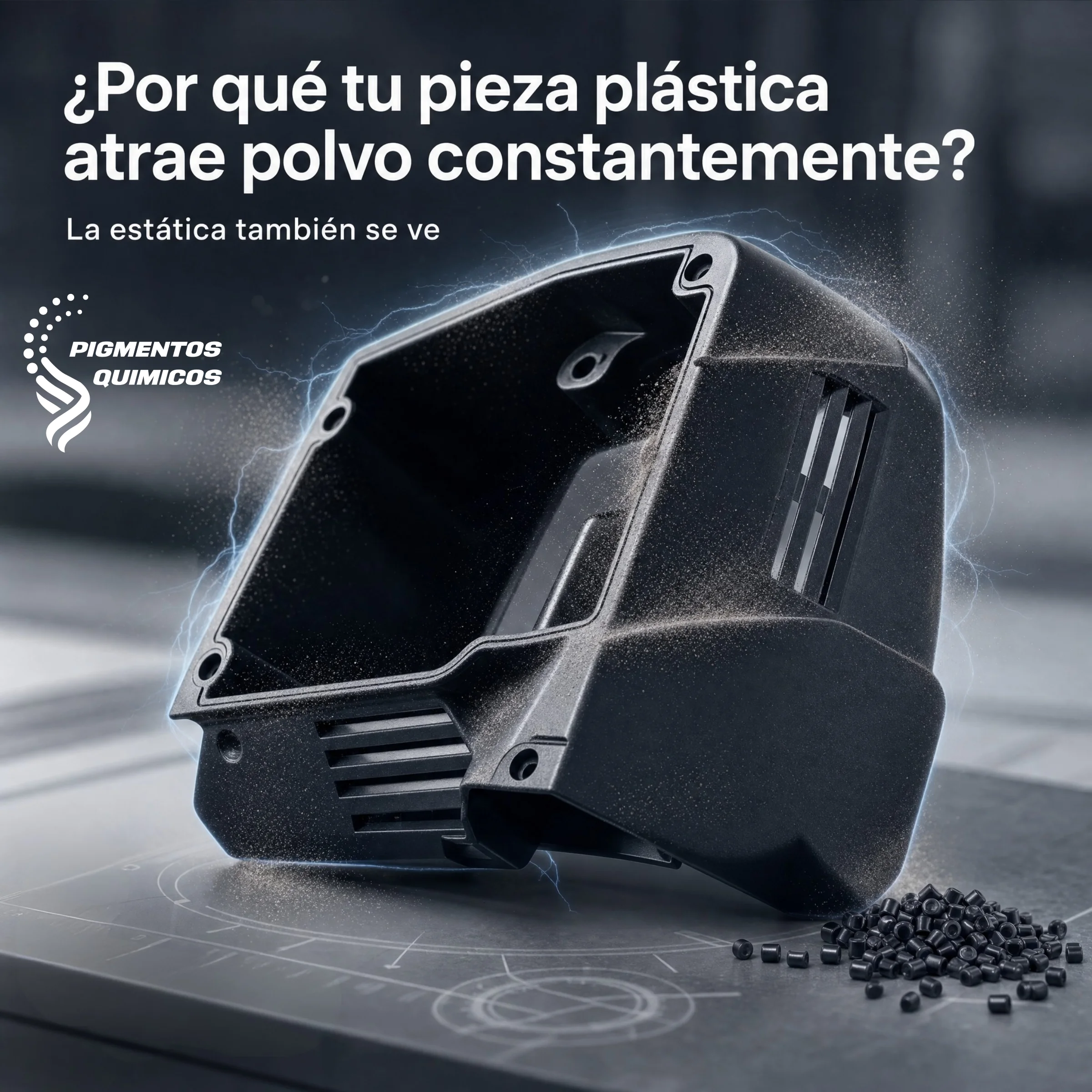
A plastic housing can come off the injection line spotless and arrive at the warehouse or assembly point covered in dust without anyone touching it. That dust isn't random: it's static electricity built up on the plastic's surface, pulling in particles from the air like a magnet. In electronic components, that same charge can generate a discharge strong enough to damage a sensitive circuit before the part even finishes assembly.
Most plastics generate static electricity by nature, even without visible friction. An antistatic additive reduces that charge, cuts down dust buildup, and can protect sensitive components during the process.
The static electricity nobody notices until the dust builds up
Plastic is, by nature, an electrical insulator. That property, useful in many applications, also means it doesn't easily dissipate the static charge generated during transformation, plant handling, or even simple contact with other surfaces.
When that charge builds up, the part starts behaving like a magnet for particles suspended in the air. The visible result is constant surface dust, even in environments that look clean. The less visible but costlier result can be an electrostatic discharge capable of damaging sensitive electronic components.
Blaming that dust on poor plant or warehouse cleaning is a common mistake. The source is usually the plastic's insulating nature, not the environment where the part is stored.
How an antistatic additive works in plastic
An antistatic additive lowers the plastic's surface resistivity so electrical charge dissipates instead of building up. Some additives migrate to the material's surface and form a layer that facilitates dissipation; others are built into the formulation as conductive agents that create an internal network capable of carrying the charge away from the part.
The most suitable mechanism depends on the resin, the transformation process, and whether the protection needs to be permanent or temporary. That's why choosing an antistatic additive isn't an isolated decision; it must be evaluated together with the resin and the part's end application.
Which applications are most affected by dust buildup
Some applications carry the greatest risk when the part lacks antistatic protection:
Not every application needs the same level of antistatic protection. An indoor part with infrequent handling and no exposure to sensitive electronic components may not need this additive at all.
Why an antistatic doesn't perform the same in every resin or process
An antistatic additive can't compensate for an unsuitable resin. Its function depends on how it interacts with the polymer base, which makes up most of the final part, while the additive occupies only a fraction of the formulation.
Before recommending an antistatic formulation, it's necessary to know the exact base resin, the transformation process, the working temperature, and the product's end application. Without that data, the technical recommendation is incomplete.
Ambient humidity also affects the performance of some antistatic additives, especially those that depend on absorbing moisture from the air to conduct charge. Because of that, the same additive can behave differently depending on the season or the region where the part is used.
When it makes sense to evaluate an antistatic development
If your part handles sensitive electronic components, is displayed on shelf, or is processed in environments where dust affects perceived quality, it's worth evaluating an antistatic development formulated around your resin and process.
At Pigmentos Químicos, a custom development starts with a 1-kilogram sample at no cost for validation, a 100-kilogram minimum order, and an estimated turnaround of 7 to 10 business days after sample approval. Validating before producing volume confirms the additive works under your plant's actual conditions.
Common mistakes when evaluating an antistatic additive
The most frequent mistake is requesting an antistatic solution without specifying whether the protection needs to be permanent or temporary. That decision completely changes the type of additive and the recommended formulation.
Another mistake is assuming the same additive performs identically across resins or processes. An antistatic formulated for injection molding can behave differently in extrusion, because residence time and processing temperature change between the two.
Cutting costs by lowering the dosage without technical validation isn't advisable either. If the additive drops below the necessary level, the part can keep accumulating static charge even though the masterbatch has already been incorporated into the process.
Frequently asked questions
Does any color masterbatch reduce static electricity?
No. Antistatic protection is a function independent of color and must be evaluated and formulated separately according to the application.
Is the antistatic additive permanent, or does it wear off over time?
It depends on the type of additive and the mechanism it uses. Some offer longer-lasting protection than others, so it's worth defining that need before development.
What information should I share to evaluate an antistatic development?
The part's end application, whether it will be in contact with sensitive electronic components, the exact base resin, and whether the protection needs to be permanent or temporary.